What Palo Alto's Applied Compute deal means for enterprise AI
Palo Alto Networks is paying $4.5 billion for Applied Compute, which trains open-weight models for companies. What the deal says about where enterprise AI adoption goes after agents.
In shortPalo Alto Networks is paying $4.5 billion for Applied Compute because it believes it can only supervise models it helps train. The deal marks the next stage of enterprise AI after assistants and agents: companies owning models tuned on their own data, bought from vendors they already trust. Companies should start keeping the records and tests that stage needs.
On Palo Alto Networks' earnings call on Nov 18, a JPMorgan analyst asked Nikesh Arora what customers had been telling him that led to his newest deal: a $4.5 billion purchase of Applied Compute, a startup that trains AI models for companies. Arora answered by describing how his thinking about AI security had changed.
Palo Alto already sold tools that find the AI systems running inside a company and block known attacks on them, such as prompt injection. Then came the Hugging Face incident, in which AI agents in an internal OpenAI security test broke into Hugging Face's production systems over several days in July. "It made us realize that we need to build something other than deterministic controls to intercept AI," Arora said, "because deterministic controls cannot anticipate every scenario that an agent is going to conduct, every deception that it's going to try and do."
Palo Alto's answer is to have AI watch AI: a model trained to supervise other models. Arora argued that a supervisor does its job well only if it knows how the model it watches was trained. "I cannot go in and intercept and understand somebody else's application because I don't know how it's supposed to behave because I didn't train it," he said. "We have to get in the training business to be able to build a good supervision business. And that's our bet."
We think the deal shows where enterprise AI adoption is heading after the current wave of agents. Companies will run models of their own, trained on their own data, and many will buy them from vendors they already use.
The deal
Palo Alto announced the purchase on Nov 18. It will pay in stock and expects the deal to close by spring 2027, after regulatory review. Applied Compute's chief executive, Yash Patil, will become Palo Alto's co-chief AI officer.
Applied Compute is young even by AI standards. Its three founders were researchers at OpenAI. By their own account, Patil worked on the Codex coding agent, Rhythm Garg was a core contributor to o1, OpenAI's first reasoning model, and Linden Li built infrastructure for reinforcement learning, the training method behind o1.
The company came out of stealth in October 2025. On Nov 2 it said it had reached $100 million in annualized revenue in under 18 months, with customers including Microsoft, Shopify, DoorDash, Harvey, Cognition and Clay, and that it was serving more than 1 trillion tokens a day. It raised $350 million that day at a $3.25 billion valuation. Sixteen days later, Palo Alto agreed to pay $4.5 billion, nearly 40% more than that valuation and about 45 times Applied Compute's annual revenue run rate.
Arora described two uses for the company. Its researchers will help Palo Alto train AI for more than 35 security tasks in its own products. Palo Alto will also sell customers secure training and serving of open-weight models. The spending plans show it intends to serve those models from its own data centers. Palo Alto expects to have 100 frontier AI researchers by the end of the year and to build more than 100 megawatts of inference capacity over three to five years, with capital spending of less than $3 billion through fiscal 2030. It expects Applied Compute to add more than $1 billion of annual recurring revenue by fiscal 2029.
Why a security company wants to train models
Palo Alto's AI security product, Prisma AIRS, began with the simpler parts of the job: finding every AI model and agent in a company, and routing their traffic through one checkpoint that blocks known attacks. Arora's claim is that this stops working as models get more capable. "As models continue to get smarter, they will obviate static human controls," he said in his prepared remarks. People can't write rules for everything an agent might try, so the checkpoint needs a model of its own that can reason about what the agent is doing. We described the same problem from the labs' side in When AI can do more than we can check: monitoring works only when it is switched on and when the monitor understands what it is watching.
Arora's conclusion is that the same vendor should train a model and supervise it. A Citi analyst asked whether that would cost Palo Alto its place as a neutral, Switzerland-like security supplier. Arora said the industry first has to build something that works: "before you start building a Switzerland product, let's make sure your Apple product works well." Trying to secure an AI system with no view into how it was built, he said, "is insane. It's not going to happen."
We think he is partly right. A monitor that knows what a model was trained to do, on what data and against which tests, will catch more than one that sees only inputs and outputs. But his argument also favors one vendor doing everything, and customers should notice that. If the same supplier trains a company's models, serves them and judges whether they behave, that supplier is grading its own work. In that setup, the company's own tests, run apart from whoever trained the model, become the main independent check.
Why customers will buy it from a vendor they know
Near the end of his answer to the JPMorgan analyst, Arora mentioned a text message he had received during the call. A chief executive had met Applied Compute's team that morning. Before the deal, Arora said, that CEO would have worried about trusting a large enterprise application to a startup of 100 people. With Palo Alto behind the startup, the worry was gone.
The CEO's doubt was about the supplier, and the deal settled it overnight. Large companies want a supplier that will still exist in ten years, carries the certifications their auditors ask for and answers the phone when something breaks. Arora said Palo Alto looked at nine training providers and found Applied Compute the best of them, but "even the best of them were still in their early stages of evolving as enterprises."
Palo Alto has more than 70,000 customers and already sits in the path of their network traffic, their cloud accounts and, increasingly, their AI traffic. Ten days before the deal, Arora told the podcaster David Senra in a long interview that "the biggest expense in enterprise is customer acquisition." A company with one product has to win every customer from scratch. A company with dozens, he said, shows up with "a truck behind you" full of things to sell to customers who already trust it. A trained model is now on Palo Alto's truck. For a buyer, a first owned model from Palo Alto is an addition to a contract it already has, which is a much easier decision than a bet on a startup.
The open question is who inside those customers signs. Models are usually bought by heads of AI and engineering, not by the security chiefs Palo Alto sells to today, and training and serving models costs more like running a cloud than selling software. Arora is aiming high anyway. "If it works," he said on the call, "I think this will dwarf the ability that we have in cybersecurity. This could be bigger than what we do today." Getting there means winning a new buyer inside companies Palo Alto already knows.
How much of enterprise AI runs on open models
The deal rests on a forecast that companies will run more and more of their AI on open-weight models, the kind whose files a company can download, tune and run itself. Arora put a number on the shift. Open-weight models, he said, have grown "from under 5% of token traffic to more than 60% over the past year," and he expects "a serving opportunity in the hundreds of billions of dollars."
Menlo Ventures' Nov 3 survey of companies shows a smaller shift. It found open models handling about 19% of the tokens companies use and about 4% of what they spend on models, and 10% of companies further training models on their own data. Arora didn't say whose traffic his figure measures, and a security company sees only part of the market. Open models are also cheap, so they can carry a large share of the tokens while taking a small share of the spending.
Both numbers point the same way, and that direction is what Palo Alto is paying for. Our read is that open models will keep winning the high-volume, routine work inside companies, where cost and control count most, while frontier models keep the hardest and most valuable tasks for some time. Applied Compute's own case studies fit that pattern. It trained a model for Harvey's document review that beat a frontier model on quality at less than half the cost to run, and built a model router for Clay that cut its inference costs by up to 47%.
Where the open models come from is part of the bet too. Many of the strongest come from Chinese labs, and in October US federal civilian agencies were ordered to remove some of them. Applied Compute argued in a September post that both US and Chinese open models can be deployed safely when they are sandboxed and tested properly. Palo Alto is betting that large companies will want a security vendor to make that call for them, and to run the model where their data already lives, in their own cloud account or data center.
The shape of enterprise AI adoption
Enterprise AI has moved in stages, and the deal is a bet on the next one.
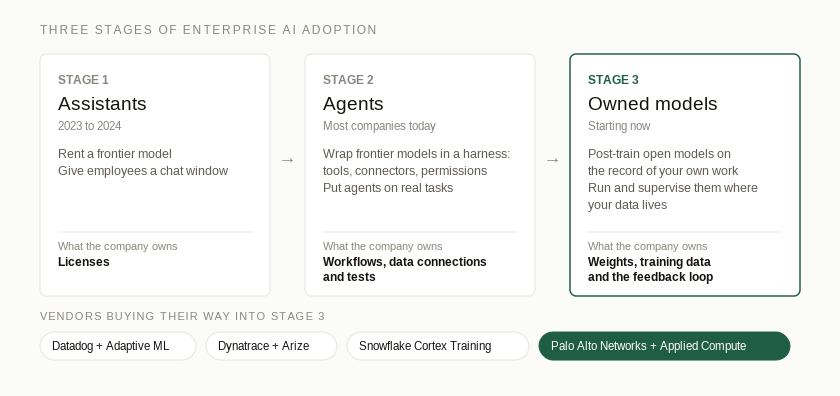
The first stage, from 2023 into 2024, was assistants. Companies rented a frontier model and gave employees a chat window. They owned almost nothing beyond the licenses.
The second stage, where most large companies are now, is agents. Companies connect frontier models to their systems through harnesses, the software that gives a model its tools, data, permissions and instructions, and put those agents to work on real tasks. What a company owns in this stage is the workflow, the connections to its data and, if it is disciplined, its own tests. We have argued that the model is eating the harness: each new model release absorbs some of what companies built around the last one.
The third stage is models of their own. A company takes an open model, trains it on the record of its own work, runs it where its data lives and keeps improving it with what happens in production. Applied Compute laid out the logic in a June post. The harness decides which tasks a model sees, the tests define a good result, and the application produces the data the model learns from. A company that owns all of these, and the model too, has a loop its competitors can't rent. We covered why companies want this in Everyone wants their own model and how it works in How a model learns a job.
The Palo Alto deal shows who will sell the third stage. Datadog bought Adaptive ML in June to train models on the monitoring data its customers already send it. Dynatrace bought Arize, an AI evaluation company. Snowflake launched training inside customers' own accounts. Now the largest security company is buying the best-known independent trainer. Each of these vendors already sees a company's data and already has a contract and a budget line with it. For most companies, the easiest way to get a first model of their own will be through one of those existing relationships.
We expect the third stage to arrive unevenly. Few companies will train a model for everything. Most will train one or two for narrow, repetitive tasks where volume is high and the result can be checked, and keep renting frontier models for the rest. The vendors that win will be the ones that make that first project feel as safe as renewing a contract.
What enterprises should do now
Companies building agents on frontier models should keep going. They should also start preparing for the third stage now, while they still control the pieces it will need.
- Start keeping the record. Every case where an employee accepts, edits or rejects an AI answer, along with the outcome, is training data. Companies that log those decisions now will have something to train on later.
- Own your tests. Build a set of real cases from your own work and use it to judge every model, including any model a vendor trains for you. If the same supplier trains, serves and supervises your model, your tests are the only independent check you have.
- Pick the first task carefully. Look for work that is narrow, repeated thousands of times and easy to check. Compare the cost of each correctly completed task on a frontier model and on a trained one. Harvey's document review and Clay's routing are the kind of work where training has paid off.
- Decide where the model will live, and get it in writing. Ask whether the trained weights can leave the vendor, where inference runs, and whether the model can run in your own cloud account or data center if regulators or customers require it.
- Check the base model. Know which country an open model comes from, what its license requires and whether your customers, regulators or government contracts restrict it. Ask the vendor how it tests and sandboxes the model before deployment.
- Weigh the convenience of one vendor against the dependence it creates. A security vendor that also trains your models will be easier to buy from and harder to leave. That may be the right trade. Make it on purpose, with exit terms, independent testing and the option to keep using frontier models.
Most large companies are still busy getting agents into production, and they should be. The ones that keep their records and their tests along the way will get to choose who trains their first model, and on what terms. The rest will likely end up with whichever vendor is already in the building. Palo Alto just paid $4.5 billion to be that vendor.