Everyone wants their own model
Why AI application companies and large enterprises are training models of their own in 2026, what it has gotten them, and how to decide what your company should own.
In shortApplication companies train their own models to stop depending on labs that now compete with them, and enterprises do it to keep their edge. Both want access no one can take away. The companies getting results own a few narrow, high-volume tasks and still rent frontier models for the hardest work.
On Nov 2, two startups raised money on the same day for the same reason. Applied Compute, founded by three former OpenAI researchers, raised $350 million at a $3.25 billion valuation after reaching $100 million in annualized revenue in under 18 months. Trajectory, an 18-person company started by three Stanford classmates, raised $45 million led by Sequoia. Both companies help other companies train AI models of their own. Their customer lists overlap: Harvey, Decagon, Clay and Shopify, plus NVIDIA.
Two years ago, training your own model was something a few research-heavy companies did. In 2026 it became a market, with its own investors, vendors and slogans. Fireworks, Applied Compute, Snowflake and Harvey all now talk about companies needing to "own their intelligence."
The first post in this series covered the neolabs. This one is about their customers: who wants a model of their own, why, and what they have gotten from it.
Two kinds of buyer
One group is AI application companies, the startups that sell AI for one profession or job, such as Harvey in law, Cursor in coding and Decagon in customer service. They built their products on models from OpenAI and Anthropic. Now they want to depend less on those labs and put their money into what they know about their customers' work.
The other is large enterprises: banks, insurers, manufacturers, retailers. They want to keep what makes them good at their business. When every competitor rents the same model, the model can't be where any of them gets an edge, while a model trained on a company's own decisions can capture judgment its competitors don't have. Palantir now sells this idea to enterprises directly, and its executives described it on the company's Nov 2 earnings call as protecting each customer's alpha and sovereignty.
We think both groups want the same thing: control over the part of AI that sets them apart. This year added a reason that applies to both. A model someone else runs can be changed, suspended or retired on that company's schedule.
Application companies
Application companies had three reasons to train: cost, suppliers turning into competitors, and the risk of being cut off.
AI agents use far more tokens, the units of text models read and write and the basis of what they charge, than a chat does. A startup paying frontier prices on every request can watch its margins disappear as usage grows.
Meanwhile the labs moved into their customers' markets. In May, Anthropic launched Claude for Legal, which overlaps with Harvey and other legal AI companies built on Claude. In September, OpenAI launched ChatGPT for Financial Services with Morgan Stanley and Evercore as design partners, which overlaps with the finance AI startups built on its models. A company whose supplier sells into its market has reason to want a second source. After Claude for Legal launched, Spellbook, which had been running more than 500,000 contract reviews a month on Claude, moved much of its spending to OpenAI.
Some were cut off outright. Anthropic cut off Windsurf in 2025 with a few days' notice. In August, after SpaceX bought Cursor's parent company for $60 billion, OpenAI gave notice that it planned to stop supplying Cursor on Nov 12, saying it could not be confident SpaceX would use its technology within its terms. Cursor had already hedged: its Composer coding models are post-trained on an open model, Moonshot's Kimi.
Decagon, which builds customer service agents, says more than 80% of the model traffic on its platform now runs on models it trained. Intercom's Fin Apex model resolved 73.1% of customer conversations in its tests, against 71.1% for the best frontier model, at about a fifth of the cost. Cognition's SWE-2 coding model came within a point of Anthropic's Fable 5.1 on one coding benchmark at about two-thirds lower cost per run, though it trailed well behind on another.
Owning a model also made these companies more valuable. Salesforce agreed in June to buy Fin for about $3.6 billion and pointed to its own models as part of the reason. Cursor's model work was part of what SpaceX paid for, though in Cursor's case the acquisition is also what triggered the OpenAI cutoff.
All of them still rent frontier models. Harvey sends its hardest work to Claude, Decagon still uses OpenAI, and Cursor offers Claude and Gemini to its users. They own the high-volume path, where their product does the same kind of work millions of times.
Harvey started in 2022 as an application built on OpenAI's models. By 2026 it had a small data research team, its own legal benchmarks and several outside training partners, each working on a different job. Tenet, built with Fireworks on Kimi, handles long legal work and passed about 20% of the tasks on Harvey's own legal benchmark, against about 11% for the open model it started from. A model for its Review Tables product, built with Applied Compute on Zhipu's GLM, costs about a tenth as much per table cell as the model it replaced. A model for searching a firm's own documents, built with Engram on a 27-billion-parameter Qwen model, cut the cost per query by about 90%, according to Harvey. Its in-house models handle the jobs it runs most often.
Not every application company thinks owning the model is the point. Sierra, which builds customer service agents for companies such as SoFi and Coinbase, describes its approach as "rent the intelligence, own the relationship." Its argument, laid out in an August post on its context engine, is that every company can rent the same intelligence, but the context about a business and its customers is unique to it. Sierra still runs fine-tuned models for most of the many model calls inside each conversation. It just doesn't think owning the model is where its value lies.
We think both positions hold, for different parts of the system. The context and the record of decisions are what make a company different, and models trained on them are the most efficient way to use that difference at high volume.
Enterprises
The strongest enterprise results in 2026 came from fintechs, funds and insurers, and each one is narrow.
In October, Coinbase described training a small open model, Alibaba's Qwen3.5 with 9 billion parameters (the adjustable numbers inside a model, a rough measure of its size), on the outcomes of its own fraud cases. Training cost under $100 on a single GPU. The model beat Anthropic's Opus 4.5 on all four measures Coinbase tracks, including 35 points better at catching fraud weighted by dollars, and answered in about half the time. Coinbase also found that newer frontier models scored worse on this task than the ones before them.
Bridgewater Associates trained a model on six of its financial filtering tasks using Thinking Machines' Tinker service. It scored 84.7% against 78.2% for the best frontier model with expert prompts. Bridgewater's bar for production is 80%, which no frontier model cleared, and the trained model cost about a fourteenth as much per task.
Airbnb fine-tuned a 2-billion-parameter Gemma model to flag listings that break its pricing rules. It matched the best frontier models at about 1% of the cost when running at high volume. Revolut runs an open model on 56 of its own NVIDIA chips as the default coding assistant for about 2,000 engineers and reports roughly 90% lower costs, though it did not disclose its baseline. Travelers built TravelersLLM for high-volume underwriting and claims questions, partly so it would "not depend on any single" vendor, and still sends hard reasoning to frontier models.
Revolut went further and trained a model from scratch. Its researchers built PRAGMA, a model trained on about 24 billion banking events from 26 million users, to represent customer behavior for tasks like credit scoring. They report large gains on credit-scoring tasks when small task-specific layers are added on top.
The largest banks have mostly taken a different route. JPMorgan and Goldman Sachs built systems that route each request to whichever vendor's model fits it best, which gives them a second source without training anything.
Access that can change
On June 12, a Commerce Department export directive required Anthropic to block foreign nationals from Claude Fable 5, its newest model. Anthropic could not check nationality in real time, so it suspended the model for every customer worldwide. It came back on July 1, after 19 days.
OpenAI is ending its self-serve fine-tuning service. Since May it has been closed to new customers, and existing customers can't start new training jobs after Jan 6, 2027. A company's fine-tuned model also lives only as long as the model underneath it. OpenAI's deprecations page says fine-tuned versions of GPT-4o and GPT-4.1 shut down with those models on Jan 14, 2027.
Access can also change without anyone switching it off. Coinbase found that newer frontier models got worse at its fraud task, and a company finds that out only if it is measuring.
A model whose weights you hold, meaning you have the trained model file itself, can't be switched off, retired or changed by someone else. That alone doesn't justify owning every task, but it is a good reason to own the ones a company can't afford to lose.
Who helps them do it
Very few of these companies trained a model from scratch. Almost all of them took an open model and trained it further on their own tasks, which the industry calls post-training, and most hired outside help to do it.
The vendors differ most on where the trained model lives and who can take it with them.
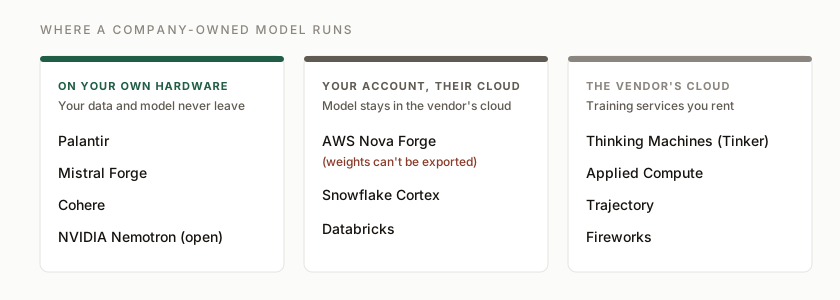
On a company's own hardware, the model and the data never leave. Mistral launched Forge in March to train models, including from scratch, on a customer's own infrastructure, with ASML, Ericsson and the European Space Agency among its first customers. Cohere earns most of its revenue from private deployments inside customers' clouds or data centers. Palantir runs training inside the customer's environment, including disconnected military and industrial sites.
Inside a vendor's cloud but the customer's own account, the data stays under the customer's control, and whether the model can leave depends on the vendor. Snowflake's new Cortex Training and Databricks train open models where the customer's data already sits. AWS's Nova Forge goes deepest, letting a company mix its data into Amazon's own Nova models partway through their original training, but the resulting model can't be exported from AWS.
The training services, such as Thinking Machines' Tinker, Applied Compute, Trajectory and Fireworks, run in their own clouds and are usually the fastest way to a first model. Most say the trained weights belong to the customer.
Palantir's software records the decisions a company makes, with the reasons and outcomes, and trains open models on that record, which we cover in the next post. Palantir's own executives call the trained model "a commodity item." Our read is that the lasting asset is the record of decisions that feeds it.
The open models underneath are mostly Chinese. Menlo Ventures' Nov 3 report found that Chinese models account for 89% of company spending on open-source models, and Moonshot's Kimi alone for 61%. That carries risk: since Oct 20, US federal civilian agencies must remove DeepSeek, including third-party products built on it, and Kimi K3's license requires a separate agreement for large commercial operators. Stronger American open models arrived this year: NVIDIA's Nemotron, Thinking Machines' Inkling and Reflection's Beam.
Governments are making the same calculation at national scale as companies, for the same reasons: cost, control over something strategic, and the risk of losing access to a model run from another country.
The European Union opened a call in July for up to seven AI "gigafactories," large computing centers for training models, backed by about €10 billion in public money. India's AI mission unveiled Sarvam's models in February, trained from scratch in India and later released as open models. South Korea is funding a national model program with LG, SK Telecom and Upstage as finalists. In January, the UAE's MBZUAI and G42 released K2 Think V2, which they describe as fully sovereign. Saudi Arabia's HUMAIN signed partnerships with both Cohere and Mistral within six weeks of each other.
These programs produce open models and computing capacity that local companies can use, and they set the rules on which models regulated industries may run.
How far this has gone
For all the activity, most companies still don't train. Menlo found that 10% of companies building with AI post-train their own models, up from 6% a year earlier. Open models carry about 19% of the tokens companies use but only about 4% of the money they spend, and frontier models' share of company spending on models rose from 35% a year earlier to 63%.
The frontier has also pulled further ahead. On Artificial Analysis' October rankings, the top closed model scored 58 and the best open model with released weights scored 32, a gap that widened during the year.
Some companies have tried and stopped. Salespeak dropped its own model after months of work, saying it offered no significant advantage, and Airbnb's own numbers show its small model only pays off at high volume.
Frontier models keep getting better at hard, open-ended work while companies move narrow, repetitive work onto models they own, and every company in this post does both.
Deciding what to own
We would decide task by task. We covered the cost math in Should I train my own model? and the general rule in What to build, and what to buy. This is the 2026 update.
- Start recording decisions now. Every case where a person accepts, edits or overrides an AI answer, along with the outcome, is training data you will want later. Coinbase trained on fraud outcomes and Palantir on logged decisions. A company that doesn't keep this record can't train on it.
- Build your own evaluation set. You need your own test cases to know whether a new frontier release got worse at your task, as Coinbase's did, and whether a trained model beats it. Bridgewater could say no frontier model was good enough because it had set an 80% bar on its own tasks.
- Pick tasks that are narrow, high-volume and checkable. Fraud flags, filtering, classification, routine coding and support answers come up again and again in the results. A task that runs a few times an hour or changes every week belongs on a rented model.
- Check the base model's license and origin. Know which country the open model comes from, what its license requires above a revenue threshold, and whether your customers or regulators restrict it.
- Decide where the weights live, and get export rights in writing. Some services let you take the trained model with you, and some, like AWS Nova Forge, keep it inside their cloud.
- Keep a frontier route. Every company in this post still rents the frontier for its hardest work. Route requests between your model and frontier models, and check the split every time a new model ships.
Applied Compute's and Trajectory's funding rounds are a bet that more companies will follow Coinbase and Bridgewater. We think they will, starting with the one or two tasks where volume is high and the cost of losing access is highest.
The next post covers how a model learns a job: the data, training, evaluation and serving behind each of these results.