The AI campaign playbook
In 2026 campaigns used AI to draft. In 2028 the first campaigns will run on it. A department-by-department guide to the operation behind a modern campaign.
In shortMost political professionals now use AI every week, but almost all of it is drafting: emails, texts, scripts and ad variants. The bigger opportunity is operational. A presidential campaign grows from a few dozen people to thousands in under two years, runs under federal law and fifty state regimes, faces one fixed deadline and then shuts down. That makes it one of the hardest operating problems in American organizational life, and the place AI can matter most. This playbook walks through each part of a campaign, from finance and compliance to field, voter contact, content and administration, and what has to be in place before the campaign launches.
Artificial intelligence arrived in American campaigns faster than almost anywhere else. In the American Association of Political Consultants' March 2026 member survey, 83 percent of political professionals said they use AI tools at least weekly, up from 59 percent a year earlier, and nearly half said they use them several times a day. The 2024 federal election cost an estimated 15.9 billion dollars, and very little of the work behind that spending is untouched now.
But look at what the tools are doing and the picture is narrower than the adoption numbers suggest. Most of it is drafting: first versions of fundraising emails, text scripts, talking points, ad variants and research memos. Useful, and real time saved, but it leaves the hardest part of a campaign almost exactly where it was.
That hardest part is the operation. This playbook is about the operation, and about why 2028 is likely to be the first presidential cycle in which campaigns run on AI rather than simply write with it.
Why a campaign is a hard organization to run
Strip away the politics and a presidential campaign is an extraordinary organizational problem.
It is a startup that has to scale faster than almost any company ever does. A handful of advisers becomes a national organization of thousands of paid staff in months, alongside tens of thousands of volunteers who arrive with no training and leave without notice. It operates under federal campaign finance law and fifty sets of state rules on ballot access, voter contact, disclosure and now artificial intelligence. It has one deadline that cannot move. And on the day after the election, it largely dissolves, scattering its people and most of what they learned.
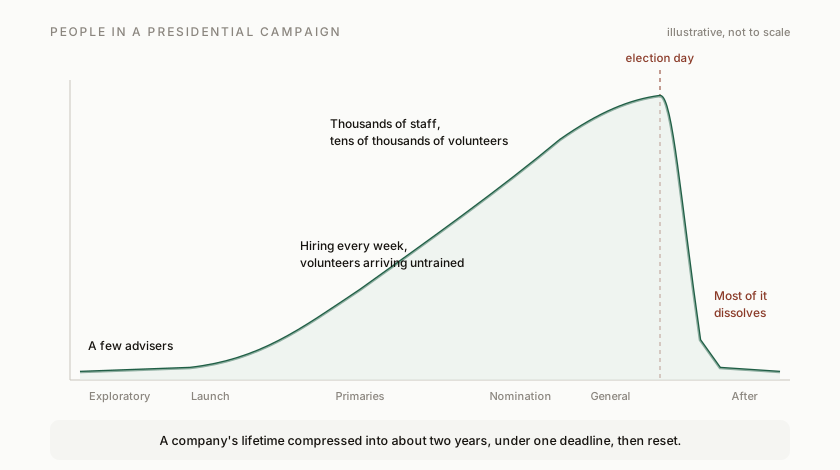
Three consequences follow, and they are why AI matters more here than in most organizations.
Capacity is always short. Every department is understaffed relative to the volume it faces, and the volume rises every week until election day.
Institutional knowledge is always thin. People are new. Policies, approved language and procedures change constantly. The person who knows the answer is usually busy or gone.
Errors are public and fast. A wrong number in a filing, a wrong answer to a voter, or an unapproved statement can become the story within hours.
An AI system that only drafts helps with none of these at the level that matters. A system that carries work across the operation, grounded in the campaign's own approved material and controlled by its own people, helps with all three.
Finance and compliance
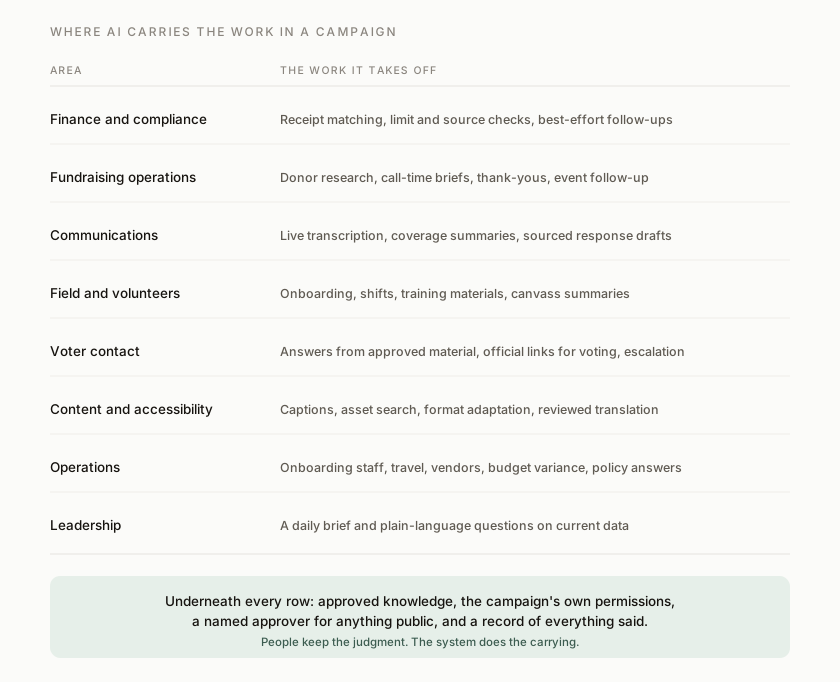
Federal law caps individual contributions at 3,500 dollars per election for the 2025 to 2026 cycle, requires campaigns to report contributors whose giving exceeds 200 dollars with their name, address, occupation and employer, and expects a documented best effort to collect missing information. Multiply that by hundreds of thousands of donors, several payment processors and constant refunds, and compliance becomes one of the largest data operations in the campaign.
AI helps by doing the reconciliation and the chasing: matching receipts across processors, flagging contributions that would exceed a limit or come from a prohibited source, drafting best-effort follow-ups for missing employer information, matching disbursements to vendor invoices and receipts, and assembling report sections for the treasurer to review. The treasurer and counsel keep every judgment. The system removes the weeks of spreadsheet work that sit between the data and the filing.
Fundraising operations
Fundraising is relationships, and the work around the relationships is enormous: donor research before call time, briefing notes for events, thank-you notes that read as personal, follow-ups after every meeting, and keeping the donor record current. This is where the drafting tools already help, and where the next step is connecting them. A finance director who walks into call time with a brief on each prospect, assembled from the campaign's own records and public information and checked by staff, makes more and better calls in the same hours.
Communications and rapid response
A national campaign monitors an unending stream of news, transcripts, posts and broadcasts, and has to respond to the ones that matter within minutes. AI changes the economics of monitoring entirely: live transcription of events and interviews, summaries of coverage as it lands, flags on mentions that need attention, and first drafts of responses built from the campaign's approved positions and sourced facts. The approval chain does not change. What changes is that the communications director starts from a sourced draft and a complete picture rather than from a blank page and a hunch.
Field and volunteers
Field operations are where scale hurts most. Volunteers need onboarding, training, shifts, locations, materials and answers, at a volume no field staff can serve one at a time. AI can onboard a volunteer through a conversation rather than a form, answer the logistical questions that otherwise fall to an organizer, schedule and reschedule shifts, translate training materials, and turn thousands of canvass notes into a summary a regional director can actually read. Field organizers get their evenings back for the work only people can do: recruiting, training and building relationships in the community.
Voter contact
Answering voters is the most promising application and the most consequential one, because an error reaches a voter directly, privately and at scale. A system that answers questions about a candidate's record, an event or how to volunteer can serve far more people, in more languages, at more hours than any phone bank. It has to answer only from the campaign's approved material, send voters to official election offices for anything about registration, deadlines or polling places, never improvise a position, and hand off to a person when a question is sensitive. Voice and text outreach also carry their own consent and disclosure rules. These requirements are serious enough that we have treated them separately in the risk isn't the deepfake.
Content, translation and accessibility
Campaigns produce an astonishing volume of material: speeches, video, social posts, mailers, op-eds, policy documents and event materials. AI can transcribe and caption every video, tag and organize the asset library so a staffer can find the right clip in seconds, adapt one approved piece into every format it needs, and produce first-pass translations for human review, which matters in a country where, by the Census Bureau's count, roughly one in five people speaks a language other than English at home. Captions and accessible formats are not a courtesy; they reach voters the campaign would otherwise miss.
Operations and administration
Behind all of this is a company being built in real time: hiring hundreds of people, onboarding them, booking travel, managing vendors, tracking budgets and approving expenses. AI can carry much of the administrative load: drafting job descriptions and onboarding materials, answering staff policy questions from the campaign's handbook, flagging budget variances and unusual expenses, and keeping a single shared record of who owns what. In an organization that doubles in size every few months, an operations team that does not drown is a competitive advantage.
Leadership
Campaign leadership makes high-stakes decisions on incomplete information every day. What helps is a current picture: a daily brief drawn from the campaign's own data, the ability to ask plain-language questions of fundraising, field and spending numbers, and meeting preparation assembled from the real record rather than from whoever last updated a slide.
What has to be in place first
Every area above depends on the same foundation, and the foundation is what most campaigns lack.
An approved knowledge base. Positions, biography, approved language, policy documents and event details, kept current with a clear owner. A system that answers from anything else will eventually say something the campaign never said.
Permissions that match the campaign's own. Donor data, opposition research and internal strategy cannot be visible to everyone. The system should inherit the access each person already has.
Approval before anything goes public. Drafts are fine. Anything that reaches a voter, a reporter or a regulator needs a named approver, and the system should enforce that, not just suggest it.
A complete record. What the system said, to whom, from which source, and who approved it. That record is what lets a campaign answer a reporter, a regulator or a lawyer, and what lets it learn.
Security from day one. Campaigns are targets. Phishing and impersonation aimed at staff are now the most common threats, and AI has made them cheaper to produce. An operation built on scattered personal accounts and shared passwords is not one to connect to anything.
The freedom to choose models. The best model for transcription, for translation and for drafting a response are rarely the same, and the frontier changes faster than a campaign cycle. Locking a campaign to one provider in 2027 is a bet that it will still be the best choice in October 2028.
The window that matters
The most important timing point in this playbook is not election day. It is the period before a campaign formally launches.
Once a campaign is running, nobody has time to build anything. Every hour goes to the next event, the next deadline and the next fire. The operating system a campaign will run on has to exist before the first staff are hired, so that the hundredth and the thousandth arrive into an operation that already works. For 2028, that window is the next twelve months.
The campaigns that use it well will not be remembered for their AI. They will be remembered for answering every voter, filing every report correctly, responding first and scaling without breaking. That is what an AI transformation looks like when the organization only exists for two years.
Key takeaways
- AI adoption among political professionals is near universal, but most of it is drafting. The larger opportunity is the operation behind the campaign.
- A campaign scales faster, turns over faster and faces stricter deadlines than almost any organization, which is why connected, governed AI matters more there than elsewhere.
- Finance and compliance, rapid response, field, voter contact, content and administration all have high-volume, rule-bound work where AI can take over the carrying while people keep the judgment.
- Voter contact is the highest-value and highest-risk application. It must answer only from approved material and send voters to official sources for anything about voting itself.
- The operating system has to be built before launch. For 2028, that means now.
The campaigns that win the operations race will not look like technology campaigns. They will simply never drop the ball.