The AI-native finance team
What a finance department looks like when agents do the routine work: which workflows they handle today, how they connect to the ledger, how the team changes shape, and how to start.

In shortIn an AI-native finance team, agents do the routine work, from invoices and payment matching to reconciliations, while people set the rules, review exceptions and sign off. The ledger stays the source of truth, and every posting carries a recorded approval. The team changes shape more than size, and review becomes the bottleneck to design around.
Over the past two months, a remarkably consistent picture of the finance department has emerged from people who rarely agree on anything.
In August, OpenAI's chief financial officer described building an AI-native finance function, with the goal of a books close that runs continuously rather than once a month. In early October, a16z argued that the CFO's job is shifting again, after accountant, banker and planner, to architect of the company's operating system, and that the leanest finance teams it sees now target about 2 percent of company headcount, against an old rule of thumb of 5. In the same weeks, Oracle, SAP and Workday each shipped agents for finance: agents that reconcile ledgers, propose accruals, prepare entries and test controls, inside the systems most large companies already run.
This is the first in a series on what each department looks like when it is built around AI rather than having AI added to it. We start with finance because it is where the work is most structured, the systems of record are most mature, and the cost of being wrong is easiest to see. The question is practical: what does the team actually do differently, what does it plug into, and what can a small team now handle?
What changes, and what does not
The short version is that the work moves. People used to spend most of their time moving information between systems: keying invoices, matching payments, chasing receipts, tying out reconciliations, pulling numbers into a deck. In an AI-native team, agents do most of that movement, and people spend their time setting the rules, reviewing what the agents could not resolve, and making the judgment calls the numbers depend on.
What does not change is accountability. Someone still signs the financial statements, owns the controls and answers to the auditor and the board. Every serious design in the market keeps that line intact. The interesting question is how much routine work can sit beneath it.
Workflow by workflow
The pattern across the market is clear once the workflows are laid side by side. Agents are furthest along where an answer can be checked against something objective, a purchase order, a bank line, a policy, and least far along where the work depends on judgment.
| Workflow | What agents do now | What people own | Maturity |
|---|---|---|---|
| Accounts payable | Read invoices, match to orders and receipts, code to the ledger, route approvals, flag duplicates and suspicious changes | Policy, exceptions, vendor relationships, payment release | Mature |
| Cash application and collections | Match incoming payments to invoices, draft reminders, prioritize accounts by risk | Disputes, credit decisions, customer conversations | Mature |
| Expenses | Review every expense against policy, code it, request missing receipts, flag anomalies | Policy and the exceptions | Mature |
| Reconciliations | Match balances to statements and sub-ledgers, explain differences, prepare support | Review, sign-off, unresolved items | Mature |
| Variance and flux analysis | Draft explanations of movements from transaction detail | The story the numbers tell, and whether it is right | Maturing |
| Accruals | Propose entries from policy, contracts and open orders, with the calculation attached | Approval and judgment calls | Proposals only |
| Revenue recognition | Read contract terms, propose schedules | Judgment on complex contracts | Proposals only |
| Procurement | Triage requests, check budgets and contracts, route approvals | Negotiation and vendor choice | Emerging |
| Planning and forecasting | Refresh models, draft commentary and board materials | Assumptions, scenarios, the plan itself | Early |
| Tax and treasury | Structured returns and data preparation; cash positioning | Strategy, positions, risk | Early |
A few numbers give a sense of where things stand. Ramp reports its payables agent fills 85 percent of invoice coding fields correctly on the first pass. BlackLine says its reconciliation agents cut manual preparation time by up to 92 percent. Both are vendor figures, and both describe work that a reviewer can check quickly. The month-end close itself we covered in detail in closing the books with agents; the principle there holds across the department: agents prepare, people post.
Planning is where expectations run furthest ahead of results. Agents are good at drafting the commentary: Cisco's CFO has said AI now writes 80 to 90 percent of the first draft of the company's management discussion in its filings. Forecasting itself, choosing assumptions and deciding what the business will do, is still people's work, and surveys of finance leaders consistently find it pays back more slowly than the transactional workflows.
How it plugs into the source of truth
The architecture of an AI-native finance team is less exotic than the headlines suggest, and it is converging fast.
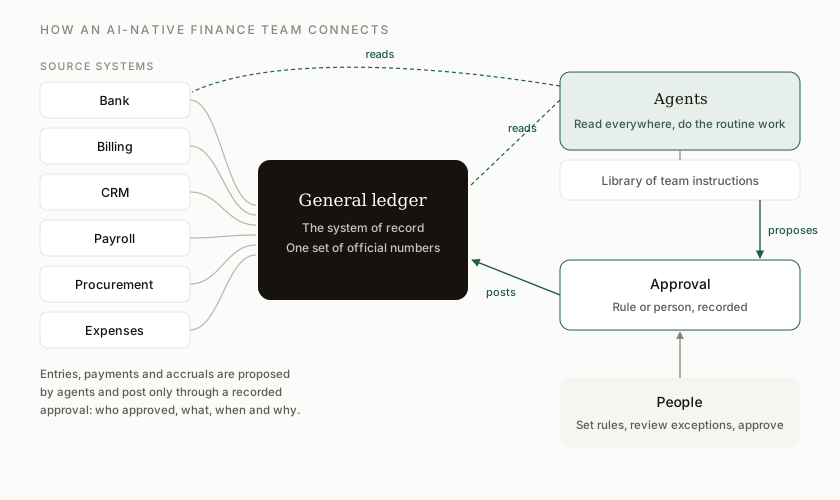
The ledger stays the system of record. The general ledger and its sub-ledgers remain the single place where the official numbers live. Bank feeds, billing, the CRM, payroll, procurement and expense systems feed it as before. Nothing about AI changes the need for one authoritative set of books, and the large vendors are doubling down on that role rather than giving it up.
Agents read everywhere and write through approvals. An agent preparing a reconciliation needs to see the ledger, the bank statement and the sub-ledger. An agent coding an invoice needs the purchase order, the vendor record and the policy. Reading broadly is what makes agents useful. Writing is different: every credible design has agents propose a change, a journal entry, an accrual, a payment, and a person or a pre-agreed rule approve it before it posts, with the proposal, the reasoning, the approver and the time recorded. Workday's new agents inherit each company's existing permissions and approval rules. Oracle runs its finance agents inside a governed envelope of policies and approval thresholds and records what each run did. The control frameworks agree: guidance on internal control over generative AI published this February treats automated transaction processing as its own capability, with its own risks and controls.
The team's know-how becomes reusable instructions. The most advanced teams capture how they do things as instructions an agent can follow: how to prepare the monthly review, how to explain a variance, how this company treats a particular kind of contract. Anthropic's finance team reportedly maintains more than seventy of them. The rule of thumb a16z cites is simple: if you do something twice, write it down as a workflow; if the workflow keeps repeating, turn it into an agent.
A general assistant becomes the front door. Increasingly, people ask questions of their finance systems through a general AI assistant connected to the ledger, rather than through the ledger's own screens. NetSuite now lets assistants run saved searches and reports and, with permission, create and update records. The system of record does not go away; it gains a second way in.
The team changes shape
The most visible claims are about headcount: finance teams of three at large companies, a fraction of the old ratio. Those stories are real for some companies, but the size math is less dramatic than it sounds. Benchmark data puts the median at about 79 finance staff per billion dollars of revenue, and the top quarter at about 45. A three-person finance team at a 100-million-dollar company is already a lean, top-quartile team by historical standards. The bigger change is not the number of people but what they do.
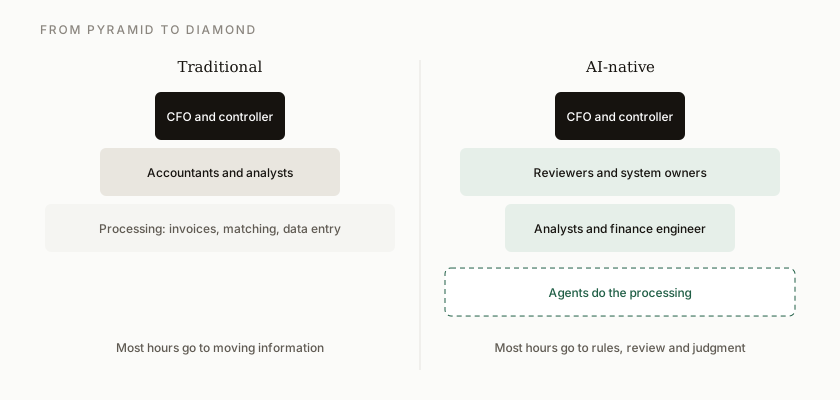
The pyramid becomes a diamond. Traditionally, a large base of junior staff did the processing and a few senior people reviewed it. With agents doing the processing, the base shrinks: in a survey of about 500 CFOs this spring, 64 percent said they expect to move away from junior roles. The middle grows, because someone has to review exceptions, own the rules and handle what agents cannot.
Controllers become system owners. The controller's job shifts from supervising people who do the work to owning the system that does it: the rules, the approval thresholds, the instructions, the exceptions and the evidence that the controls work.
A new role appears. The finance engineer, as a16z calls it, is usually a finance professional with technical fluency who builds and maintains the team's agents and workflows. In practice it is the person who turns "we do this every month" into something that runs on its own.
The training ladder needs rebuilding. Junior work was how accountants learned the craft. If agents do it, the next generation of reviewers has to learn some other way. Research on accountants using AI has found that experienced practitioners gain the most from it, which makes the question more pressing, not less. Teams doing this well give junior staff ownership of agent quality: reviewing outputs, writing instructions, investigating exceptions. It is a faster way to learn how the books work than keying invoices ever was.
The data so far supports reshaping more than cutting. In a survey of 270 CFOs published this month, 60 percent said they are redeploying finance staff to other work because of AI, and 3 percent said they are cutting. The pattern among early adopters is to stop backfilling routine roles as people move on, rather than to reduce teams outright.
Design for review, not for automation
The most useful finding from this year's surveys is where the bottleneck has moved. In that same survey, CFOs reported that their teams spend about a quarter of the working week checking or correcting AI output. Only 4 percent trusted AI to run the close without review. On independent tests of finance analyst work, the best models get everything right about half the time.
That is not a reason to slow down. It is a design requirement. An AI-native team is built around how much review it can absorb.
Route only the exceptions to people. If an agent matched an invoice to an order and a receipt within tolerance, it should not need a human glance. If it could not, a person should see it, with the evidence laid out. The goal is that review time goes to the cases that need judgment, not to confirming routine work.
Check everything, not a sample. Traditional controls sampled transactions because people could not look at all of them. Agents can. Expense platforms now review every expense against policy, and the large audit firms are building agents into tools that already analyze full populations of journal entries. This matters more now that AI also makes fraud cheaper: convincing fake receipts and vendor letters take minutes to produce. Checking every item, with people on the flagged ones, is a stronger control than sampling ever was.
Measure accepted work, net of rework. OpenAI's CFO has put the right test plainly: judge AI by completed, usable work, net of the cost of reviewing and fixing it, not by how many people have access or how many tokens it uses.
The scorecard
An AI-native finance team still tracks the classic measures, and a few new ones.
| Measure | What it tells you |
|---|---|
| Days to close | Whether the close is getting faster, toward continuous |
| Share of invoices processed with no human touch | How much routine work agents handle end to end |
| Cost per invoice | The unit cost of payables, with a wide gap between average and best-in-class |
| Share of payments matched automatically | How much of cash application runs on its own |
| Finance staff per billion of revenue | Team efficiency against peers |
| Share of agent output accepted without changes | Whether agents are getting better at the work |
| Share of the week spent reviewing AI | Whether review is the bottleneck |
| Value delivered per dollar of AI spend | Whether the AI itself is worth what it costs |
The last one deserves attention. Finance now owns a new cost line: the company's AI. A third of CFOs in the same survey had overspent their AI budgets by at least 10 percent in the past year. The team that measures everyone else's spending is also the natural owner of this one.
A 90-day start
Weeks 1 to 3: pick two checkable workflows. Payables and reconciliations are the usual starting points: high volume, clear right answers, measurable today. Record the baseline: how long it takes, how many people touch it, how often it is reworked.
Weeks 3 to 6: connect and set the rules. Connect the agents to the ledger and the source systems with read access, and define exactly what they may propose, what requires approval and who approves. Write down the team's instructions for each workflow as you go.
Weeks 6 to 10: run alongside people. Let the agents prepare the work while the team does it as usual, and compare. Measure accuracy, the share accepted without changes and the review time.
Weeks 10 to 13: shift the work. Move routine items to the agents, keep people on the exceptions, and decide where the freed time goes. Hold off on backfilling roles until the review load has actually come down.
Then add the next workflow, and the one after that. The teams that get furthest do not automate one task brilliantly; they build the habit of turning repeated work into rules, instructions and agents, one workflow at a time.
Key takeaways
- The work moves, the accountability stays. Agents do the routine movement of information; people set the rules, review exceptions and sign off.
- Start where the answer can be checked. Payables, payment matching, expenses and reconciliations are mature. Accruals and revenue schedules are proposals for approval. Planning, tax and treasury are earlier.
- The ledger stays the source of truth. Agents read everywhere, propose changes and post only through recorded approvals. The team's know-how becomes reusable instructions.
- The team changes shape more than size. Fewer junior processing roles, more reviewers and system owners, a new finance engineer role, and a deliberate plan for how junior staff learn.
- Design for review. Route only exceptions to people, check every transaction instead of a sample, and measure accepted work net of rework.
Fig helps finance teams build this: connecting agents to the ledger and the systems around it, with approvals and an audit trail built in. If you want to see what it would look like for your team, talk to us.