One view of the business
Private equity owners and management teams often see the same company differently. A playbook for the systems that close the gap, with less reporting work for both sides.

In shortThe information gap between private equity owners and the management teams running their companies is real and well documented: in one survey, 92 percent of sponsors called their reporting demands reasonable while only 26 percent of portfolio CFOs agreed. The gap is mostly structural, not personal. It comes from bandwidth, from definitions that mean different things to different people, and from timing. This playbook describes the systems that close it: finance, sales and operations views drawn directly from systems of record, a value creation plan tracker, one place for sponsor questions and a board pack drafted from live data. It also covers the design principles that make both sides trust the result.
"There are some trust issues." We have heard versions of that sentence from private equity firms all year, some put more politely than others.
The surveys say the same thing with numbers. In an earlier study by Accordion and Wakefield Research, 92 percent of sponsors said their reporting demands on portfolio companies were reasonable. Only 26 percent of portfolio company CFOs agreed. Accordion's 2025 survey of 200 sponsors and 200 PE-backed CFOs found 74 percent of sponsors saying their CFOs were not meeting expectations, and 77 percent of those CFOs worried about their job security. A September 2026 survey of 270 finance leaders by CFO Recruit found 71 percent describing tighter scrutiny of finance under private equity ownership, with heavier reporting among the changes founders least anticipated.
The view from the other side of the table is no clearer. In S&P Global's February 2026 survey, 37 percent of general partners said they were dissatisfied with the operating metrics they get from portfolio companies, fragmented data was named as a key barrier, and 75 percent rated AI as ineffective for portfolio monitoring so far.
So both sides are frustrated, and both sides are spending a great deal of time on the problem. The argument of this piece is that the gap is mostly structural rather than personal, and that structural problems have system solutions.
Where the gap comes from
Buying a company does not give you a clear view of what is happening inside it. Management knows the business better, and always will. The question is why that difference so often turns into friction. There are three causes, and only one of them is about people.
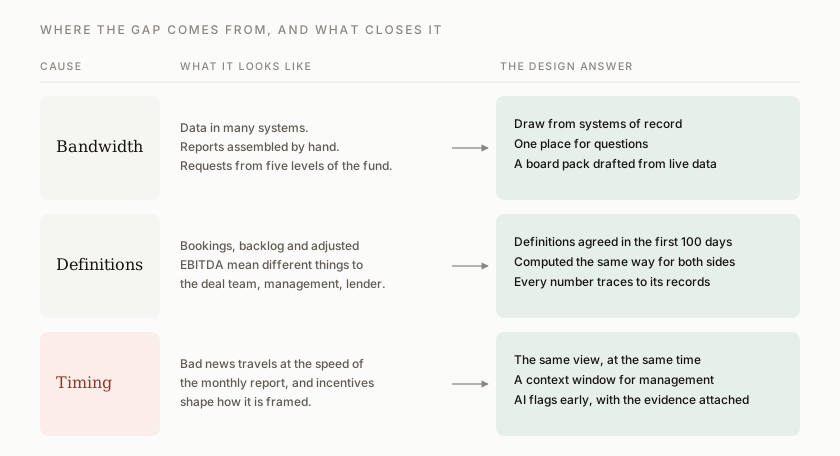
Bandwidth. The information lives in many systems: billing, the bank, the general ledger, the CRM, the job management system, a dozen spreadsheets. Assembling it into a report is manual work, usually done by the same small finance team that is also closing the books, managing cash and supporting the value creation plan. When a sponsor asks a question, the answer competes with running the business. Requests often arrive from several levels of the fund at once, which is why Bain advises new portfolio companies to designate a single liaison, usually the CFO, to keep information requests from flooding the team.
Definitions. "Bookings," "backlog," "active customer" and above all "adjusted EBITDA" can mean different things to the deal team, the management team and the lender. Two people looking at the same business can arrive at different numbers in complete good faith. Much of what feels like a trust problem is actually a definitions problem that nobody wrote down.
Timing. This is the one everyone recognizes. Incentives are rarely perfectly aligned. A missed target can affect a bonus, a reputation or a job; Bain reports that new owners replace 50 to 70 percent of portfolio company chief executives during the hold. That pressure can influence when an issue is raised and how it is framed, especially while the team is still trying to fix it. Bain's advice to management is blunt: "No one likes surprises, least of all PE investors." But surprises are also produced by systems in which bad news can only travel as fast as the next monthly report.
The systems that close it
What follows is a slice of what we build for private equity firms and their portfolio companies. None of it replaces the conversation between owner and operator. All of it changes what that conversation is about.
Finance, from the records up
Revenue, costs and cash drawn directly from billing, bank and accounting records rather than from a spreadsheet someone updated last Thursday. A daily cash position. A rolling 13-week cash forecast that updates itself as invoices are issued and paid. A flash profit and loss statement before the books formally close, with the variance against plan explained in plain language and every explanation linked to the transactions behind it.
For leveraged companies, the same data calculates covenant metrics continuously, so headroom is visible every week rather than discovered at the quarterly compliance certificate.
Sales and customers
Pipeline, renewals and churn risk, taken from the CRM, the billing system and product usage data rather than from what a sales leader remembers to update. The most useful thing here is not the dashboard. It is the flag: when the activity behind a forecast does not support it. A quarter that needs forty new deals, built on a pipeline where the meeting count dropped by a third in the last month, deserves a conversation now rather than in eight weeks.
Operations
For services, industrial and field businesses, the operating records tell the story before the financials do: job progress, backlog, schedule slippage, labor utilization and cost overruns against estimate. Connected directly to the job management and scheduling systems, they show where margin is being made or lost while there is still time to act.
The value creation plan tracker
Every value creation plan has three to five levers. Each should have a named owner, a baseline captured before anything changed, and a monthly series showing progress against it, tied to the income-statement lines it is meant to move. That turns the board conversation from "how is the pricing initiative going?" into a look at the same numbers both sides already have. It is also the evidence a buyer will ask for at exit, a point we develop in the private equity AI playbook.
One place for questions
Instead of requests arriving by email from an associate, a vice president, an operating partner and the fund's finance team, all questions land in one place, get routed to the right owner, and are answered once. Most routine questions can be answered directly from the data, with the source attached. The rest go to the right person with the context already assembled. The CFO stops being an information switchboard.
A board pack drafted from live data
The board pack is usually the single largest reporting task in a portfolio company, and most of it is assembly. A system connected to the records can draft the financial and operating sections from current data, flag what changed and why, and leave management to do the part only management can do: explain what it means and what they plan to do about it.
Design principles that make both sides trust it
Technology does not close an information gap on its own. A system that management experiences as surveillance will be worked around, and a system the sponsor suspects is curated will be ignored. The design choices below are what make the difference.
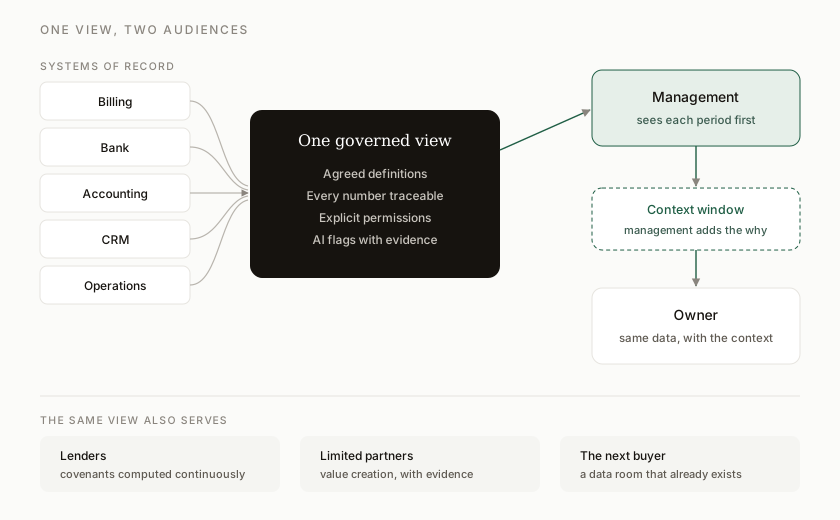
Systems of record are the only source. Numbers come from billing, banking, accounting, CRM and operating systems, not from hand-assembled spreadsheets. That removes most of the work and most of the doubt at the same time.
Definitions are agreed early and written down. In the first hundred days, owner and management sign off on what each metric means: what counts as bookings, how backlog is measured, which adjustments are in adjusted EBITDA. The definitions live in the system, so every number on both sides is computed the same way.
Every number traces back. Any figure on any page can be followed to the records behind it. That single property does more for trust than any number of assurances, because it makes a disagreement about a number a five-minute exercise rather than a week of reconciliation.
Same view, same time. Owner and operator look at the same data, refreshed on the same schedule. Neither side has a version the other cannot see.
Management gets a context window. Before a new period's results reach the owner's view, management has a short window to annotate them: what happened, why, and what is being done. That protects the team's ability to frame its own results honestly, which is exactly what removes the incentive to delay them.
Permissions are explicit. The sponsor sees what was agreed: financial, commercial and operating data at the agreed level of detail, not employees' email or individual performance records. The access model should mirror what each side has agreed to, and connectors that inherit source permissions make that enforceable rather than aspirational.
AI flags, people judge. The AI's job is to connect the dots and point at what is worth discussing: the forecast that the pipeline does not support, the cost line drifting from estimate, the customer whose usage dropped. It does not issue verdicts, and every flag carries its evidence. Anything that leaves the company, to a board, a lender or an investor, passes a named approver, with an audit record of what was sent.
What changes for each side
For operators, it means fewer spreadsheets to assemble, fewer one-off requests, less time explaining numbers and more time running the business. It also means fewer surprises in the other direction: when owners can see the business directly, they ask fewer anxious questions.
For owners, it means more direct visibility without waiting for the next board pack, earlier warning when something drifts, and board meetings spent on decisions rather than on reconciling numbers.
For both, the conversation changes. Less time is spent preparing and chasing updates, and more is spent working through what actually needs attention.
The payoff compounds
The same governed data serves audiences beyond the board.
Lenders need covenant calculations and compliance certificates, often monthly. Computed from the same records with the same definitions, they stop being a separate project.
Limited partners increasingly want to understand how value is being created. Accordion found 95 percent of sponsors saying it is more important than ever to communicate the value creation levers being pulled. A tracker with baselines and monthly evidence answers that directly.
The next buyer will run a quality-of-earnings review. A company that can show agreed definitions, traceable numbers and a monthly record of each value creation lever is a company whose earnings survive diligence. The system built to close the gap with the current owner becomes the data room for the next one.
Key takeaways
- The information gap between private equity owners and management teams is real, measurable and mostly structural: bandwidth, definitions and timing.
- Most of what feels like a trust problem is a definitions problem nobody wrote down. Agree the metrics in the first hundred days and put them in the system.
- Draw every number from systems of record and make every number traceable. That removes most of the reporting work and most of the doubt.
- Give management a window to add context before results reach the owner. It removes the incentive to delay bad news.
- The same governed view serves the board, the lenders, the limited partners and, eventually, the next buyer's diligence team.
The goal is not to give owners more control over operators. It is to give both sides the same picture, so that every conversation starts from it. That is the kind of system we design and build in an AI transformation.