The latest AI primitives: what agents learned to do this fall
A roundup of the AI primitives that shipped from September to November 2026: agents that spend money, make phone calls, join meetings and make fast decisions. What each one is, who shipped it and how companies should prepare.

In shortA roundup of the AI primitives from the past three months: agents that spend money, place phone calls, join video meetings and make fast, calibrated decisions. Each shipped with its own control, such as an approval for every purchase, a call card or a confidence threshold. Companies should set those controls on purpose before their customers' agents arrive.
This is a roundup of the new AI primitives from the past three months: the building blocks that other products are now assembling into agents.
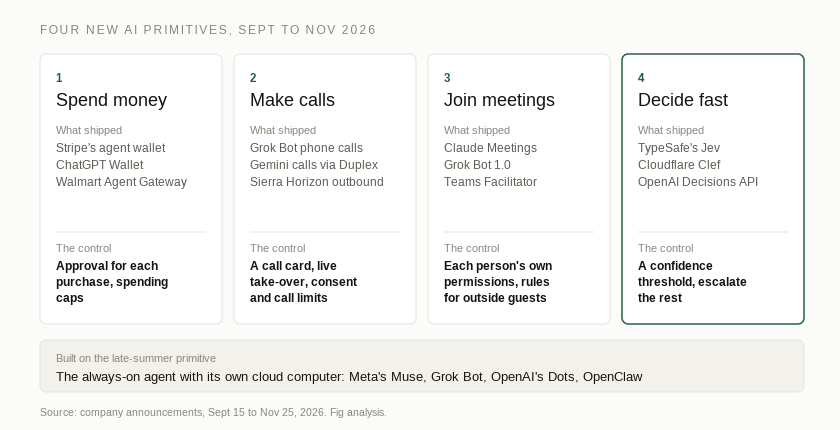
In late summer, the primitive everyone shipped was the always-on agent with its own computer. Meta's Muse, Grok Bot, OpenAI's Dots and the open-source OpenClaw each gave an agent a cloud machine, a browser and somewhere to keep working after you close the laptop, as we wrote in early October. Since September, four more have been built on top of it:
- Agents that spend money, through wallets from Stripe, OpenAI and Google and checkout deals with Shopify and Walmart.
- Agents that make phone calls, both for consumers (Grok Bot, Gemini) and for companies running outbound campaigns (Sierra).
- Agents that join the meeting as a visible participant (Claude Meetings, Grok Bot 1.0, Microsoft's Teams Facilitator).
- Models that make fast, calibrated decisions without writing a sentence (TypeSafe's Jev, Cloudflare's Clef, OpenAI's Decisions API).
The demo that showed where this is heading came on Nov 4, when xAI posted a 42-second video of Grok Bot making a phone call. The bot had noticed that its user's internet contract would renew in three days and asked whether it should cancel. The user said yes and added one instruction: "And don't let them talk me into a discount." The bot showed a card naming the company it was about to call, waited for a tap and dialed. A support agent named Dan offered 10% off for a year. The bot turned him down, saying the customer had found a better deal elsewhere, and Dan cancelled the plan. "Done. Your plan is canceled," the bot reported. "As you said, they tried. But I said no thanks."
Dan's offer was written for a person: someone tired, on hold, a little guilty about leaving. It had nothing to work on with an agent that had been told to say no.
We think these four primitives belong together. Each gives an agent a new way to act outside the chat window, and each shipped with a specific control that decides who approved the action. Those controls are where companies have real choices to make, whether the agent is their own or one sent by a customer. We go through the four from most to least mature, then turn to what companies should do.
Agents that spend money
The fastest-moving of the four is also the one with the most money behind it. On Nov 20, Stripe's chief economist, Ernie Tedeschi, published new data on agents buying things through Link, Stripe's consumer wallet. Daily spending through Link's wallet for agents was nearly 80 times higher in mid-November than at the start of September, and it had doubled in the past month. More than 40% of the previous week's volume went to airfare, travel and lodging, and about a third to retail. More than half of the people who made one purchase through an agent came back for a second. Two days later Stripe's chief executive, Patrick Collison, shared it with one line: "Agentic commerce is growing extremely quickly."
The growth starts from a small base, and Stripe hasn't published dollar totals. The repeat rate tells us more than the multiple. Half of first-time users trusting an agent with a second purchase is a strong number for a habit that didn't exist in the summer.
The payment layer was built in a few months. Stripe's wallet for agents now handles payments for Muse, Grok Bot and Instinct. At the more than 1 million businesses that accept Link, the agent checks out with the card the shopper has saved; everywhere else, Link issues a single-use virtual card limited to the approved purchase. The shopper approves the total in the chat, and the agent never sees the card number (Stripe, Sept 8). On Sept 29 Stripe added the pieces agents kept getting stuck on. An agent can now raise an approved amount when a checked bag adds to the fare, receive instructions it can act on when a payment fails, and, with the shopper's permission, read spending history from 12,000 banks to recommend stores and set a budget. Some purchases now come with protection if the agent makes a mistake.
OpenAI followed on Nov 13 with ChatGPT Wallet, built with American Express, Chase, Mastercard and Visa and available first in Dots for ChatGPT Pro subscribers in the US. The card network issues a payment token for each purchase, and the user approves every one with Face ID or a fingerprint. Card rewards and dispute protections still apply. On Nov 17 Google made its Gemini agent free in six countries and let it check out with Google Pay, sign into sites without exposing a password and confirm before it buys.
The retailers split. Shopify went first and furthest. In January Tobi Lütke announced that the Universal Commerce Protocol, built with Google, was live. On Sept 21 he wrote: "We are excited to announce we are partnering deeply with Muse to enable agentic checkout with Shop Pay on all Shopify stores." Walmart opened an Agent Gateway on Oct 21 for outside shopping agents, with spending caps, approvals and access the shopper can revoke. On Nov 24 it put its Black Friday deals inside Muse. The agent sends the request to Walmart, Walmart builds the cart, and Muse never sees the shopper's purchase history.
Amazon went the other way. It blocked Muse in September, saying the agent's access violated its terms. In October Andy Jassy told investors that few customers were buying through outside agents because the experience was "still not great, nor more convenient than coming to a retailer directly." This month, at a Semafor conference, he said Amazon hadn't ruled them out, as long as they offered a "fair exchange of value." This morning, Fortune reported that Amazon and Meta have held several rounds of talks about ending the blockade. The two open issues are how search results would appear and how advertising would work, and any deal needs both chief executives to sign off.
Advertising is the heart of it. Amazon's ad business brings in $68.6 billion a year, nearly 10% of its revenue, and almost all of it depends on a shopper seeing sponsored listings on Amazon's own pages. An agent that searches, compares and checks out never sees those pages. Mark Zuckerberg has said Meta eventually plans to take "a small fee from transactions." When Amazon first blocked Muse, we expected more standoffs like it, followed by negotiations over access and fees. The negotiation has now started, two days before Black Friday.
Our read is that this primitive is further along than the others and its next step is already visible. Every system above asks the person to approve each purchase. OpenAI has said that users will later be able to approve purchases in advance, within spending limits, categories or time periods. When that arrives, the agent stops being a shopping assistant and becomes the buyer. Travel leading the volume is the better guide to where agents win: expensive, many-step purchases that people dislike doing themselves. And the fight is over discovery. The card networks, the banks and Stripe have already made agent payments work. What a retailer stands to lose is the moment when it decides what the shopper sees first.
Agents that make phone calls
Phone calls are where agents are now proving they can act on someone's behalf, on both sides of the line.
On the consumer side, Grok Bot's calls went live on Nov 4 with the cancellation demo above. During a call, the user sees a live transcript with buttons to take over or hang up. Google tested a "Call for Me" feature with Pixel owners in September, in which the agent announces that it is an AI. On Nov 17, calling local businesses became part of Gemini's free agent in the US. xAI's demo didn't say whether Grok Bot tells the other side.
On the company side, the shift is from answering calls to running campaigns. In July, Sierra, whose agents already handle phone calls for Santander, Rocket Mortgage, Cigna and almost half of the Fortune 50, launched Horizon. A Horizon agent pursues a goal such as originating a loan, getting a prior authorization or booking a specialist referral. It reaches the customer by phone and text over days, weeks or months and learns from each sale or refusal. "Where agents to date have delivered customer experiences, Horizon delivers outcomes," Sierra wrote, and it charges for outcomes delivered, not tokens. One of its first customers is a US healthcare provider that uses it to schedule referrals from primary care doctors to specialists, a job that can take dozens of calls and texts among the patient, the specialist and the referring physician.
The cost of a call has collapsed. xAI's Grok Voice 3, released in October, costs $0.08 a minute, and xAI says Starlink's support line now resolves about 70% of its 20,000 daily calls without a person. Salesforce agreed to buy Cresta, a contact-center AI company, on Nov 2. At those prices, outbound work that companies used to ration, like payment reminders, renewal calls, collections, appointment scheduling and lead follow-up, can be run for every customer instead of the ones worth a person's time.
Banks, insurers and outsourcers said in September that calls from customers' AI agents were a small share of their volume and that they expected more. A growing share of calls will be one company's agent talking to another company's agent, about a bill, a dispute or a cancellation, with no person on either end until something goes wrong.
The rules lag behind. The Federal Communications Commission ruled in 2024 that AI-generated voices count as "artificial" under the Telephone Consumer Protection Act, so automated outbound calls to consumers need their prior consent. Its proposal to require AI calls to disclose themselves is still not final. Debt collectors face their own limit: the Consumer Financial Protection Bureau presumes a violation after seven calls about one debt within seven days.
Our read is that phone agents will change the economics of every call center twice. First, outbound gets cheap enough to use everywhere, and the vendors that bundle consent, disclosure and call limits into the product will win the regulated buyers. Second, scripts written to work on tired people stop working: retention offers, hold queues and deliberately tedious cancellation steps all lose their force against an agent with instructions and unlimited patience. Companies that rely on that friction to keep customers should assume it is going away. We covered where voice works well, and where it still fails callers, in Where voice actually works.
Agents in the meeting
The third primitive gets less attention than the other two, and it may end up the most useful at work. Agents now join a video call as a visible participant, hear the discussion firsthand, build the document while people are still talking and act afterward with the tools each person has connected.
Anthropic opened Claude Meetings in beta on Nov 12 for Team and Enterprise customers. Claude joins a Google Meet call with a live tile that shows what it is doing. Anyone can say "Claude, make a doc" or "Claude, make a whiteboard," and the result appears on a meeting page that everyone in the organization can edit before the call ends. It can use each person's connected tools, such as sending a Slack message, but only with that person's permission. The day before, xAI released Grok Bot 1.0, which made its agents shared teammates in Slack, Teams and video calls. The bots learn from everyone they work with, follow up on unfinished work without being asked, coordinate with other bots and "bring people in when a decision requires their judgment." Microsoft's Facilitator agent in Teams writes shared notes during the meeting, answers questions in the meeting chat, keeps the agenda on time and drafts a Word document from the discussion, and it watches for voice phishing when outsiders are on the call. Zoom used its annual conference to pitch its calls and meetings as context for agents, linked to more than 40 other business applications.
The human side shows up in the fine print. Anthropic's instructions start with a reminder to make sure everyone on the call is comfortable being transcribed. When people from outside the company are on a call, Claude only takes notes and doesn't speak in the chat. If a company has outside guests turned off, Claude leaves the meeting when another company's notetaker bot joins. Those rules answer questions most companies haven't asked yet. Who decides whether an agent attends? What may it say in front of a customer? What happens when the customer's agent is also on the call?
We think the meeting is worth an agent's time because that is where the context lives. Decisions, objections and who owns what are spoken aloud and rarely written down. Agents fail at real work mostly because nobody briefed them, and an agent that heard the discussion doesn't need a brief. The products differ less in features than in permissions: whose tools the agent uses, what it may say in front of outsiders and who is accountable for what it does. Microsoft, for example, gives each of its Autopilot agents an identity of its own, separate from the person it works for. Those choices will decide whether companies let these agents into meetings that count.
Models that decide instead of write
The fourth primitive is the least visible, and we think it will be the most widely used inside companies.
On Sept 15, TypeSafe AI released Jev, which it calls the first "System One" model, after the fast, intuitive mode of thinking in Daniel Kahneman's work. Its founder, Diogo Almeida, helped build the instruction-following research behind ChatGPT. Jev cannot hold a conversation. A developer sends it a piece of information and a set of typed questions, and it returns choices, scores and probabilities with calibrated confidence, in 70 to 500 milliseconds. It answers every question in parallel, so asking ten costs about the same time as asking one. TypeSafe's advice is to break a judgment into small questions and combine the answers in code. Instead of asking a model to "rate this startup pitch," ask separately about market size, feasibility and differentiation. When priorities change, change the weights in your code instead of rewriting a prompt.
The category formed in ten weeks. Cloudflare released Clef, two open-source decision models compatible with Jev's interface, on Oct 1. Its threat team uses Clef to classify websites in 2.2 seconds, against 4.7 seconds for a general open model that returned fewer answers. TypeSafe raised $870 million at a $7.5 billion valuation on Oct 9, led by Andreessen Horowitz, and says a third of the Fortune 500 are using Jev. On Oct 22 OpenAI made its Decisions API generally available. It is built on GPT-6 Luna, up to 10 times faster than asking Luna normally and priced at $0.10 per million input tokens, with no charge for output. Inside OpenAI, the personal finance team uses it to categorize transactions, and the API now plugs into OpenAI's real-time voice model so voice apps can react while people are still speaking. That links this primitive to the other three: the purchase approval, the turn in a phone call and the moment in a meeting are each a small decision.
Researchers moved quickly too. A November study tested 14 decision models against large models used as judges on eleven benchmarks. Five matched GPT-5.6 without reasoning. Given a reference answer, eleven reached 90% to 93% on JudgeBench, level with Claude Opus 5.5 and GPT-5.6 with reasoning, at about one-sixteenth of the cost, and several were better calibrated than any of the large models. Another paper found that letting Jev accept the verdicts it was confident about and passing the rest to GPT-6 was slightly more accurate than GPT-6 alone, at 41% of the cost. Decision models still fall behind on math, code and logic, where the answer has to be worked out. A third paper showed where they are vulnerable: whoever prepares the input, writes the question or interprets the answer can tilt the decision without touching the model.
Our read is that this is the primitive enterprises have been missing. Most of what a company wants from AI is a stream of small judgments made thousands of times a day: route this ticket, flag this transaction, check this claim, approve this request. A model that returns "approve, 0.93" in a tenth of a second can have its threshold set, audited and changed by a risk team, which is much harder with a paragraph of generated text. The pattern that works is a cascade, in which the decision model handles the confident majority and sends the uncertain rest to a larger model or a person. We expect decision models inside most serious agent systems within a year, making the many small calls while a large model plans and writes. We first flagged the category in our September roundup.
What the four have in common
Each of the four lets an agent act beyond the chat window. Each also arrived with a control at the point of action: an approval for every purchase and a spending cap, a call card and a take-over button, each person's own permissions and rules for outside guests, a confidence threshold and an escalation path. None of these primitives is a finished product. All of them put a person or a rule at the moment the agent acts, and how a company sets that control decides how much it is actually handing over.
Companies meet these primitives from two directions. Their own agents will pay suppliers, call customers, sit in their meetings and make decisions inside their systems. And their customers' agents will arrive at their websites, phone lines and meetings, acting on someone else's instructions. The rest of this post is about preparing for both.
What companies should do now
If you sell online, prepare for agent shoppers
- Decide your position on outside agents. Walmart opened a gateway with caps and approvals. Amazon blocked Muse and is now negotiating terms. Shopify made every store reachable. The right answer depends on how much of your margin comes from controlling what shoppers see first. Make the choice deliberately, before an agent makes it for you by failing at your checkout.
- Make your products readable by machines. Agents choose from what they can parse. Keep product feeds, prices and stock levels accurate, claim your business listing in the AI assistants that offer one, and if you sell on Shopify, check how your store appears through its commerce protocol.
- Let legitimate agents through. OpenAI's merchant guidance asks sites to recognize agents that sign their requests (Web Bot Auth) so firewalls and bot filters don't block them. Separate those agents from scrapers. Treating every automated visitor as an attacker will cost you sales you never see.
- Retune fraud rules. Agent purchases look unusual: fast, from a data center, with a token instead of a card. OpenAI names Forter, Riskified, Sardine and Signifyd as partners for this. Ask your fraud provider how it scores agent orders and what your decline rate is on them.
- Write terms for agent orders. Decide how returns work when an agent bought the wrong size, what spending caps you will honor and how you mark orders an agent placed. Track agent orders as their own channel, starting with this holiday season.
If customers call you, prepare for agents on the line
- Find out how many of your callers are agents. Start measuring now, through disclosure, voice analysis or simply asking, even if the number is small.
- Check authority before acting. An agent that says it represents a customer needs to show it does before it can cancel, change an account or dispute a charge. Use the same step-up checks you would for a person calling on someone else's behalf.
- Review scripts that depend on friction. Retention offers, long hold times and multi-step cancellations were designed for people. Decide which of them you still want once a patient agent is on the other end, and where a straightforward offer works better.
- Give agents a better path than the phone. A documented way to cancel, reschedule or dispute online is cheaper for you than an agent on the line for 20 minutes. Agents will use the cheapest route that works.
If you run outbound calls, start with the rules
- Begin with low-risk campaigns. Payment reminders, appointment confirmations and renewal notices are high-volume, easy to measure and low-stakes if a call goes badly. Collections and sales come after.
- Treat consent and disclosure as product requirements. Keep a record of consent for every number you dial. Have the agent say it is an AI, whether or not the rule is final yet. Enforce call-frequency limits and quiet hours in the system, not in a policy document.
- Buy outcomes where you can. Pricing per booked appointment or collected payment, as Sierra does with Horizon, puts the vendor's incentive where yours is and makes the business case easy to check.
Inside the company: meetings and decisions
- Write a meeting policy before people install agents themselves. Decide which meetings an agent may join, whether it may join calls with customers or partners, how long transcripts are kept and whose connected tools it may use. Start with internal planning meetings, where the payoff is high and the risk is low.
- Measure the meeting by what comes out of it. The useful metric is the time from the end of a meeting to a finished document or completed action item. Agents that build the document during the call should bring that close to zero.
- List your high-volume judgments. Routing support tickets, categorizing transactions, triaging claims, checking eligibility, screening documents, checking quality: any decision made thousands of times a day with a small set of possible answers is a candidate for a decision model.
- Build the test set from your own history. Take a few hundred past cases where you know the right answer, and measure a decision model against them before trusting it. Calibration counts as much as accuracy: when the model says 0.9, it should be right about 90% of the time.
- Run a cascade, and let the risk team own the threshold. Let the decision model handle cases above a confidence threshold, and send the rest to a larger model or a person. Record the input, the questions, the answers and the confidence for every decision, because the research shows that is where manipulation happens.
A sequence for the next six months
Through the end of December, measure agent traffic and agent orders through the holidays. Let signed agents through your firewall. Write the meeting policy. Pick one high-volume decision and build its test set.
January to March 2027, run a decision-model cascade on that one workflow. Start handling agent callers on purpose, with authority checks and a plan for retention scripts. Pilot one low-risk outbound campaign with consent and disclosure built in.
April to June 2027, decide your terms for pre-approved agent purchases, which we expect the large agent makers to offer by then. Extend decision models to the next few workflows. Revisit your position on outside shopping agents with six months of data on what they bought and returned.
Back on that Nov 4 call, Dan offered the same discount he would have offered anyone, and it didn't work. Over the next year, more of a company's customers will reach it through agents like the one that called him, and more of its own work will be done by agents that pay, call, attend meetings and decide. The companies that set those controls on purpose will be the ones deciding what their own agents may do, and what their customers' agents can do to them.