Where voice actually works
Voice stopped being a demo this year. A map of what it is good at now, what it is still bad at, and the places it should not go.

In shortFull-duplex models, sub-second turn-taking, and telephony built into the APIs removed the reasons voice agents used to feel wrong, and voice now handles roughly a fifth of inbound contact-center volume against 6 percent two years ago. The model is no longer the constraint. What matters is where you point it: customer-facing work where the agent is grounded and can act, and the internal half nobody writes about, where people's hands and eyes are busy. Voice is a surface on a governed agent, not a separate product.
Anyone who tried to deploy a voice agent two years ago remembers why it did not work. The thing talked over you, or waited two seconds before answering, or lost the thread the moment you interrupted it to correct a digit. The technology was impressive in a demo and unusable on a real phone line, and most enterprises shelved it.
That changed this year, and quietly. Models now hold full-duplex conversations, meaning they listen while they speak rather than taking turns like a radio. Turn-taking gaps have come down toward 300 milliseconds, which is roughly human. Telephony is built into the APIs, so putting an agent on a phone number is no longer an integration project. Benchmarks now exist for voice agents on grounded customer-service tasks rather than for speech quality alone. The result is that voice has gone from about 6 percent of inbound contact-center volume in 2024 to roughly 19 percent this year, with banking and telecoms leading.
So the interesting question is no longer whether voice works. It is where to point it. This piece is a map: what voice is good at now, what it is still bad at, the half of the opportunity almost nobody writes about, and the places it should not go at all.
What a voice agent actually is
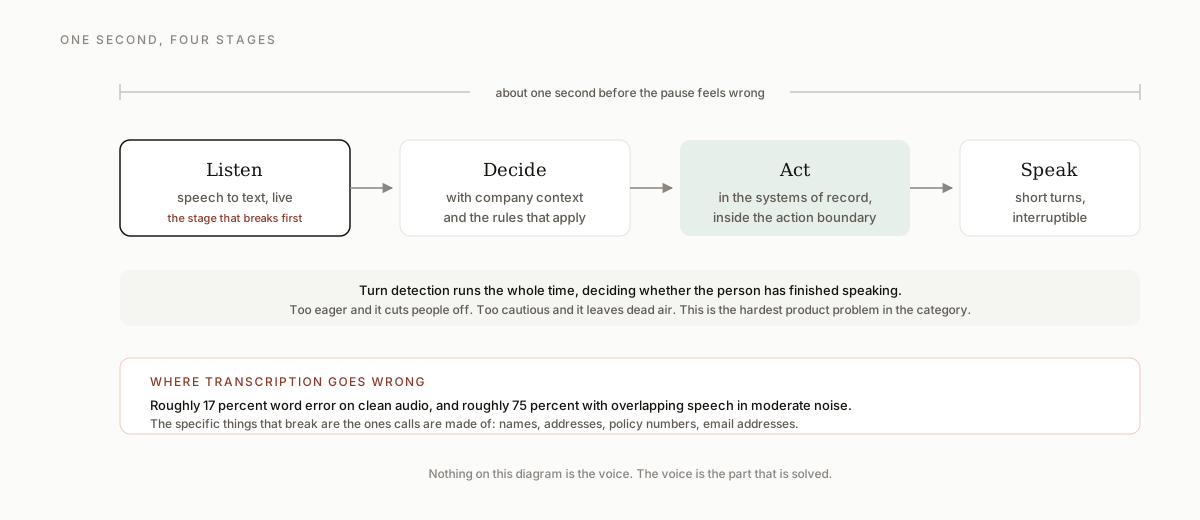
It helps to be concrete about the machine, because the failure modes follow from its shape. A voice agent is a pipeline with a budget. It listens and converts speech to text, decides what is being asked, retrieves whatever it needs, decides whether to act, acts, then generates speech back. Every stage spends milliseconds out of a budget of roughly a second before the pause starts to feel wrong.
Two stages in that pipeline are where deployments live or die, and neither is the voice.
Turn detection is the hardest product problem in the category. Too eager and the agent cuts people off mid-thought, which users hate more than almost anything else, and which also feeds a truncated sentence to the model. Too cautious and the agent leaves dead air. The current answer is a small dedicated model that does nothing but decide whether a person has finished speaking, running in tens of milliseconds alongside everything else.
Transcription under real conditions is the other. On clean audio, modern speech recognition is close to solved. In a study of realistic conditions, overlapping speech at moderate noise pushed transcription error from about 17 percent to about 75 percent. Names, addresses, policy numbers and email addresses are the specific things that break, and they are exactly the things customer service calls are made of. Getting them right is not a matter of picking a better model, it is a matter of domain adaptation and of designing the conversation to confirm what it heard.
The customer-facing map
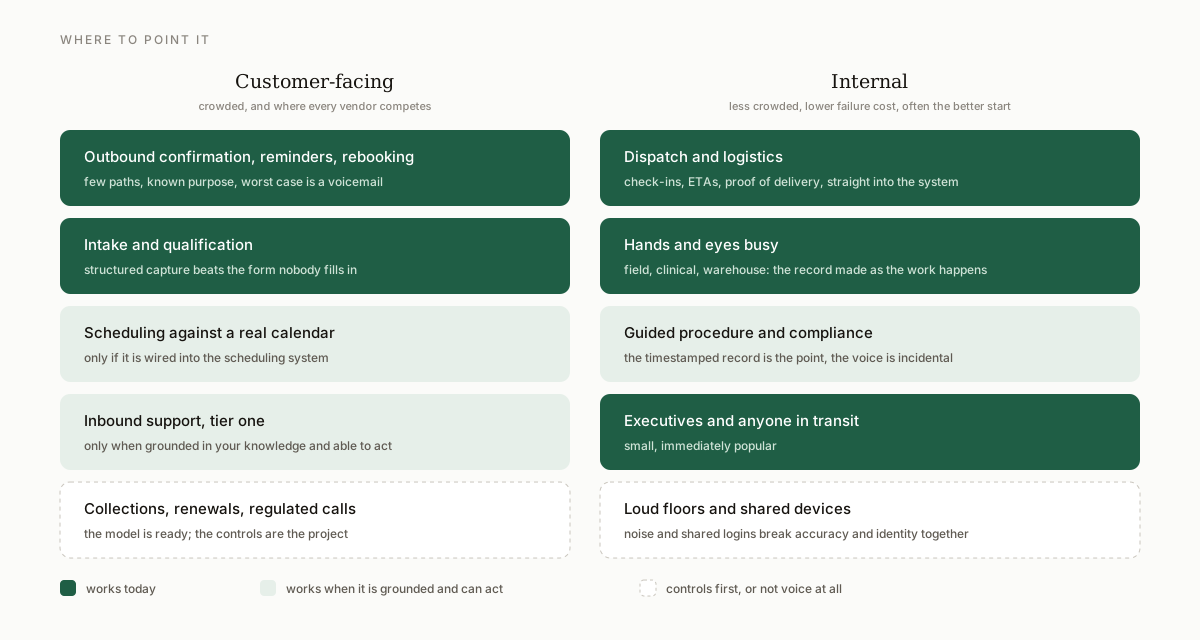
Outbound confirmation, reminders and rebooking. The most reliable place to start, and the most underrated. The agent knows why it is calling, the conversation has a small number of paths, and the worst case is a voicemail. Appointment confirmations, delivery windows, renewal reminders, post-visit check-ins. Works today, nearly everywhere.
Inbound support, tier one. Works well when two conditions hold: the agent is grounded in the company's actual knowledge rather than a general model's impression of it, and it can perform the action the caller wants rather than describing it. Order status, balance checks, password resets, address changes, appointment moves. Where those two conditions fail, the agent is a fluent switchboard, which we will come back to tomorrow.
Intake and qualification. First-touch calls that end with a complete, routed record instead of a voicemail. Strong today, because the goal is structured capture rather than resolution, and because the alternative in most companies is a form nobody fills in.
Scheduling. Booking, moving and cancelling against a real calendar with real constraints. Works when the agent is wired into the scheduling system rather than describing availability it cannot see.
Collections, renewals and anything regulated. Technically well within reach, and the constraint is not the model. It is disclosure, consent, recordkeeping and the rules about what may be said to whom. Feasible, but it belongs to teams that already have those controls.
The internal half
Almost everything written about voice AI is about talking to customers. The other half of the opportunity is talking to your own people, and it is less crowded, easier to govern and frequently a better first deployment, because the users are employees who can be trained and the failure cost is low.
Hands and eyes busy. Field technicians, maintenance crews, warehouse staff, clinicians. A person on a ladder or under a machine is not going to open a laptop to log a part number, so the work gets written up at the end of the day from memory, badly. Narrating it as it happens produces a better record and takes no extra time.
Dispatch and logistics. Driver check-ins, dock assignments, arrival and departure timestamps, ETA updates, proof of delivery. This is high-volume, structured, repetitive phone work that goes straight into a system of record, and it is the internal use case with the clearest reported returns.
Guided procedure and compliance. Walking someone through a safety check, an audit question set or a clinical protocol while producing the timestamped record as a byproduct. The voice interface is incidental; the value is that the record gets created at the moment of the work rather than reconstructed afterward.
Executives and anyone in transit. The rundown read aloud, with the ability to act by reply. Less transformational, immediately popular.
Why voice is not text with a microphone
Teams that have shipped text agents tend to underestimate this, so it is worth saying plainly. Voice removes four things a chat interface gives you for free.
There is no scrollback. Whatever the agent says exists for a second and then is gone, so a long answer is worse than a short one, and a list of five options is worse than a question.
There is no skimming. A reader takes what they need from a paragraph in two seconds. A listener sits through the whole thing, which means the agent has to decide what matters rather than covering itself.
People interrupt. Not occasionally, constantly, and correctly, because that is how humans talk. An agent that cannot be interrupted gracefully feels broken no matter how good its answers are.
Latency is the experience. In text, a two-second wait is normal. In speech it is a signal that something is wrong, and users start talking again, which compounds the problem.
The design consequences are specific: short turns, one question at a time, read back anything alphanumeric, never make the caller repeat something the system already knows, and make the handoff to a person fast and complete rather than a last resort.
Where not to put voice
Voice is a poor fit when the person needs to see something, compare options, or review a document before deciding. It is a poor fit for long structured capture, where a form is simply better. It is a poor fit where an error is irreversible and the confirmation is weak, since hearing "yes" is not the same as a person reading and approving a screen. And it is a poor fit for high-stakes emotional conversations without a fast, obvious path to a human being.
The useful test is whether the medium is helping the person or helping the company avoid staffing a phone line. Callers can tell the difference within about ten seconds.
Disclosure is now table stakes
One thing changed the compliance picture this year. Since the EU AI Act's transparency obligations took effect on 2 August 2026, people interacting with an AI system have to be told, and for a voice agent that means audibly, at the start of the call, not buried in a privacy notice. Synthetic voice output has to carry machine-readable marking, and if the system infers emotion the caller has to be told that too. Penalties run to 15 million euros or 3 percent of global turnover. Recording consent rules vary by jurisdiction on top of that.
The practical effect is small if you design for it and awkward if you retrofit it. Write the disclosure into the first line, make it sound like a courtesy rather than a legal notice, and keep the transcript and the record of what the agent did.
How we think about it
Fig's Voice Agent is an agent that picks up the phone: real-time calls for scheduling, follow-ups, intake and service, on your scripts and under your governance, with transcripts, outcomes and system updates landing where they belong.
The important part is the second half of that sentence. A voice agent should not be a separate product with its own memory, its own permissions and its own audit trail. It is a surface on the same governed agent that works in your channels, on the desktop and on mobile, which is the argument we made about meeting the work where it happens. The same identity, the same company context, the same approval gates on anything irreversible, and one record of what happened regardless of whether the request arrived by phone or by chat.
That matters more in voice than anywhere else, because the phone is where the hardest cases arrive and where a caller is least able to check the agent's work.
Key takeaways
- The model is no longer the constraint. Full-duplex conversation, roughly human turn-taking and built-in telephony removed the reasons voice used to feel wrong, and adoption roughly tripled in two years.
- The failure modes live in turn detection and in transcription under noise, names and alphanumerics, not in the voice itself.
- Start outbound and structured, or start internally, where hands are busy and the failure cost is low. The internal half of the map is far less crowded.
- Voice is not text with a microphone: no scrollback, no skimming, constant interruption, and latency as the whole experience.
- Disclosure is a legal requirement in Europe as of August, so design it into the opening line.
Its companion piece, talking is not solving, is about the number the industry likes to quote for voice agents, and the one that actually tells you whether yours is working.