Anthropic's S-1: a preliminary read
Anthropic filed publicly to go public on Oct 26. A first read of the numbers, the margins, the compute commitments, the governance and the risk factors, and what the filing still leaves blank.

In shortAnthropic's S-1 shows $16.3 billion of revenue in the first half of 2026 and a second-quarter operating profit, on about $9 billion of lifetime cash burn. It also shows roughly $637 billion of compute commitments against mostly pay-as-you-go revenue, founders with permanent voting control, and unusual risks, including a government order that switched two models off.
On Oct 26, Anthropic made its registration statement public. The company plans to list on the Nasdaq under the ticker ANT, with Goldman Sachs and Morgan Stanley leading the offering. This is a preliminary filing: the price range, the number of shares and the third-quarter revenue figure are all still blank, and an amended version will fill them in. What follows is our first read of what is already there, which is a great deal.
The growth
The headline numbers are hard to compare with anything else in technology.
| 2023 | 2024 | 2025 | First half 2026 | |
|---|---|---|---|---|
| Revenue | $41M | $386M | $4.6B | $16.3B |
| Compute and infrastructure | $433M | $2.5B | $7.3B | $8.9B |
| Operating loss | $551M | $3.0B | $8.1B | $693M |
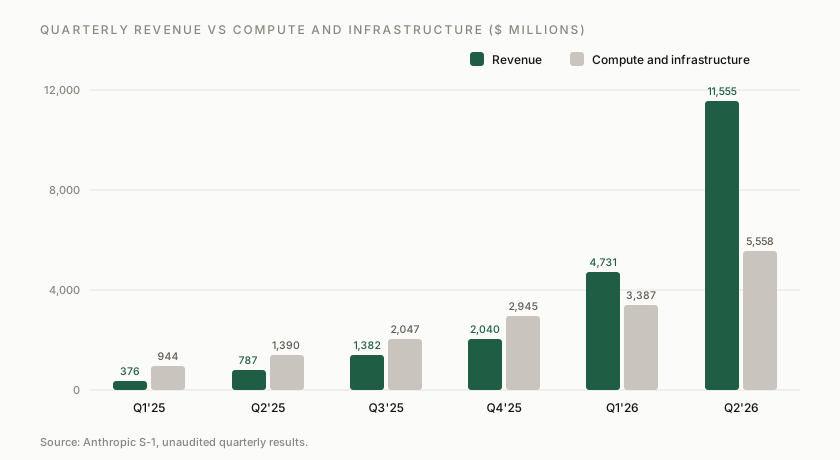
Revenue in the second quarter of 2026 alone was $11.6 billion, up 1,368% on the same quarter a year earlier, while compute and infrastructure spending grew 300%. That gap produced the first operating profit in the company's history: $974 million in the second quarter, an 8% operating margin, after years of losses. Anthropic told investors in mid-October that third-quarter revenue reached $16.8 billion, up 45% on the second quarter, according to press reports, but that figure is not yet in the filing.
What the margin actually is
The filing does not report gross margin, and the answer depends on what you count. In its breakdown of expenses by function, Anthropic reports cost of revenue of $2.4 billion for the first half of 2026, which implies a gross margin of about 85%, up from about 40% in 2025 and negative in 2024. That figure is impressive, and it leaves out a lot. Training compute sits in research and development, which came to $9.7 billion in the first half, or 60% of revenue. The fees paid to cloud marketplaces sit in sales and marketing.
A simpler measure is revenue minus all compute and infrastructure spending, whatever it was used for. On that basis, Anthropic kept about 45% of revenue in the first half of 2026. That is the number we would watch. It captures the real trade at the heart of the business: how much revenue each dollar of chips produces, counting the chips used to build the next model.
A large loss that is mostly accounting
The net loss for the first half of 2026 was $80.7 billion, a number that has already been widely quoted. Almost all of it, $72.4 billion, is a change in the fair value of convertible notes and similar instruments, which rise in value on paper as the company's valuation rises. The operating loss for the same period was $693 million, and operating cash flow was positive at $3.9 billion.
The cash figures tell an even more striking story. Anthropic has raised $141.1 billion in total. At the end of June it held $112.4 billion in cash and $19.3 billion in short-term investments. Subtract one from the other, and the company has consumed only about $9.4 billion of cash over its entire life to reach a revenue run rate in the tens of billions.
Fixed costs, variable revenue
The part of the filing that deserves the most attention is the compute. Anthropic has signed multi-year agreements with seven suppliers, several of which are also its investors.
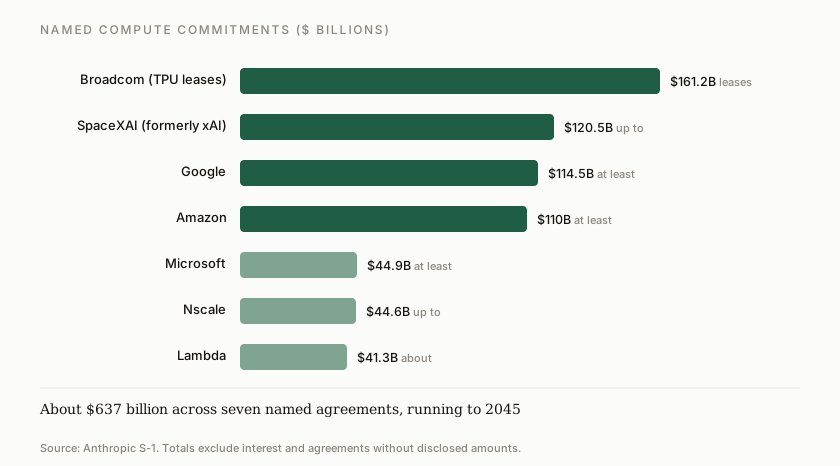
The largest is a set of finance leases for Google-designed TPU chips through Broadcom, with rent of about $161 billion. The most surprising is with SpaceXAI, formerly xAI, under which Anthropic agreed to spend up to $120.5 billion on Nvidia-powered capacity, about $3.1 billion a month once it is fully delivered in December. Commitments to Google, Amazon and Microsoft add roughly another $270 billion. The filing says most of the spending falls after 2030, with some running as late as 2045.
Against that, the revenue is mostly pay-as-you-go. About 80% of first-half revenue came from usage-based charges rather than subscriptions, and contracted future revenue, what accountants call remaining performance obligations, was only $10.8 billion at the end of June. The company reports net revenue retention of about 900%, meaning existing customers spent roughly nine times as much as a year earlier, but that growth comes from customers using more, not from long contracts. The business has the cost structure of a manufacturer and the revenue structure of a utility meter.
That works beautifully while demand outruns supply, as the filing says it has. The test will come in a slowdown, when the chips still have to be paid for and customers can simply use less.
Half the revenue arrives through other companies' clouds
Sales through the cloud marketplaces of Amazon, Google and Microsoft grew from 11% of revenue in 2023 to 48% in the first half of 2026, and those platforms account for 58% of Anthropic's receivables. Anthropic records the full amount as its own revenue, because it holds the contract with the customer and sets the price; the clouds bill the customer and pass the money back, minus their fees.
The arrangement makes the same companies Anthropic's distributors, its suppliers, its lenders and its shareholders. Amazon and Google are both significant shareholders, holding non-voting shares, and between them they have committed another $35 billion of funding that Anthropic has not yet drawn. It is a web of mutual dependence with few parallels.
The customers
As of Sept 30, Anthropic had more than 11,900 customers paying over $100,000 a year, more than 1,900 paying over $1 million and about 250 paying over $10 million. Every company in the Fortune 10 is a customer at the $100,000 level, as are more than half of the Fortune 500.
Concentration is falling fast: the top five customers produced about a quarter of revenue over the first nine months, but customers outside the top five rose from 64% of revenue in the first quarter to 79% in the third. Spending is also still tiny relative to the size of these companies. Anthropic says its revenue from Fortune 500 customers averaged less than 0.1% of their total expenses in the third quarter, and less than 1% even for the ten largest. The company presents that as headroom, and it probably is.
Constant reinvention
Over 80% of third-quarter revenue came from model versions released in the previous six months. Each new version also lowers the cost of a task; the filing says its latest Opus model cut customers' cost per task by about 40% compared with its predecessor. Anthropic is replacing its own product every few months and cutting its price as it goes, and revenue keeps growing anyway. That pattern is the strongest evidence in the filing of how much demand there is, and the clearest picture of how expensive it is to stay at the frontier.
Who controls the company
The governance is unlike any large listing we know of. A single share of Class F stock, held by a company owned by the seven co-founders, carries 50.1% of the voting power on most matters, with no expiry date; it ends only if fewer than three of the founders remain. Public shareholders' votes are capped at 49.9%. Separately, the company's Long-Term Benefit Trust, whose trustees may not own Anthropic stock, elects a majority of the board.
Shareholders should also note that Anthropic has issued 5% of its fully diluted shares to a wholly owned Public Benefit Fund, and the board may issue up to another 2% each time the share price rises 50% above the previous milestone. And there is about $26.6 billion of stock compensation not yet recognized as an expense, much of which will appear in the quarter the company lists, making its first public results look far worse than its operations.
The risk factors worth reading
A few of the risk factors go well beyond boilerplate.
A government switched models off. In June, the Commerce Department imposed worldwide export restrictions on two of Anthropic's most capable models, and the company disabled them for every customer until the restrictions were lifted.
Some revenue came from customers who broke the rules. Anthropic estimates that 5% to 7% of its revenue in the first nine months of 2026 came from customers it later found violating its usage policies or terms, and says it has stepped up enforcement.
Safety affects the schedule. The company delayed pre-training a new frontier model by more than a month to strengthen protections against theft of its model weights, and launched its most capable model only to selected organizations through Project Glasswing.
The dispute with the Pentagon is not over. After the Department of War designated Anthropic a supply-chain risk, a federal court in California ruled largely in Anthropic's favor, but on Sept 25 a divided appeals court in Washington upheld the designation. Anthropic has asked for a rehearing.
Copyright has a price. The company paid $1.5 billion to settle the Bartz class action over training data, and other suits are pending.
One more detail is less a risk than a sign of where software is heading: the company says Claude wrote more than 90% of the code contributed to its own codebase in September.
What is still missing
The amended filing should answer the questions this one leaves open: the third-quarter results, the current run rate, the total value of compute commitments, the price range and the number of shares on offer. Press reports point to a listing in mid-November at a valuation of $1.5 trillion to $2 trillion, which would make it one of the largest offerings ever.
Our preliminary read is that this is a company with extraordinary demand, unusually efficient use of capital and a cost base that is almost entirely committed years in advance. Whether those commitments look prudent or reckless will depend on something no filing can show: whether demand for frontier AI keeps outrunning supply long enough for the chips to pay for themselves.