How AI is rebuilding finance, from seed to public
AI changes the finance function differently at each stage of a company. What a zero-day close really means, what is now possible for startups, growth companies and public companies, and a roadmap for each.

In shortA zero-day close keeps the books current every day; signing them off still takes judgment. What AI makes possible depends on stage: startups can run accrual books from day one, growth companies can switch systems in weeks, and public companies gain earlier certainty inside the audit and SEC calendar. Each stage needs its own plan.
Every company runs a different finance function at each stage of its life. A seed-stage startup has a bookkeeper, a spreadsheet and a founder who checks the bank balance. A growth company has a controller, a few accountants and a system it is starting to outgrow. A public company has a close calendar, an audit committee, internal controls signed off every year and a filing deadline set by the SEC.
AI is changing all three, and in different ways. The phrase that keeps coming up is the "zero-day close": books that are finished the moment the month ends. It is a useful goal and an easy one to misread. This piece explains what it means in practice, what is now possible at each stage, and what a finance leader at each stage should do about it.
What a zero-day close means
There are two things people mean by closing the books, and they move at different speeds.
The first is keeping the books current. Every transaction is recorded, categorized and matched when it happens: bank lines against invoices, card spend against policy, payments against what customers owe. In most companies, this work piles up and gets done in the first days of the following month. With agents doing the recording and matching continuously, there is no reason for it to wait. The books can be current every morning.
The second is closing the books: deciding the numbers are right and signing them off. That involves estimates (accruals for services received but not yet billed, reserves, bonuses), judgments (how to recognize revenue on an unusual contract), review by someone accountable, and in larger companies, evidence an auditor can test. Agents can prepare most of it, but someone still has to decide.
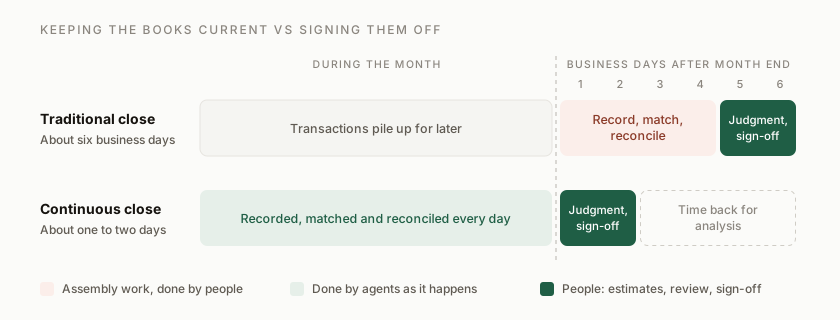
The median company still takes about six business days to close, according to APQC benchmarks, and the best performers four to five. Gartner predicts that finance teams using cloud ERP systems with built-in AI will close 30% faster by 2028. When we talk about a zero-day close, we mean the first part, books current every day, with the second part shrunk to a day or two of real decisions. That is achievable now for many companies. A close with no judgment at all is not, and finance leaders should be wary of anyone who promises it.
What that looks like depends on the company's stage.
Early stage: start with books that are always current
Until recently, a startup hired an outside bookkeeper who kept cash-basis books, closed them three or four weeks after month end, and caught up before each funding round or tax deadline. The founder ran the real numbers in a spreadsheet. Moving to proper accrual accounting, the kind investors and auditors expect, was a project for later, usually around the Series B.
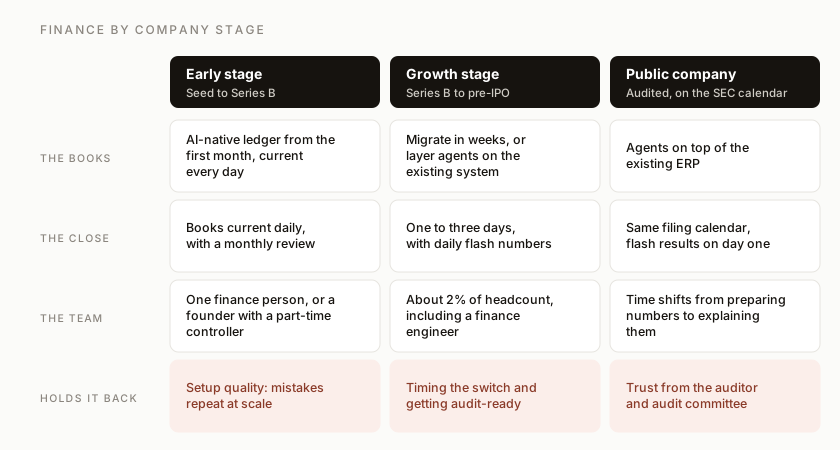
Today, a company with a handful of employees can run accrual books from its first month, current every day, without a full-time accountant. Agents categorize transactions, match them to invoices and receipts, reconcile bank and card accounts, chase missing receipts and build revenue schedules from signed contracts. The founder sees cash, burn and runway from live numbers rather than from a spreadsheet updated whenever someone remembers. The monthly investor update can be drafted from the books in minutes.
The team at this stage is often one finance person, or a founder with a part-time controller who reviews the month and makes the judgment calls. That person's job moves from data entry to setting things up correctly: the chart of accounts, the categorization rules, the revenue policy, the approval limits.
The main risk is that bad setup compounds silently. An agent that categorizes thousands of transactions a month will repeat a mistake thousands of times. Books that are always current still need a monthly review by someone who knows what the numbers should look like.
Growth stage: switch systems without a lost year
Somewhere between the Series B and the run-up to an IPO, the finance function hits several walls at once. A second legal entity, often abroad, brings a second currency and intercompany transactions. Contracts get more complex, with usage pricing, multi-year deals and bundles, which makes revenue recognition harder. The company has its first full audit. The board wants metrics every month that tie to the books. The entry-level accounting system stops coping.
The usual answer was a move to a mid-market ERP, a project that typically took six to twelve months, consumed the controller's attention and required a consultant. Then the company hired accountants in proportion to transaction volume. Finance teams have traditionally run at about 5% of company headcount.
The switch itself is much less painful. Migrating a ledger, with its history, sub-ledgers and attachments, has gone from a multi-quarter project to a matter of weeks, and some companies now skip it entirely by putting agents on top of the system they already have. Either way, a growth company can realistically:
- close in one to three days, with daily flash numbers in between;
- post most routine entries without a person touching them;
- run consolidation and intercompany matching continuously rather than at month end;
- produce board metrics from the same ledger the auditors test.
The leanest teams at this stage now target about 2% of headcount. The work changes shape as well as size. Fewer people do data entry and more do review, systems and analysis. Many growth-stage teams now have a finance engineer: an accountant or analyst who builds and maintains the automations the rest of the team relies on.
The decision that matters most is when to switch systems. Switching too late means the migration happens during audit preparation or an IPO process, when the team has no time. Switching too early wastes effort. The triggers worth watching are a second entity, a first full audit, revenue contracts that no longer fit a simple schedule, and transaction volume that the team handles only by working weekends.
Preparing to go public also belongs at this stage. Investors and auditors will expect controls that can be tested, and that is far easier to design in than to retrofit. An agent that posts entries needs the same things a person would: limited authority, a recorded approval for anything above a threshold, and a trail showing what it saw and why it acted. Companies that build that in at the growth stage arrive at their IPO with an audit trail already in place.
Public companies: earlier certainty inside a fixed calendar
A public company's finance function is defined by obligations that do not change with technology. Large companies must file their quarterly report within 40 days of quarter end and their annual report within 60. Management must assess internal controls over financial reporting each year, and for larger companies an outside auditor must attest to them as well. Auditing standards require the auditor to evaluate the reliability of information produced by the company's systems (AS 1105), and an agent's output is information produced by the company's systems.
Most large companies also run on established ERP systems, with years of customizations, integrations and tested controls built around them. Replacing that rarely makes sense. The realistic path is agents working on top of the existing ERP, and the ERP vendors have started shipping their own close agents too.
At this stage, the biggest gain is earlier certainty. Even a close that still takes four days can look very different:
- reconciliations, intercompany matching and variance explanations prepared continuously, so controllers start the close reviewing rather than assembling;
- flash results on the first business day, so leadership knows the quarter's shape weeks before the earnings call;
- fewer late adjustments, because problems surface during the month instead of at the end;
- audit evidence assembled as the work happens, linked to the transaction and the approval;
- controls tested continuously across every transaction, instead of on a sample once a quarter.
The headcount effect tends to be slower here than at a startup, because public companies carry review, compliance and reporting work that does not shrink with automation. The more useful measure is how much of the team's time moves from preparing numbers to explaining them.
Trust sets the pace. The finance team, the audit committee and the external auditor all have to be confident that numbers prepared by agents are as reliable as numbers prepared by people. That confidence comes from evidence over several quarters, which is why public companies should start sooner rather than later even though their gains arrive more slowly.
A roadmap for each stage
The steps differ by stage, but every company should start the same way.
Before anything else: measure where you are
Agree on what "closed" means at your company and measure the close as it runs today. Five numbers are enough:
- Days to close, from month end to sign-off, and separately, days until the books are current.
- Touchless rate: the share of entries posted without a person editing them.
- Exceptions: how many items need a person each month, and how long they stay open.
- Late adjustments: entries posted after the close that change reported numbers.
- Finance cost: finance headcount as a share of the company, and finance cost as a share of revenue.
Track them monthly. They show whether automation is working, and they are the numbers an auditor or board will ask about.
Early stage
- Choose a ledger that can grow with you. The cheapest migration is the one you never have to do. Pick a system that can handle accrual accounting, multiple entities and revenue schedules before you need them.
- Set up accrual books from the start, with a chart of accounts and categorization rules written down. Have a part-time controller review the setup before the agents run on it.
- Connect every account: bank, cards, payroll, billing and the contract repository. The agents are only as current as their inputs.
- Review monthly anyway. Thirty minutes with someone who knows what the numbers should look like catches the mistakes that compound.
- Run the investor update and runway forecast from the live books, so the board and the bank see the same numbers.
Growth stage
- Decide on systems before the triggers arrive. If a second entity, a first audit or an IPO is within eighteen months, plan the switch, or the layer of agents on top of your current system, now.
- Automate in order of how checkable the work is. Start with bank and card reconciliations, payment matching and intercompany, where the answer can be verified against a document. Move to accruals, flux commentary and revenue schedules once the first set is reliable.
- Hire or develop a finance engineer, someone who can maintain the automations, the rules and the integrations. This role pays for itself faster than another accountant.
- Design controls into the system now. Give agents limited authority, require recorded approval above set thresholds, and keep a trail of inputs, outputs and approvals. This is the work that makes an IPO feasible on schedule.
- Target a one-to-three-day close with daily flash numbers, and hold the team to the five measures above.
Public company
- Start with work that is checkable and close-adjacent: account reconciliations, intercompany, variance explanations and audit support. Avoid judgment-heavy areas such as reserves and complex revenue recognition until the controls are proven.
- Run in parallel for at least one quarter. Let agents prepare work alongside the existing process, compare results, and document the differences before relying on them.
- Bring the auditor in early. Walk them through how agent-prepared work is produced, reviewed and evidenced. An auditor who understands the design will test it; one who discovers it late will add procedures.
- Put controls around the agents themselves: who can change their instructions, how changes are tested and approved, what access each agent has, and how its output is reviewed. Treat a change to an agent like a change to any system that affects the financial statements.
- Aim for day-one flash results and fewer late adjustments first. Cut close days only after a few quarters of stable results, and report progress to the audit committee in the same five measures.
At every stage: plan one stage ahead
The moments that force change in finance are predictable: the first audit, the second entity, the decision to go public, the first year of auditor attestation. Each is far easier with a system and controls designed for it in advance. The companies that get the most from AI in finance will be the ones that build for the stage they are about to enter.
Fig works with finance teams at each of these stages to connect their systems, build the agents and put the controls in place.