What is a neolab?
Researchers are leaving OpenAI, DeepMind and Meta to start their own labs, and investors have given them more than $40 billion. Who they are, what they're betting on, and why businesses should watch.
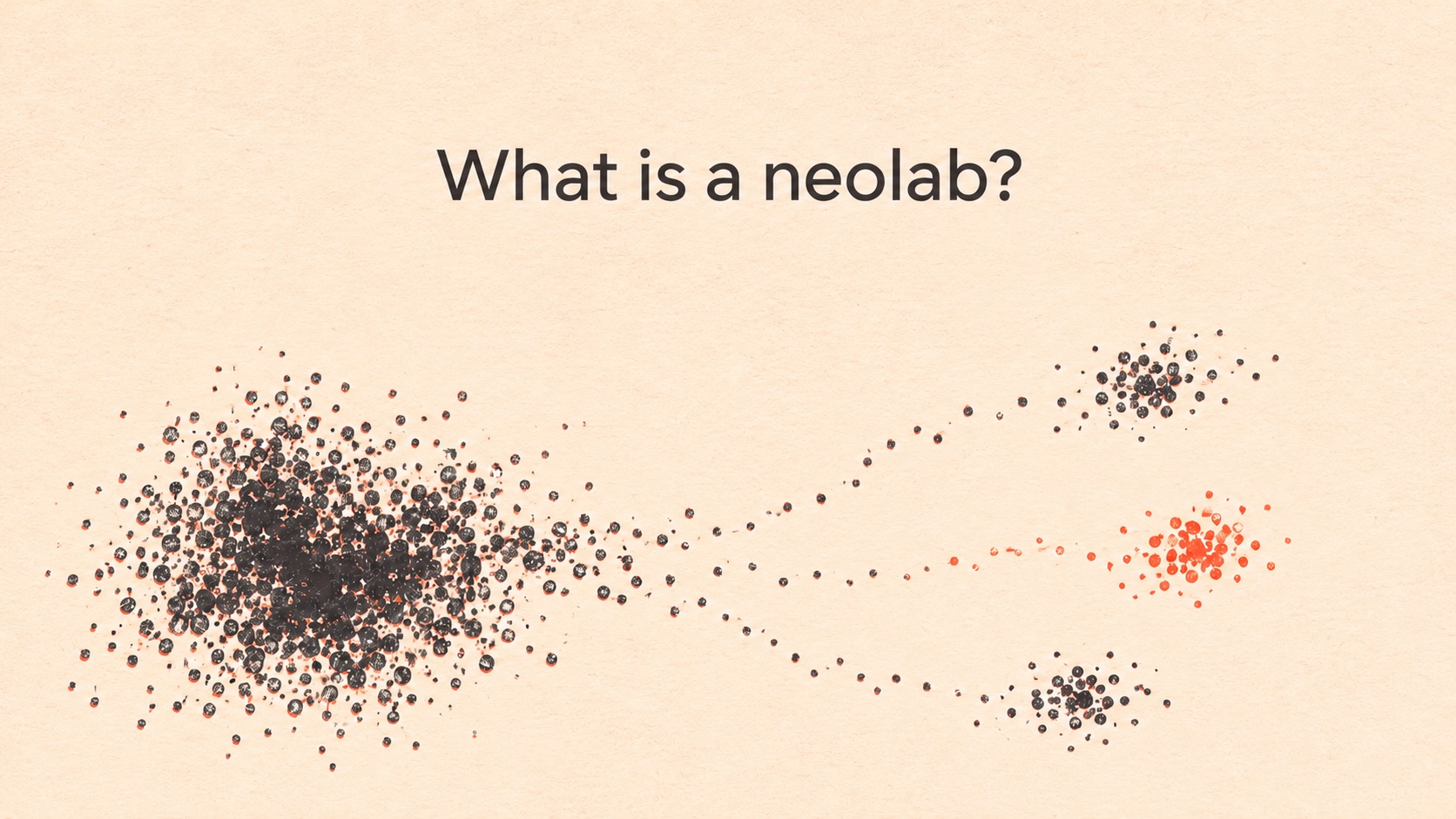
In shortA neolab is a research company started by people who left the big AI labs to pursue an idea of their own, funded at huge scale before it has a product. More than 40 had raised over $40 billion by June. Most sell nothing yet, but a few already supply the open models and training tools companies use to build their own AI.
Last week, reports said Thinking Machines Lab was about to close a $5 billion funding round at a $40 billion valuation, with Accel leading. The company is not two years old. Mira Murati, who was OpenAI's chief technology officer until late 2024, started it in February 2025, and its first product was Tinker, a service that lets other companies train their own versions of open AI models. Two days before the funding news, Cognition, the company behind the coding agent Devin, said its newest fast coding model, SWE-2 Flash, runs on a Thinking Machines model.
Thinking Machines is the best-known example of a neolab, a word that barely existed two years ago and now covers more than 40 companies. This post opens our four-part series on who trains AI models and why, starting with the labs, because a few of them are becoming suppliers to every company that wants a model of its own.
Where the word comes from
Most people date the neolab era to June 2024, when Ilya Sutskever, OpenAI's co-founder and former chief scientist, started Safe Superintelligence. Others followed from every large lab. David Silver, who led DeepMind's AlphaGo work, started Ineffable Intelligence. Yann LeCun left Meta in 2025 to start AMI Labs in Paris. Former DeepMind researchers built Reflection AI, and Jerry Tworek, a former OpenAI vice president of research, started Core Automation.
Radical Ventures, a venture firm that invests in AI labs, published the most-cited definition in June: "a startup focused on long-term technical breakthroughs, typically founded by research scientists and engineers from leading AI industrial or academic organizations." Most neolabs fit a pattern. The founders come from a frontier lab or a top research group, the company is built around a research idea they couldn't pursue at their old employer, and it raises money at a scale that used to be reserved for companies with revenue.
The labs that came before
The pattern is older than the word. Anthropic was started in 2021 by a group that left OpenAI over how AI should be built and made safe. By the standard definition it was a neolab, and it is now one of the two largest AI companies in the world. Mistral, founded in Paris in 2023 by researchers from DeepMind and Meta, and Cohere, founded in Toronto by former Google researchers, both became model companies with real revenue, largely by selling to governments and to enterprises that want models they can run themselves.
Most of the first wave ended differently. In March 2024, Microsoft agreed to pay Inflection AI about $650 million to license its models and hired its co-founders and most of its roughly 70 staff, leaving a smaller company behind. In June, Amazon hired Adept's founders and much of its team under a licensing agreement. In August, Google hired Character.AI's co-founders and licensed its technology. Windsurf, a coding-tool company more than a research lab, went the same way in July 2025, when Google paid about $2.4 billion to license Windsurf's technology and hire its chief executive, and Cognition bought the rest of the company days later.
These deals let a large company get a team and its technology without buying the company, so they didn't automatically trigger merger review. Investors got some money back, the researchers moved to a big lab, and the product usually faded.
The current neolabs have raised several times what that first wave did. Inflection had raised $1.3 billion before Microsoft's deal, so the payment came to about half of that. Safe Superintelligence has raised about $8 billion, and it is hard to see a license-and-hire deal returning that much. The second wave has to produce a business or a breakthrough.
Why researchers leave
The big labs pay their best researchers extraordinary amounts, with reported offers above $100 million for a few, and they have the most computing power, which is the scarcest input in AI research.
A big lab rarely lets a researcher choose the research. A frontier lab runs on a product calendar: the next model has to ship, and most of the compute goes to making it better along the path that already works. A researcher who thinks that path is missing something can argue for it internally and share compute with the flagship model, or raise money and run their own lab.
LeCun is the clearest example. He argued for years that language models alone would not reach human-level intelligence and that AI needs models of how the physical world works. AMI Labs is built around an architecture he proposed in 2022 for exactly that. Silver co-wrote an essay in 2025 arguing that the next era of AI would come from models learning through their own experience, the way AlphaGo learned by playing itself, more than from human data. He founded Ineffable Intelligence to test it.
The investors' side of the trade is simpler. A handful of people built the methods behind today's models, and a lab started by one of them is the closest thing to buying an option on the next method.
How much money
Counts vary with the definition. Radical counted more than 40 neolabs that had raised over $40 billion between June 2024 and June 2026. Dealroom, citing a separate and narrower Radical tally, put it at 29 labs and $23 billion in October. The Decoder sorted 45 of them by research bet in its Nov 6 survey, and Dealroom's own map of new AI labs founded since 2023 runs to 163.
The money also arrived fast. OpenAI and Anthropic together raised $5.3 billion in the seven years between OpenAI's founding and the launch of ChatGPT. According to Radical, the neolabs raised nearly five times that in just the two quarters before June, and eight of the 13 model makers in North America and Europe that have raised a billion-dollar round since the start of 2025 are neolabs.
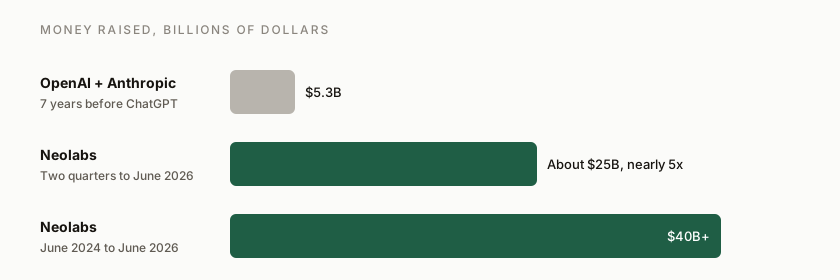
Radical's count stops in June, and the rounds since then have been larger still. Prometheus, which applies AI to science and engineering, raised $12 billion at a $41 billion valuation that month. NVIDIA agreed in July to invest $5 billion in Safe Superintelligence. Flapping Airplanes raised a $1 billion Series A in October. Thinking Machines was valued at about $12 billion when it raised its $2 billion seed round in July 2025, so the reported new round would more than triple that.
Much of the money goes straight back out the door, because Radical estimates that computing power is well over half of a neolab's spending. NVIDIA, which sells most of that computing power, has made 32 separate investments in startup model makers, according to Dealroom. Radical counts more than 40 neolab founders who came from DeepMind alone.
Ten neolabs at a glance
The table below covers ten of the best-known labs, with funding as reported and products as of November. Several of these rounds were never confirmed by the companies, and some figures differ between sources.
| Lab | Founders came from | Main bet | Reported funding | Shipped so far |
|---|---|---|---|---|
| Safe Superintelligence | OpenAI (Ilya Sutskever) | Safe general intelligence | About $8 billion | Nothing public |
| Thinking Machines | OpenAI (Mira Murati) | General intelligence, tools for training | $2 billion seed; about $5 billion reported in talks | Tinker, Inkling open model |
| Prometheus | Amazon, Google X | AI for science and engineering | $12 billion (June 2026) | Nothing public |
| Reflection AI | DeepMind | Open models trained with reinforcement learning | $2.5 billion (2026) | Beam open model |
| Ineffable Intelligence | DeepMind (David Silver) | Learning from experience | $1.1 billion seed | Nothing public |
| AMI Labs | Meta (Yann LeCun) | World models | $1.03 billion seed | Nothing public |
| World Labs | Stanford (Fei-Fei Li) | World models for 3D spaces | $1 billion (Feb 2026) | Marble, World API |
| Physical Intelligence | DeepMind, Berkeley, Stanford | Models for robots | About $1 billion (2026) | Open robot models |
| Periodic Labs | OpenAI, DeepMind | AI with physical labs for materials | Hundreds of millions | Not confirmed |
| Core Automation | OpenAI (Jerry Tworek) | Continual learning | $432 million | Nothing public |
Sources: The Decoder's Frontier Radar, Dealroom, VC Cafe and company announcements.
What they're betting on
Each neolab is built around a claim that the big labs are missing something. Grouped by that claim, most fall into a handful of camps.
Silver's Ineffable Intelligence and Reflection are betting that models should learn mainly by trying things and seeing what works, the method behind AlphaGo, more than by reading human text. Core Automation and Adaption Labs are working on models that keep learning from their own work after they ship, which the industry calls continual learning. The last post in this series covers how far that has gotten.
World Labs, AMI Labs, Physical Intelligence and Skild AI are building models of space, motion and objects, for robots and simulation. Periodic Labs, Lila Sciences and Prometheus pair models with physical laboratories to discover materials, drugs and chemicals, where the model proposes an experiment, a robot runs it and the result becomes training data.
Some are betting on a different design for the model itself. Inception Labs generates text with diffusion, the technique image generators use, which drafts a whole passage at once and refines it in place of writing one word at a time. Safe Superintelligence, Thinking Machines and humans& are chasing the same general intelligence as OpenAI and Anthropic, with smaller teams and their own methods.
Few products so far
Most neolabs don't sell anything. Dealroom found that fewer than 35% have released a commercial product, and only just over half have released any code. When VC Cafe looked at the ten best-funded in September, two had shipped a product: Thinking Machines and World Labs.
Part of that is by design, since these founders left labs that run on a product calendar and their investors are buying them time. Time costs money, though, and the forecasts are long. FutureSearch, a forecasting firm, expects three of the six best-funded neolabs to reach the top tier of model rankings no earlier than the mid-to-late 2030s, if at all.
Holding on to researchers is another strain. About a third of Thinking Machines' founding team has gone since it launched, and the big labs pay top researchers enough to win some of them back. And the money moves in a circle, with NVIDIA investing in the labs and the labs spending much of it on NVIDIA's chips.
How neolabs plan to make money
Thinking Machines sells tools built from its own research. It built Tinker to make its training methods available to other companies, and it is reported to have passed $100 million in annualized revenue. Customers include Bridgewater Associates, which used it to train a model that beat frontier models on its own financial tasks at a fraction of the cost, and Glean.
Reflection releases open models and sells the work around them. It gives away Beam's weights and sells to governments that want AI they control. It is building a sovereign AI data center in South Korea with the retailer Shinsegae and supplying the US Department of Energy, according to TechCrunch.
The science labs plan to sell or license what their models discover, such as new materials or drug candidates, which could be worth more than any software subscription and will take years to prove.
If these don't work, the first wave showed the fallback: a large company licenses the technology and hires the team.
Why businesses should watch them
Our read is that most neolabs should be judged like research institutes with a commercial option. A few will produce a breakthrough that changes what AI can do. Many will end up inside a larger company, and some will run out of money first. A business deciding what to build on should ask which neolabs ship things it can use.
A few already do. An open model is one whose weights, the trained model file itself, anyone can download, run on their own computers and train further. Thinking Machines' Inkling, the model under Cognition's SWE-2 Flash, and Reflection's Beam are both open models.
That makes these few labs useful well before their bigger bets pay off. Most of the open models companies build on today are Chinese, and US rules on them are tightening, as the next post covers. Until this year, a company that wanted a strong American open model had few to choose from. Thinking Machines, Reflection and NVIDIA's Nemotron family changed that.
The research bets will take longer. World models, AI that runs experiments and models that learn on the job are where the neolabs are spending most of their money, and they will reach companies gradually from 2027 on. Watching which labs have shipped anything is the simplest way to tell progress from a funding announcement.
What to take from it
Most of what neolabs are working on will take years to reach an enterprise, and some of it never will. The parts that have arrived, open models from American labs and services that train them on a company's own data, are already in use, and the rest of this series follows the companies using them.
- A neolab is a research company started by people who left the big labs, funded before it has a product. Anthropic was one before the word existed.
- More than 40 had raised over $40 billion by June, and the rounds since have been bigger.
- The first wave mostly ended in license-and-hire deals. The second has raised too much for that to be an easy way out.
- Fewer than 35% sell anything, so judge each one by what it has shipped.
- The labs releasing open models and training tools are the ones companies already depend on.
Next in the series: why application companies and enterprises want models of their own.