AI across a portfolio, sector by sector
The same technology lands differently in software, services, healthcare, defense, industrials and home services: different work, different constraints, and a different share of the gain the company keeps.

In shortA diversified portfolio cannot run one AI plan. In software the question is disruption as much as opportunity, after a year in which the software index fell 27 percent in a quarter. In professional services the prize is turning hours into products before an AI-native competitor does. In healthcare, defense and government services, regulation shapes both the architecture and how much of the gain the company keeps. In industrials and home services, speed to quote and capacity in the field are revenue levers hiding as operations projects. For each sector: where the value is, what constrains it, how durable the gain is likely to be, and a sensible first project.
A generalist fund might own a vertical software company, an accounting platform, a physician services group, a defense supplier, an industrial distributor and a home services roll-up at the same time. Each is being told the same thing about AI. Each should be doing something different.
The differences run along three lines. The work is different, so the use cases are. The constraints are different: regulation, data sensitivity and the physical world shape what is possible and how it has to be built. And, the line most often missed, the share of the gain the company actually keeps is different. That depends less on the technology than on market structure: how fast competitors will reach the same capability, and whether they will use it to cut price.
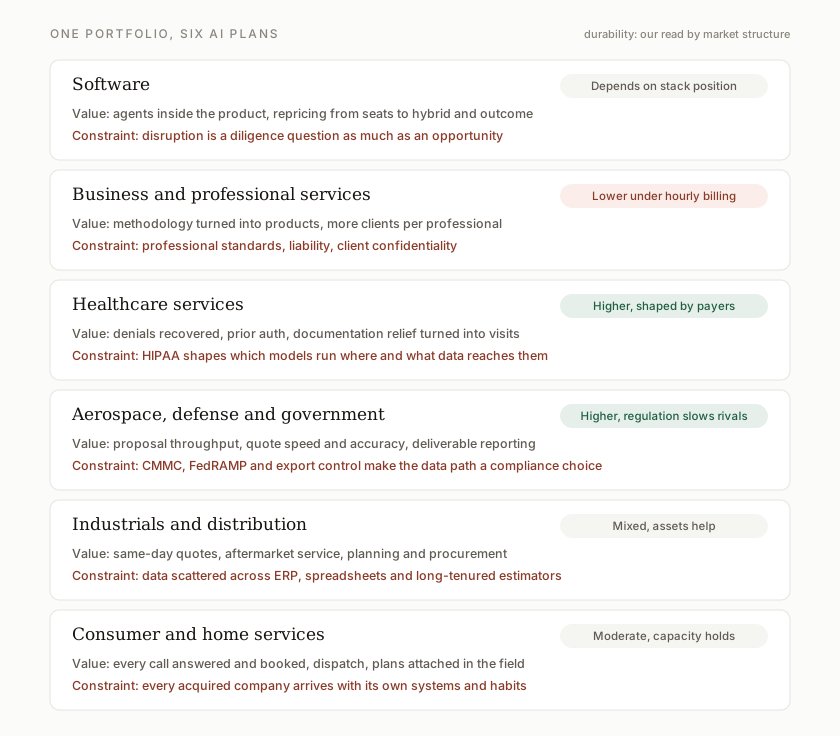
What follows is a sector-by-sector read. The durability column reflects our judgment about market structure, informed by BCG's 2026 work on who captures AI's value; it is a starting point for a deal team's own view, not a rating.
Software
Software is the one sector where AI is as much a question in diligence as an opportunity in ownership. The S&P 500 software index fell 27 percent between early January and late March. Tech deal value dropped roughly 70 percent from the fourth quarter of 2025 to the first quarter of 2026, as buyers struggled to price how AI would reprice software. Investors sought to pull more than 10 billion dollars from private credit funds over software exposure. Fitch's view is more measured than the market's: half of the software companies it rates are at low risk of AI disruption, and 9 percent at high risk.
The distinction that matters is position in the stack. Systems of record that hold data customers cannot easily move, and that sit underneath many workflows, are far more defensible than thin applications whose value is an interface over someone else's data. BCG's warning applies most sharply here: revenue and retention can look intact while an AI-native competitor takes the most profitable layer of the work.
Where the value is: agents inside the product that complete work customers used to staff, sold as add-ons or new tiers; repricing away from pure seats toward hybrid and outcome pricing; engineering and support productivity. First project: one agent that finishes a high-frequency customer job end to end, priced from day one. We go deeper on the pricing side in Beyond cost: AI as a revenue engine.
Business and professional services
Accounting, IT services, insurance brokerage, benefits administration and specialist consulting are where private equity's buy-and-build playbook and AI are colliding. Private equity has taken stakes in 11 of the 30 largest US accounting firms. Venture investors have joined in: General Catalyst has committed 1.5 billion dollars to buying and rebuilding services businesses on AI, and Thrive Holdings more than a billion, with OpenAI embedding engineers in its companies.
The work is the most automatable in any portfolio: document review, reconciliation, preparation, research and client correspondence. That is exactly why durability is the concern. If the firm bills by the hour, every hour AI removes is revenue it no longer charges, and competitors with the same tools will compete the price down.
Where the value is: turning methodology into products sold at a fixed price or per outcome; capacity pointed at more clients per professional rather than fewer professionals; and, for roll-ups, the integration cost per acquisition, which AI lowers by giving every add-on the same workflows and back office from the start. The constraint: professional standards, liability and client confidentiality, which require a clear line between what the system prepares and what a credentialed person signs. First project: one recurring engagement type rebuilt so the system prepares and the professional reviews, with pricing that captures the difference.
Healthcare services
Physician groups, specialty practices, home health and healthcare business services carry large administrative loads that sit between the clinician and the payment. Revenue cycle work, prior authorization, coding, denial management, scheduling, intake and clinical documentation are where AI earns its place.
The key is that much of this is revenue, not cost. A recovered denial is cash that would otherwise have been written off. Documentation relief that gives a clinician back an hour a day becomes more patients seen. Payer-set reimbursement also means savings are not passed through to patients as lower prices in the way they would be in an open market, although payer dynamics shape how long advantages last.
The constraint is HIPAA, and it is architectural rather than procedural. Every vendor that touches protected health information needs a business associate agreement, the minimum-necessary standard limits what each system sees, and clinical judgment stays with clinicians. Which models run where, and what data reaches them, has to be designed in rather than reviewed after. First project: denial prevention and appeals on the highest-volume payer, measured in cash collected.
Aerospace, defense and government services
Suppliers and contractors in these sectors run on documents: requests for quote, proposals, contract deliverables, compliance evidence and program reporting. A government services firm's growth is limited by how many solicitations its capture team can answer well. A defense supplier's win rate depends on how quickly and accurately it turns an RFQ into a quote that production can actually meet.
The constraint is the strongest in any portfolio, and it is also what makes the gains durable. The Pentagon's Cybersecurity Maturity Model Certification program entered its first phase in November 2025, and its second phase, which brings third-party assessments to many contracts involving controlled unclassified information, begins in November 2026. Cloud services sold to federal agencies need FedRAMP authorization. Export-controlled technical data cannot go wherever a model happens to be hosted. In this sector, the choice of model, where it runs and which data reaches it is a compliance decision first.
That friction slows competitors too, which is why BCG's framework predicts regulated markets keep more of the AI dividend for longer. Where the value is: proposal throughput and quality, quote speed and accuracy, and deliverable and reporting automation. First project: proposal or quote drafting from approved past material, with the data path documented well enough to survive an assessment. The case for owning that layer rather than renting it is made in the sovereign AI operating playbook.
Industrials, manufacturing and distribution
The value here hides inside operations projects. Quoting and configuration, demand planning, procurement, supplier follow-up, quality documentation and maintenance planning all look like cost programs. Several of them are revenue programs.
Speed to quote is the clearest. In industrial distribution and contract manufacturing, the supplier that answers a request for quote accurately the same day wins business the supplier answering next week never sees. Aftermarket parts and service, where the installed base is known and the data sits in the ERP, is often the highest-margin revenue a manufacturer has and among the least developed.
The constraint is data: product, customer and pricing information scattered across ERP, spreadsheets and the heads of long-tenured estimators, and a real separation between operational technology on the plant floor and corporate IT. Durability is mixed. Physical assets and deep integration with customers, both on BCG's list of durable advantages, protect margin; commodity products do not. First project: quote generation from the RFQ, drafted for an estimator's review, measured in turnaround and win rate.
Consumer and home services
HVAC, plumbing, electrical, pest control, landscaping and similar businesses have been private equity's favorite roll-ups, and the market is now consolidating the consolidators, as regional platforms are sold to larger funds. Most of these businesses share a problem that looks like operations and is actually revenue: calls that go unanswered become jobs that go to a competitor.
Where the value is: answering every call and booking the job, by voice or message; dispatch and scheduling; quoting from photos or site details; membership and maintenance plan attachment; and support for technicians in the field. The workforce is overwhelmingly deskless, which changes the interface entirely, a point we made in the deskless majority. The constraint is franchise and local variation: each acquired company arrives with its own systems and habits. Durability is moderate, since local competitors will adopt the same tools, but capacity and conversion gains hold better than pure cost savings. First project: after-hours and overflow call handling that books jobs directly into the scheduling system.
What travels across sectors
The use cases differ; the foundation does not. In every sector above, the first project needs the same things: clean definitions of the core objects, an owned layer of rules and precedent, a governed action boundary, and the freedom to use whichever model does each task best. Built once and deliberately, that foundation is what lets a fund carry the pattern from one company to the next, which is the subject of scaling AI across a portfolio.
Key takeaways
- One portfolio, several AI plans. The work, the constraints and the durability of the gain all differ by sector.
- In software, AI is a diligence question first. Position in the stack, not the product's AI features, decides exposure.
- In professional services, hourly billing turns AI productivity into lost revenue. Productize the methodology before a competitor does.
- In healthcare and defense, regulation shapes the architecture, and the same friction lets companies keep more of the gain for longer.
- In industrials and home services, speed to quote and answering every call are revenue levers that look like operations projects.
The question for each company is not what AI can do. It is which part of the gain that company will still own at exit.