The private equity AI playbook
What a fund should actually do with AI at each stage of an investment, from diligence through exit, and how to build AI EBITDA that survives the next buyer's diligence.

In shortWith holds near seven years, distributions below 15 percent of NAV for four straight years and most GPs expecting flat multiples, operating improvement is the lever left, and AI is the largest new source of it. The gap is scale: in FTI's 2026 survey, 36 percent of portfolio companies use AI across several use cases but only 7 percent have reached enterprise scale. This playbook walks the investment stage by stage: underwrite AI in both directions before you buy, set baselines and owners in the first 100 days, build toward revenue as well as cost during ownership, and assemble AI EBITDA that a buyer's quality-of-earnings team will actually underwrite at exit.
The arithmetic of private equity has quietly changed underneath every conversation about AI. Bain's 2026 report puts the average holding period at exit near seven years, up from five to six through most of the last decade, with almost 40 percent of companies now held longer than five years. Some 32,000 unsold companies worth 3.8 trillion dollars sit in portfolios. Distributions as a share of NAV have stayed below 15 percent for four years running, an industry record, and about 80 percent of GPs expect multiples to stay flat. When the exit is further away and the multiple will not do the work, EBITDA growth inside the company has to.
That is the real reason AI has moved from the technology agenda to the value creation plan. The question is no longer whether it works in a portfolio company. FTI's 2026 survey of 200 fund and operating leaders found that 95 percent of funds report their AI initiatives meeting or exceeding the original business case. The same survey found that only 7 percent of portfolio companies have reached enterprise-scale deployment, against 36 percent using AI across several use cases. The business cases are being met because they were scoped small. The value is in the gap between those two numbers.
This is a playbook for closing it, stage by stage, written for deal partners and operating partners who have already seen the pitch decks and want the mechanics.
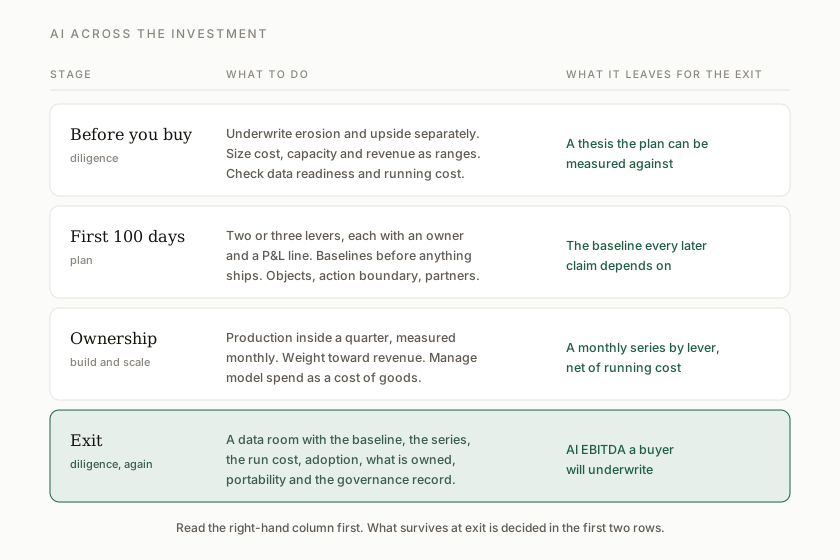
Before you buy: underwrite AI in both directions
Every deal team now asks some version of "is there an AI angle here." The useful version is two separate questions, answered separately, because they point in opposite directions.
Does AI erode this business? Where the company sits matters more than what it says about itself. A system of record that holds data customers cannot easily move sits very differently from a thin workflow tool whose value is a user interface over someone else's data. Revenue priced per seat, where the seat is a person doing work an agent can now do, is exposed in a way usage- or outcome-priced revenue is not. And market structure decides how much of any AI gain the company keeps, which we cover at length in Beyond cost: AI as a revenue engine.
What can AI add? Size it in three buckets, not one: cost (the same output for fewer hours), capacity (the same people producing more, which is revenue without headcount), and new revenue (AI features, new services, new pricing). Give each a range rather than a point estimate, and be honest about which bucket the thesis actually depends on.
Two diligence items get skipped more often than they should. The first is data readiness: whether the systems of record are clean enough that an agent acting on them will act on the right customer, order or claim, and whether the company's customer contracts permit the use of customer data the plan assumes. The second is execution economics: what it costs to build, what it costs to run, and how long until it pays. Running cost is new. Model usage is a variable cost that scales with volume in a way seat software never did, and a thesis that ignores it will be wrong at exactly the moment it succeeds.
The output of this stage is not an AI score. It is a short list that becomes the first page of the 100-day plan.
The first 100 days: levers, owners, baselines
The pattern that separates programs that scale from programs that demo is simple to state and routinely ignored: AI attaches to a value creation lever with an owner and a P&L line, never to a department or to "AI" as an initiative.
Pick two or three levers. Name the executive who owns each. Name the line on the income statement each is meant to move. Then do the thing almost nobody does in the first hundred days: set the baseline before anything ships. Cycle times, cost per transaction, win rates, quote turnaround, days sales outstanding, whatever the lever is measured by, captured for a representative period before the first workflow goes live. Without it, every later claim of impact is a story, and stories do not survive a quality-of-earnings review.
Three foundational decisions belong here rather than later:
Where the objects live. An agent that works across the CRM, the ERP and the ticketing system needs one definition of a customer, an order and a contract. Getting that right once is what makes the second and third workflows cheap. We describe the approach in what an ontology is for.
Where the line is drawn. Decide in writing what happens automatically, what happens after a person approves it, and what never happens without a person doing it. Consequential actions belong behind approval gates, and everything that happens belongs in an audit record. Buyers now ask for this.
What gets built, bought or partnered. The line runs through every layer rather than between them, which we argued in what to build and what to buy, and the partner decision has become more consequential this year for reasons covered in choosing an AI partner for your portfolio.
Ownership: build, measure, weight toward revenue
The first workflow should reach production inside a quarter and be measured against its baseline monthly from the day it does. Production means real volume with real consequences, not a pilot group using a tool on the side.
Three disciplines matter most during the hold.
Weight the plan toward revenue where competition will erode savings. Cost programs are easier to measure, which is why they dominate. But in competitive markets AI savings tend to be passed through to customers as prices fall across the industry, sometimes well inside a seven-year hold. New revenue built on what only the company has does not erode the same way. FTI found revenue acceleration is now the top AI priority for 41 percent of fund and operating leaders; most value creation plans have not caught up with that intent.
Manage model spend as a cost of goods. Routing each task to the model that does it well at the lowest cost is a margin lever, not a technical preference. Prices move fast and in both directions across labs, and a company locked to one model pays whatever that model costs next year. Auto routing exists for this reason.
Plan for the people who will run it. Talent is the single largest constraint on scaling AI in portfolios, cited by 35 percent of FTI's respondents. A system that only its builders can operate is a liability the day they leave. Build-operate-transfer, with a named internal owner and a trained team, is the only model that holds over a multi-year hold. Scaling that across many companies is its own discipline, covered in scaling AI across a portfolio.
Exit: build AI EBITDA a buyer will pay for
This is the stage that should shape the other four, and the one most programs think about last.
A buyer's quality-of-earnings team exists to take the seller's EBITDA apart. Sellers present adjustments and add-backs; the provider tests each one for whether it is real, traceable and recurring, and a meaningful share of every list does not survive. AI savings will be tested the same way, and they are unusually easy to challenge: the headcount that was "avoided" rather than removed, the efficiency claimed on a process nobody measured beforehand, the run-rate saving extrapolated from three good months.
The arithmetic is unforgiving. At a 10x multiple, every million dollars of EBITDA a buyer declines to underwrite removes ten million dollars from the price.
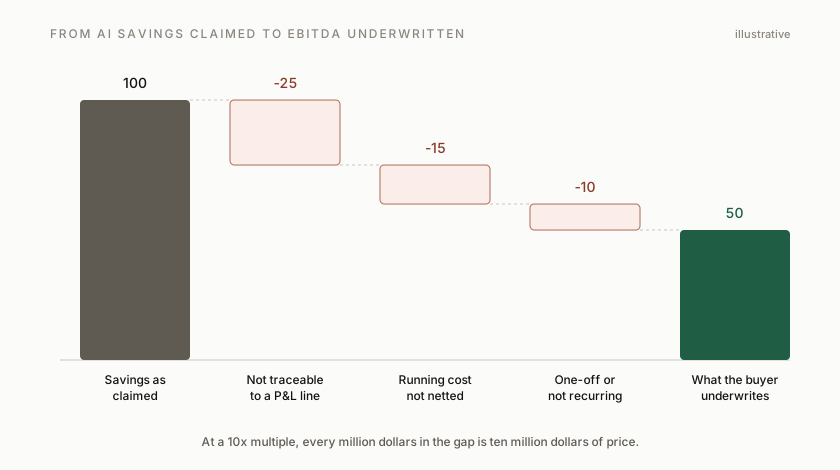
What survives is what was built to survive. The data room for an AI program should contain, at minimum:
- The baseline and the method: what was measured, over what period, before anything shipped.
- A monthly series by lever: impact tied to specific income-statement lines, over enough months to show it recurs.
- The full run cost: model usage, vendors, and the people who operate the system, netted against the gain rather than left for the buyer to discover.
- Evidence of adoption: volumes, not licenses.
- What is owned and what is contracted: which workflows, rules, evaluations and integrations belong to the company, and which exist only inside a vendor's environment.
- Portability: whether the system runs on another model, and what happens to it under a change of control.
- The governance record: approvals, audit trail, incidents and how they were handled.
The last three are where AI programs most often lose value at exit, and they are decided at the beginning, not the end. A capability that is really a vendor contract with a change-of-control clause will be priced as a risk. A capability that the company owns, that runs on whichever model is best next year, and that the buyer can inspect is priced as an asset.
Revenue helps here too. New AI products with their own revenue lines, customers and growth rates are easier to value, and easier to put a growth multiple on, than cost savings of any quality.
What limited partners are listening for
The same evidence serves a second audience. McKinsey's 2026 private markets research found 53 percent of 300 LPs rank a GP's value creation strategy among their top five manager-selection criteria. Gen II's 2026 technology survey found LPs care considerably more about operational outcomes than about AI adoption as such. A portfolio AI program is a fundraising asset only when it is evidenced the way a buyer would evidence it. Built that way, the same data room serves the exit and the next fund.
Key takeaways
- Diligence should ask two separate questions: whether AI erodes the business, and what AI can add in cost, capacity and new revenue. Running cost belongs in the model from the start.
- Set baselines before the first workflow ships. Every later claim of impact depends on them, and a quality-of-earnings team will not accept a reconstructed one.
- Weight the plan toward revenue wherever competition is likely to pass cost savings through to customers before exit.
- What the company owns, and whether it runs on more than one model, is decided in the first hundred days and priced at exit.
- The evidence a buyer needs and the evidence an LP wants are the same evidence. Build it once.
The fund that wins on AI will not be the one with the most pilots. It will be the one whose AI EBITDA is still standing after the buyer's diligence.