Beyond cost: AI as a revenue engine
Most portfolio AI plans are cost plans. The larger and more durable opportunity is revenue: capacity that turns into growth, new AI products and services, and new ways to price.

In shortAI creates value in three ways: lower cost, more capacity from the same people, and new revenue from AI products, services and pricing. Most value creation plans book almost everything as cost, because cost is easy to measure. But cost savings are the part competitors can copy: BCG finds AI capability converges to parity within two to three years, and in competitive markets the gain passes through to customers as prices fall. Revenue built on what only the company has, its data, its expertise and its place in the customer's workflow, compounds instead. The plan should lean toward revenue exactly where competition will erode the savings.
Ask an operating partner what AI did for a portfolio company last year and the answer is almost always a cost number. Hours taken out of the monthly close. Tickets handled without an agent. Invoices processed without a clerk. There are good reasons for this. Cost is measurable within a quarter, it flows straight into an EBITDA bridge, and it does not depend on customers doing anything differently.
The intent has already moved. In FTI's 2026 survey of fund and operating leaders, revenue acceleration was the top AI priority for 41 percent of respondents. Most value creation plans have not moved with it, and the gap matters more than it looks, because cost savings and revenue behave very differently over a seven-year hold.
This piece argues for rebalancing: what the three sources of AI value actually are, why the cost one is the least durable, and where new revenue in a portfolio company actually comes from.
Three sources of value, not one
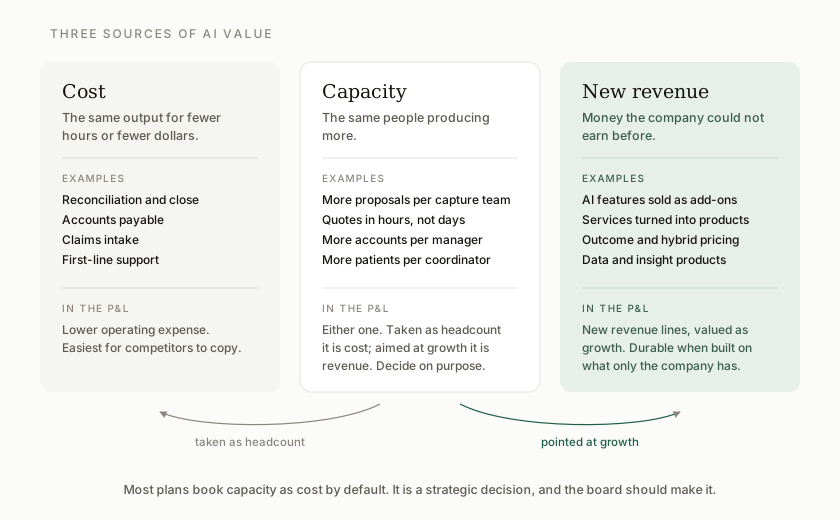
Cost is the same output for fewer hours or fewer dollars. Reconciliation, accounts payable, claims intake, first-line support, document review. It shows up as lower operating expense and it is where almost every program starts.
Capacity is the same people producing more. A business development team that can respond to three times as many solicitations. An estimator who turns quotes in hours rather than days. An account manager covering twice the book. A care coordinator handling more patients because documentation no longer eats the afternoon. Capacity is the most under-appreciated category, because it can be booked either way. Take the capacity as headcount reduction and it is a cost saving. Point it at more bids, more quotes and more accounts and it is revenue without a matching increase in cost. The decision between the two is a strategic one, and most plans make it by default rather than on purpose.
New revenue is money the company could not earn before. AI features sold as paid add-ons. Entirely new products. Services that turn a firm's expertise into something that runs without an hour of labor behind every unit. New pricing that captures more of the value delivered. This is the category with the most upside and the least attention.
Why cost savings do not stay
The case for weighting toward revenue is not that cost programs fail. It is that their gains are the easiest for competitors to copy, and in many markets the copying hands the gain to customers.
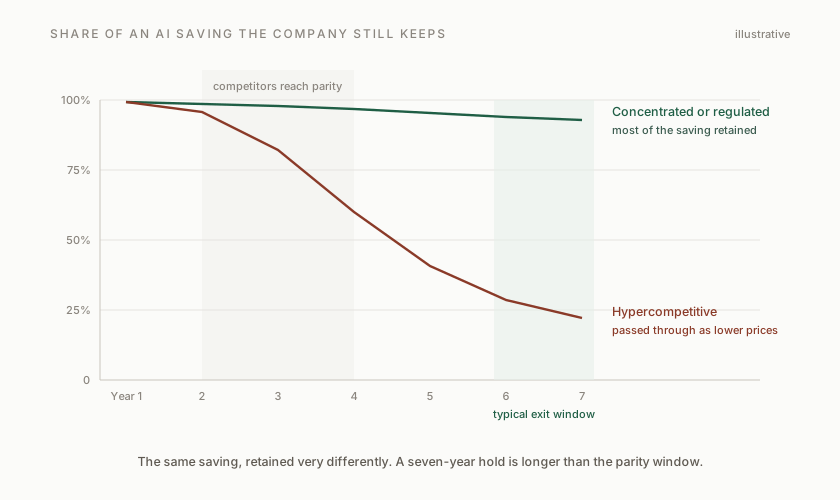
BCG's 2026 analysis of who captures AI's value makes the mechanism explicit. The technology itself converges to parity within two to three years; once every competitor has access to the same capability, the advantage it conferred is gone. What happens to the savings then depends on market structure. In hypercompetitive markets, BCG finds, almost all of the AI dividend passes through to customers within a handful of years, as competitors use their own savings to cut prices. Where markets are concentrated or regulated, companies keep more of it for longer.
For a private equity owner, the timing is what matters. A seven-year hold is longer than the parity window. A cost-out thesis in a competitive market can deliver real EBITDA in years two and three and give much of it back through pricing by years five and six, which is exactly when the exit is being prepared.
BCG also names a more dangerous pattern: revenue, share and retention that all look intact while margin and pricing power drain away, as AI-native competitors take the most profitable layer of the work. A company can pass every customer metric in the board pack while being hollowed out.
The durable advantages BCG identifies are the ones that deepen with use: proprietary flow data, trusted relationships, deep integration into the customer's systems, network scale and scarce physical assets. Those are also, not by coincidence, the raw materials of new revenue.
Where new revenue actually comes from
In practice it comes from four places, and they look different in software, services and industrial businesses.
AI products and features inside software companies. The most direct route, and the one with the clearest evidence at scale: Hg reports more than a hundred AI products launched across its portfolio and generating growing revenue. The shape that works is an agent that completes a job the customer used to staff, sold as an add-on or a new tier, rather than a chat box bolted onto the existing interface.
New pricing. AI is breaking the seat. When an agent does the work of several users, per-seat pricing shrinks the invoice at precisely the moment the product delivers more value. The market is already moving: one 2026 study of software companies found seat-based pricing fell from 21 percent to 15 percent in a year, while hybrid models rose from 27 percent to 41 percent. Outcome pricing, where the customer pays per result, has gone mainstream in customer service, with major vendors charging per resolved conversation; Deloitte published revenue-recognition guidance for outcome-based agentic pricing in June, which is a reliable sign a practice has arrived. For a portfolio software company, repricing is both defensive and offensive: it protects revenue from seat compression and captures value the old model left on the table.
Services that become products. This is the largest and least exploited opportunity in services portfolios. Buyers of AI have so far mostly spent from software budgets; the next and much larger pool is services spend. A services firm that encodes its methodology, its judgment and its precedent into a system that delivers a defined outcome can sell that outcome at a fixed price, with margins that do not depend on the hours behind it. If it does not, an AI-native entrant will make the same offer to its clients.
Capacity pointed at growth. The least glamorous and often the fastest. A government services contractor that doubles proposal throughput without doubling its capture team. An industrial distributor that answers every request for quote the same day. A home services business that stops losing jobs to missed calls. None of these require a new product, only a decision to spend the capacity on growth rather than on headcount.
What makes revenue durable
The same qualities that let a company keep margin make its new revenue hard to copy. An AI product built on a general-purpose model and public information can be replicated by any competitor with the same model in a quarter. One built on the company's own data, its codified expertise and its position inside the customer's workflow cannot.
That has two practical consequences for how the capability is built.
The proprietary layer has to belong to the company. The objects, rules, precedent, evaluations and integrations that make the product work are the asset. If they live inside a vendor's environment, the company has built someone else's moat, and a future buyer will notice. We have written about why ownership is the foundation of durable AI in the sovereign frontier enterprise.
Unit economics depend on model choice. Unlike seat software, an AI product carries a variable inference cost on every unit sold. Gross margin depends on routing each task to the model that does it well at the lowest cost, and on being free to move when prices change, which they do quarterly. A product tied to one model's price list has handed its margin to that model's provider. This is why model-agnostic routing is a commercial question as much as a technical one, and why post-training a smaller model on the company's own data sometimes pays, as we discussed in should I train my own model.
Putting revenue into the value creation plan
Revenue bets are harder to underwrite than cost programs, which is why they get crowded out. A few practices make them tractable.
Run one revenue bet alongside the cost levers from the start. Not after the cost program is done. The capability it needs, clean objects, owned rules, a governed agent, is largely the same.
Decide capacity deliberately. For every capacity gain, write down whether it is being taken as cost or pointed at growth, and why. Make it a board decision rather than a default.
Size revenue bets as options. A small, bounded first release to a set of existing customers, with a price, a target attach rate and a date to decide. Kill quickly or fund properly.
Measure attach and retention, not launch. A shipped AI feature nobody pays for is a cost. The metric is paid adoption and whether it holds.
Test pricing early. Outcome and hybrid pricing change revenue recognition, forecasting and sales compensation. Those are solvable, but not in the quarter before exit.
At exit, the payoff is asymmetric. Cost savings of any quality are valued once, at the multiple, and only if they survive diligence, which we cover in the private equity AI playbook. A new revenue line with its own customers and growth rate is valued as growth. Which sectors favor which approach is mapped in AI across a portfolio, sector by sector.
Key takeaways
- AI creates value three ways: cost, capacity and new revenue. Capacity can be taken as either cost or growth, and most plans decide by default rather than deliberately.
- In competitive markets, AI cost savings tend to pass through to customers once competitors reach parity, a window BCG puts at two to three years. That is shorter than most holds.
- New revenue comes from AI products, new pricing, services turned into products, and capacity pointed at growth. Services budgets, not software budgets, are the larger pool.
- Revenue built on the company's own data, expertise and workflow position is durable; revenue built on a general model and public information is copied within a quarter.
- AI products carry inference cost on every unit. Model choice and routing are gross-margin levers, not technical preferences.
Cost is the half of AI that everyone can copy. Revenue is the half that compounds.