Your advantage is already on campus
Access to capable AI is now ordinary, which moves the question from what an institution can buy to what it already has. Four things a university holds that nobody can copy, and how each becomes a system.

In shortWhen every institution can buy the same models, the models stop being the differentiator and what you already have starts being the whole game. A university holds four things nobody can replicate: the expertise of its people, the way work actually moves there, the precedent behind its decisions, and its record of what worked. None of those are currently in a form software can use. Turning them into a layer the institution owns is what makes the second project cheaper than the first, and the four contract and design choices that decide whether you keep it are worth getting right at the start.
Two years ago, having access to a frontier model was itself a position. Today an institution can license capable models on a Tuesday, and so can every peer it competes with for students, faculty and philanthropy. Campus-wide agreements have become routine rather than newsworthy.
That is genuinely good news, and not only because of the price. It moves the question. When everyone can buy the same capability, the capability stops being the thing that separates institutions, and what an institution already has starts being the whole game.
Universities are unusually well supplied here. A university is an accumulation of judgment: people who have made the same kind of decision several thousand times and got better at it, ways of working refined over decades, and an institutional memory of what happened when things were tried. None of that is purchasable. Most of it is also, at the moment, in a form no software can use, which is the actual opportunity.
What is genuinely rare
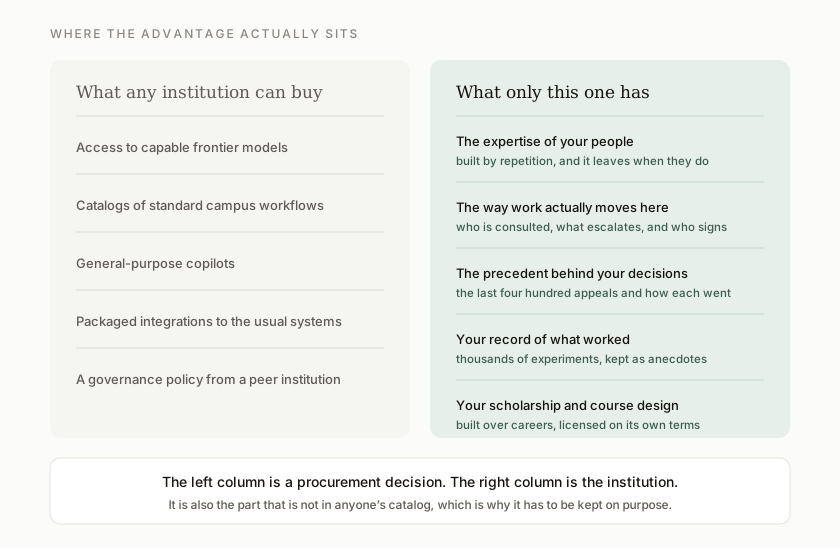
The expertise of your people. The registrar who knows which substitutions have been approved and why. The financial aid director who can look at a family's circumstances and tell you in ninety seconds what will actually change the decision. The department chair who recognizes a transcript pattern. This is real expertise, built by repetition, and it currently exists only in the people holding it, which means it leaves when they do.
The way work actually moves here. Not the process map from the last consulting engagement. The real sequence: who gets consulted before the exception is approved, what triggers the escalation, which hold clears which way, who signs. Every institution has its own, they differ more than anyone expects, and they are almost never written down in full.
The precedent behind your decisions. The last four hundred appeals and how they went. The substitutions granted and refused. This is the material that makes decisions consistent and defensible, and at most institutions it lives in email and in memory.
Your record of what worked. An institution that has run student success work for twenty years has conducted thousands of natural experiments: which interventions helped which students, which outreach mattered and at what point in the term, which aid adjustments changed an outcome. Almost everywhere, the results are retained as anecdotes and institutional lore rather than as something a system can read.
How each of those becomes a system
This is the part that is usually skipped, and it is the part that actually produces the advantage. Having rare material is not the same as having it in a usable form.
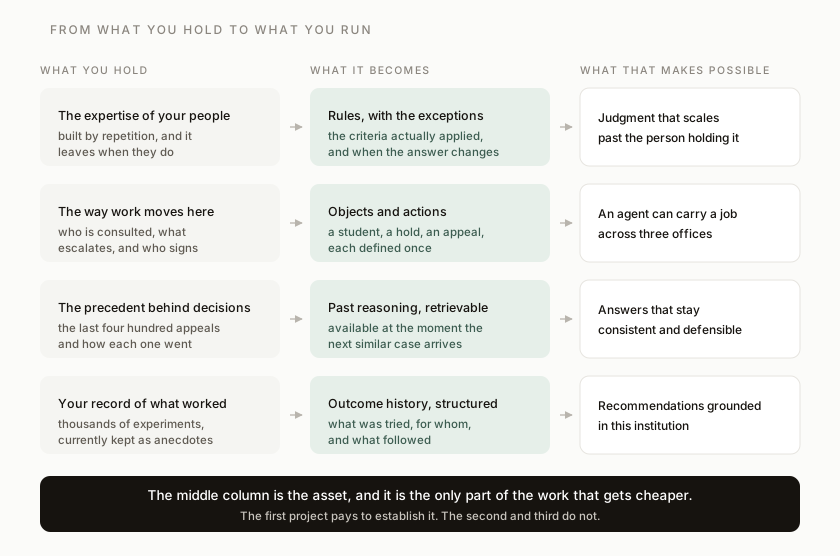
Expertise becomes rules, including the exceptions. The point is not to replace the registrar's judgment but to capture its shape: the criteria actually applied, the conditions under which the answer changes, the cases that always go to a person. Written down, that judgment scales past the person holding it and survives their retirement. Done well, this is the single most valuable week of work in a transformation, and institutions consistently report that the exercise is worth doing on its own merits.
Workflows become objects and actions. A student, a program, a term, a hold, an appeal, a credential, each defined once, with the actions that can be taken on them and who may take them. This is the layer that lets an agent carry a job across three offices instead of answering a question in one. It is also what makes the institution's processes legible to itself, which is why the ontology is the foundation rather than a by-product.
Precedent becomes retrievable. Past decisions, with their reasoning, available at the moment the next similar decision is being made. Consistency stops depending on whether the person who remembers is in the room.
Outcome history becomes structured evidence. What was tried, for whom, and what followed, in a form that can be queried. This is what separates a recommendation grounded in what works at this institution from one grounded in what works on average somewhere else, and it is what the new federal reporting will shortly require anyway.
Why this compounds
The practical reason to build this layer rather than buying point solutions is that it is the only part of the work that gets cheaper.
A point solution for transfer credit solves transfer credit. The objects, permissions, decision rules and audit trail assembled while solving transfer credit are the same ones an accreditation-evidence project needs, and an advising project, and a program review. The first project carries the cost of establishing them. The second does not. Institutions that choose the first project for visibility end up with a pilot that is hard to extend. Institutions that choose it for what it leaves behind find that year two costs a fraction of year one. The area-by-area version of where those projects sit is in where AI helps across a university.
This is also the honest answer to why AI programs stall on campuses that have done everything else right. It is rarely the model. It is that each new use case starts from zero, because nothing durable was built the first time.
Keeping what you build
Which raises the question of who holds the layer once it exists, and it is worth being deliberate rather than discovering the answer later.
The industry is consolidating in a direction that makes this live. Student information systems, ERPs and the agent layers on top of them are increasingly the same vendor, with prepackaged workflow catalogs numbering in the thousands. Standardized workflows are worth buying, and most administrative work on a campus is not distinctive and should not be. But a catalog of standard workflows is, by construction, a description of the ways in which every institution is the same. The part of your institution that is not in the catalog is the part described above, and it should not become a customization request against someone else's roadmap.
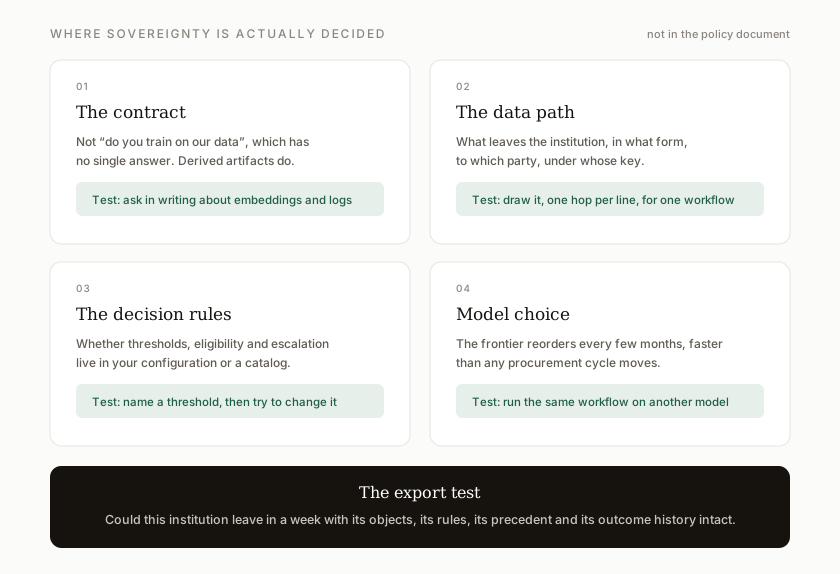
The contract. Ask about derived artifacts specifically, not about training in general: embeddings, indexes, caches, evaluation sets, and logs retained for abuse monitoring. Ask what deletion means on termination and whether it reaches them. Ask for the subprocessor list and notice on change. FERPA's school official exception carries real conditions, and more than 130 state student privacy statutes now sit alongside it.
The data path. What leaves the institution, in what form, to which party. Draw it, one hop per line, for one real workflow. The exercise routinely finds a hop nobody knew about.
The decision rules. Whether your thresholds, eligibility criteria and escalation paths live in configuration you control. Name one and find out what it takes to change it. If the answer is a support ticket and a release cycle, the rule is not yours, whatever the contract says about data ownership.
Model choice. Whether you can move to a different model next quarter without rebuilding, and run different work on different models. The frontier reorders itself every few months and reprices faster than any procurement cycle. We keep that choice open as a platform property in Model Hub, for the same reason we argue against betting an institution on one lab in should I train my own model.
Underneath all four is one test: could the institution leave in a week, taking its objects, its rules, its precedent and its outcome history, in a form that works somewhere else. Not whether it would.
What this does not mean
It is not an argument for running models on campus hardware. For most workloads the security case is weaker than it sounds.
It is not a case for training your own model as a first move. That is a real option in specific circumstances and rarely the place to start.
And it is not an argument against commercial platforms or standardized workflows. Standard work should run on standard software. The argument is narrower: the layer that encodes how your institution decides things, and the record of what those decisions produced, should be yours, legible to your own people, and portable.
One reason this lands differently in higher education
Every sector has a version of this argument, and we have made the general one in the sovereign frontier enterprise. It is sharper on a campus for a reason that has nothing to do with compliance.
A university is an institution whose central commitment is knowing how it knows things. Provenance, method, and the traceability of a claim back to its evidence are the disciplinary norms the place is built on. A system that produces a recommendation about a student, a number in a board report, or an assertion in a self-study, and cannot show its reasoning or its source, sits badly inside that commitment whether or not a regulation is implicated.
Which makes the audit trail something other than overhead. It is what lets a dean defend a decision to a faculty committee, a registrar answer a student a year later, and a provost put a number in front of a board and say exactly where it came from. That is the standard the institution already applies to its scholarship. Applying it to how the institution runs is the work, and it is what an AI transformation with colleges and universities is actually for.
Key takeaways
- When every institution can license the same models, the differentiator moves to what an institution already has. Universities are unusually rich in exactly that material and unusually poor at having it in a usable form.
- The most valuable week of a transformation is often the one spent writing down the rules and their exceptions, and institutions report it is worth doing regardless of what software follows.
- Outcome history is the asset that makes a recommendation yours rather than generic. Twenty years of natural experiments retained as anecdotes cannot inform anything.
- The reason to build the shared layer is compounding: the second project should cost a fraction of the first, and if it does not, nothing durable was built the first time.
- If changing a threshold requires a support ticket, that decision rule belongs to a vendor, whatever the contract says about who owns the data.
The advantage was never going to be the model. It is the thing your institution spent decades accumulating, finally in a form it can use.