Meet the work where it happens
Fig is not religious about form factor. Slack or Teams, the mobile app or WhatsApp, desktop or web: the AI fits how your organization operates.
In shortMost enterprise AI arrives as a form factor the organization has to bend around: a teammate that lives only in one chat tool, a single app that asks all work to move inside it, an assistant bound to one office suite. Organizations are not shaped like that. Some run in Slack or Teams, some are many small teams each running their own agents, some are in the field or spread across countries where messaging is the workplace. Fig runs the same agent, with the same identity, context, policy, and record, on whichever surfaces fit how a company actually operates.
Ask how an enterprise AI product wants to be used and the answer is usually a form factor. A teammate you tag in one chat tool. A single application that pulls documents, code, and workflows inside it and asks you to live there. An assistant that exists inside one office suite and nowhere else. Each is a good answer for the organizations that happen to be shaped like it, and a bad answer for everyone else, because the product has decided in advance where work happens.
Organizations are not shaped like products. A company that runs on Slack and a company whose sales force lives in WhatsApp are not the same company, and a dispatch operation with three hundred people in vehicles is not either of them. Fig starts from the other end. We are not religious about the form factor. We are religious about the fit: the AI should sit where the organization's work already is, and it should be the same governed agent in every one of those places.
This post is about what that looks like in practice: the shapes organizations actually come in, which surface fits each, and what stays constant no matter which surfaces a company chooses.
Four shapes an organization can take
There are more than four, but these cover most of the enterprises we work with, and each one points at a different primary surface.
The workspace-centric organization. Work happens in channels. Decisions get made in threads, in the presence of the people who have to live with them, and a document that is not linked from the channel does not exist. For these companies the AI belongs in the channel as a teammate. Fig Team joins the workspace, is mentioned like a colleague, and researches, plans, builds, and reports back into the thread where everyone can see and correct the work. Slack today, Microsoft Teams next, so the same teammate is available to organizations that run on either.
The federation of small teams. Some companies are many small units working with a lot of autonomy: pods, practices, regional teams, a research group. Here the natural unit is not the channel but the person or the small team, and the right pattern is an individual operating a team of agents: a Super Agent that takes a whole job and orchestrates the specialists beneath it, run from the desktop or the web app, reporting to whoever the team reports to. The organization gets consistency from the shared platform, policy, and context, not from forcing every pod into one chat tool.
The field and dispatch organization. Technicians, inspectors, drivers, site managers, sales reps on the road. Work appears as a photo, a voice note, a two-line message, and the person who needs the result is not at a desk. For these companies the primary surface is mobile, and mobile comes in two forms. The Fig app on iOS and Android is the whole platform in a pocket: capture the request, hand it off, review a checkpoint, approve from anywhere. And messaging, where the work already happens: send the photo to Fig on WhatsApp or Telegram and get the finished work back in the same thread. The app is the custom surface; messaging is the surface the team already lives in, with the AI reachable inside it.
The international organization. In much of the world WhatsApp is the workplace. Suppliers, distributors, regional offices, and customers are all in the same app, and a chat tool the head office chose is a foreign country. For these companies messaging is not a mobile convenience, it is the primary surface, and the AI has to live there as a first-class participant with the same permissions and the same audit trail as it has anywhere else.
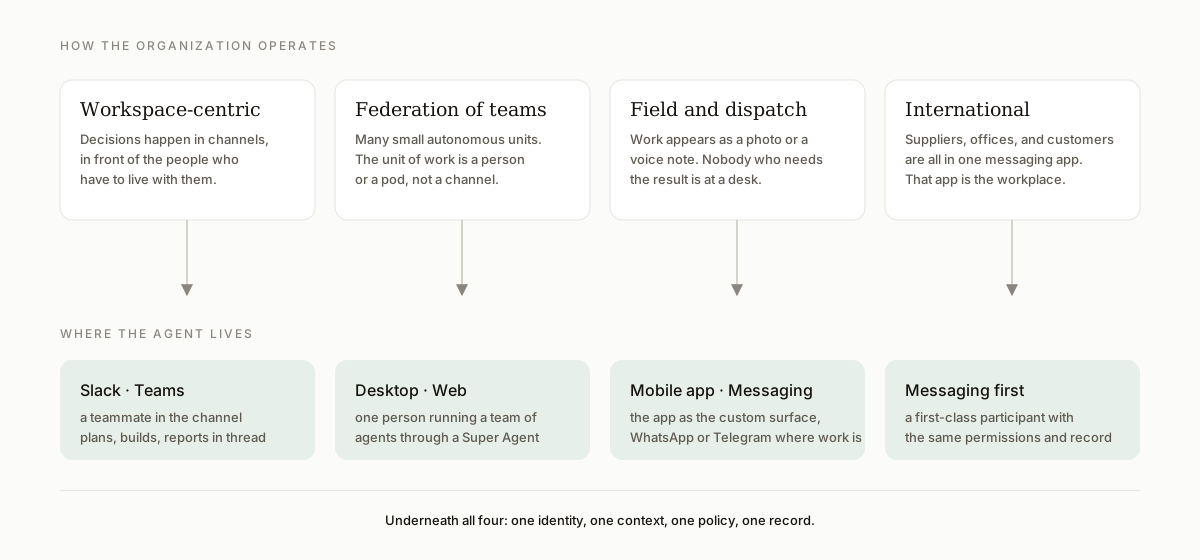
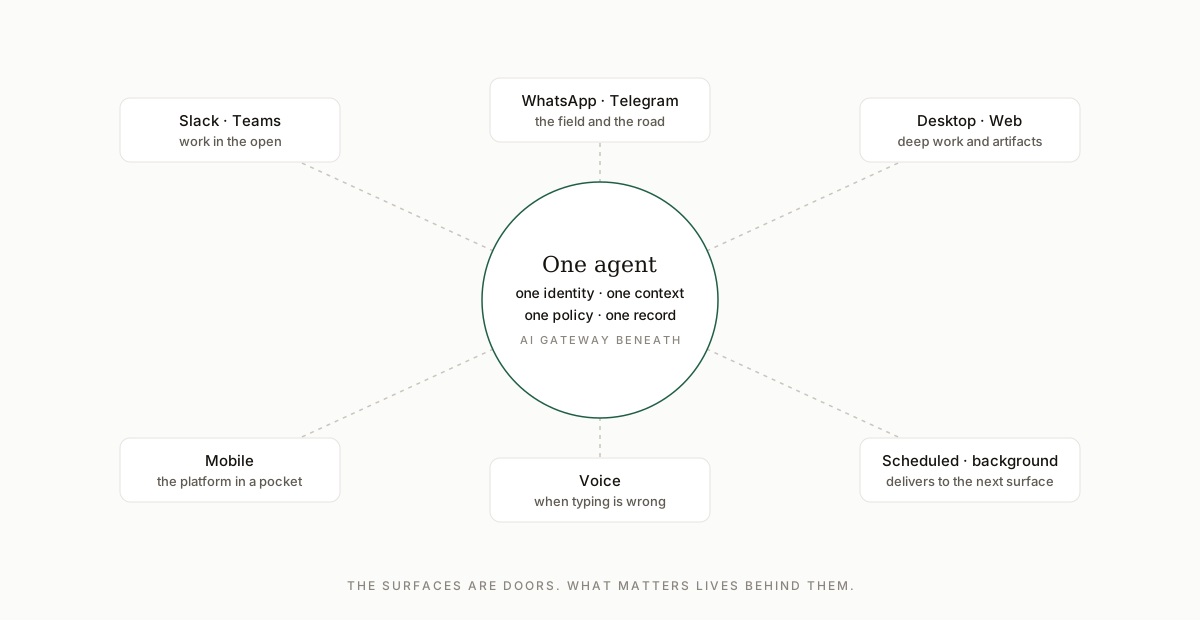
Most companies are a combination. The head office runs in Slack, the field runs on WhatsApp, finance does deep work on the desktop, and an executive approves things from a phone in a taxi. A product that has picked one surface forces everyone else to adapt or go without. A platform that runs the same agent on all of them lets each part of the company keep working the way it already does.
What stays the same on every surface
Being available in many places is easy. Being the same agent in all of them is the engineering problem, and it comes down to five things that must not change with the surface.
One identity. The agent acts as you, with your permissions, whether you reach it from Slack, from your phone, or from the desktop. In a channel it answers with what the people in that channel are allowed to see, which is a narrower question than what you personally can see, and it has to get that right every time.
One context. The project you were working on at your desk is the project the agent is talking about when you message it from the airport. Preferences, prior decisions, open questions, and the files in play travel with the person, which is what Enterprise Context is for.
One set of connectors. The systems the agent can read and act in are the same everywhere, with source permissions intact. An agent that can update the CRM from the desktop but not from WhatsApp is two agents.
One policy. Which models may serve a team, what an agent may do without asking, what requires approval, and what is prohibited are set once and enforced on every surface. The AI gateway is the single control plane beneath every front door.
One record. Every action, from every surface, lands in the same audit trail in Command Center. A request that started in WhatsApp and finished on the web is one trace, not two.
One piece of work, four surfaces
The test is a single job crossing surfaces without losing anything.
A regional manager photographs a damaged shipment at a customer site and sends it to Fig on WhatsApp with one line: "claim, and tell logistics." The agent reads the photo, pulls the order and the carrier contract from the connected systems, drafts the claim, and posts a summary to the logistics channel in Slack with the draft attached. The logistics lead opens the draft on the desktop, corrects the quantity, and asks the agent to file it. Filing the claim with the carrier leaves the company, so it stops at an approval gate. The approval reaches the operations director on their phone with the claim, the records affected, and the expected side effects. They approve. The agent files it, records the result, and the Slack thread gets the confirmation.
Four surfaces, three people, one agent, one audit record. Nobody re-explained anything, nobody pasted anything, and the one irreversible step went through a person.
Why fit is a sovereignty question
The reason to insist on this is not convenience. A product that dictates the form factor also dictates where your context lives, whose identity model you adopt, and which log you get. Every surface bolted on to a fragmented setup is another place permissions get flattened, another memory that cannot be inspected, another record that does not join the others. An auditor asked "what did the AI do with this record" should get one answer, not one per app.
With one identity, one policy, and one record, adding a surface adds no new risk, and choosing surfaces becomes an operating decision rather than a vendor decision. The approval gate that stops an outbound message on the desktop stops it in WhatsApp. The model policy that confines a regulated team to approved providers applies in Teams. That is what a sovereign AI product suite means in practice: the company decides how it operates, the platform fits, and the controls come along.
Key takeaways
- Enterprise AI usually arrives as a form factor the organization has to bend around. Organizations are not shaped like products.
- Workspace-centric companies want the agent in the channel; federations of small teams want a person running a team of agents; field operations want mobile, as an app and as messaging; international companies often want messaging as the primary surface. Most are a mix.
- What must not change with the surface: one identity, one context, one set of connectors, one policy, one record.
- Fit is a sovereignty question: the company decides how it operates, and the platform, with its controls, follows.
Work happens where it happens. The agent should already be there.