Where AI creates value in healthcare
For hospitals, physician groups, dental and outpatient practices, and home and post-acute care providers, most of AI's value shows up as revenue: patients who could not get through, care that was never fully recorded, claims that were never paid. Why that value is contested, which of it lasts, and the decisions providers face.

In shortFrom hospitals to dental groups and home health agencies, AI's largest returns for providers come from revenue that already exists: patients who could not get through, care not fully recorded, claims not paid. Payers automate too, so documentation-driven gains are contested. Access, capacity and earned revenue last; coding gains last only when the record supports them.
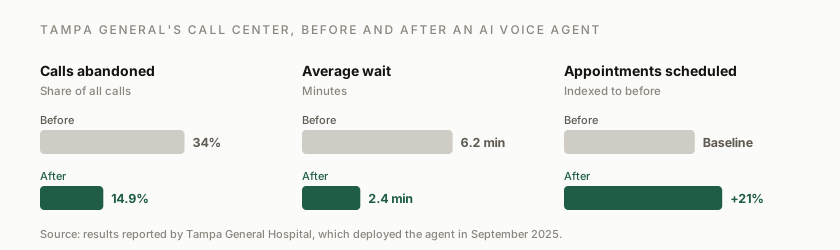
Until last year, Tampa General Hospital was losing about 40,000 phone calls a month. Patients called to book a visit, waited, and hung up; about a third of all calls were abandoned. In September 2025, the hospital put an AI voice agent on the line. Abandoned calls fell from 34% to under 15%, the average wait dropped from 6.2 minutes to 2.4, and the number of appointments scheduled rose 21%, according to results the hospital has reported.
The hospital did not hire doctors, open clinics or add beds. The patients were already there, trying to get in.
Versions of this story play out across healthcare. A dental group's front desk misses calls at lunchtime while patients due for a cleaning drift away. A physical therapy clinic watches patients stop coming halfway through the visits their surgeon prescribed. A home health agency loses a patient because another agency answered the hospital's referral first.
That is the shape of most of the value AI is creating for healthcare providers today. Discussions of AI in healthcare tend to start with cost: the administrative overhead, the paperwork, the staff hours. Those savings are real. But for providers of almost every kind, the larger and faster gains show up as revenue, from patients who could not get through, care that was given but never fully recorded, and claims that were filed but never paid. That revenue is also contested in a way cost savings are not, because the insurers who pay it are deploying AI of their own.
Healthcare is several industries at once. The United States spent about $5.3 trillion on it in 2024, across providers who deliver care, payers who pay for it, and life sciences companies that discover and make drugs and devices. This piece is about providers, and it uses the word broadly: hospitals and health systems; physician groups in primary and specialty care; dental and eye care groups; outpatient services such as physical therapy, behavioral health, urgent care and imaging; and home health, hospice and skilled nursing. They differ in size and in how they are paid, and those differences come up throughout. Payers appear as the other side of nearly every dollar a provider collects. Life sciences, which runs on a much longer clock, gets a short section at the end.
Three leaks between demand and cash
Every provider's revenue passes through three points where it can leak away. A patient has to get through the front door and onto the schedule. The care delivered has to be recorded in a way that supports payment. And the claim built from that record has to be paid.
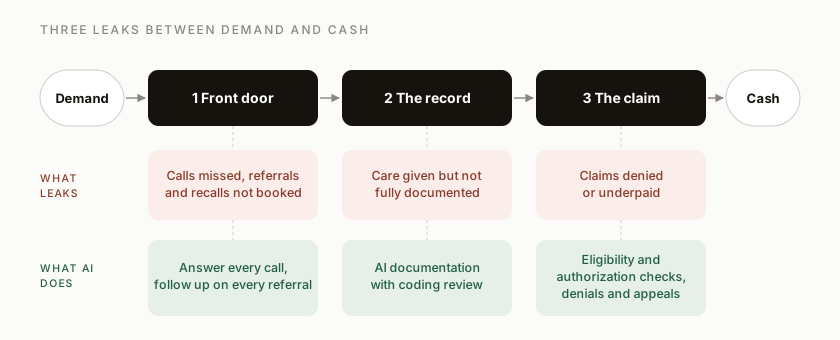
The leaks look different from one type of provider to the next.
| Provider | The front door | The record | The claim |
|---|---|---|---|
| Hospitals and health systems | Call centers, referrals between departments, transfers in | Notes that document the complications and conditions that set payment for a stay | Prior authorization, denials, payer audits |
| Physician groups | Phones, referrals from other doctors, no-shows | Visit notes that set each visit's complexity code | Prior authorization, coding denials |
| Dental and eye care groups | Patients due for cleanings and exams who never book, broken appointments | Charts, x-rays and narratives that justify each procedure | Eligibility and benefit checks, insurer review of x-rays |
| Therapy, behavioral health and other outpatient care | No-shows, patients who stop before finishing a course of treatment | Progress notes that show medical necessity | Visit limits, authorizations, medical necessity denials |
| Home health, hospice and skilled nursing | Hospital referrals, where speed decides who gets the patient | Patient assessments that directly set payment | Medicare reviews, authorizations, medical necessity |
Each leak has grown harder to ignore. Fitch expects median operating margins at nonprofit hospitals to reach only about 2% this year, and the federal Medicaid cuts passed in 2025 begin next year, with the heaviest exposure for providers that depend on Medicaid, including nursing homes, home care and behavioral health. Clinical staff are scarce across the board, from physicians and nurses to hygienists and therapists, so cutting staff is rarely an option. And getting paid has become harder. In Experian Health's latest survey of provider finance leaders, released Oct 28, three-quarters said claim denials are rising, and 40% said more than one in ten of their claims are denied.
When margins are thin and the scarce resource is clinical labor, a dollar of revenue recovered is worth more than a dollar of overhead cut, and it is usually easier to find. AI happens to be good at exactly the work where these leaks occur: answering, recording, checking and following up, at a volume no staff could match.
The front door
Most providers lose patients before the first visit, and they lose them in ordinary ways. Phones go unanswered at peak hours. A referral arrives by fax and sits until someone has time for it. A patient due for a six-month cleaning or an annual eye exam is never called. A therapy patient misses two visits and stops coming.
AI agents now handle this work at scale. WellSpan Health's voice agent manages more than 160,000 patient calls a month, and the system is extending it to follow-up calls after discharge and check-ins with patients who have chronic conditions. The same pattern applies in a dental or eye care group: answer every call, book during the call, fill cancellations from a waitlist, and work the list of patients who are due. In therapy and behavioral health, it means following up the moment a visit is missed, before a gap becomes a dropout.
For home health, hospice and skilled nursing, the front door is the referral from a hospital, and speed decides the outcome. Discharge planners often send a referral to several providers at once and place the patient with whichever confirms first that it can take them. Agencies are now using AI to read incoming referrals, check eligibility and coverage, and respond within minutes; Compassus, one of the larger home health and hospice operators, has rebuilt its intake around it.
There is a cost effect at every door, since fewer staff can handle more calls and referrals. But the gain that matters is the patient who would otherwise have been lost, and it is the easiest gain to measure: appointments booked, recalls completed and referrals accepted, before and after.
The record
The second leak sits in the record of the care. Clinicians in every setting spend hours a day on documentation, much of it after the last patient leaves, and a note written from memory at nine at night rarely captures everything that happened.
Ambient documentation, in which software listens to the visit and drafts the note, has spread faster than almost any technology in medicine. At Kaiser Permanente's medical group in Northern California, 7,260 physicians used it in about 2.5 million patient encounters over 15 months, saving nearly 16,000 hours of documentation time. Versions built for therapists, behavioral health clinicians, dentists and home health nurses are now common.
What the record has to do depends on how the provider is paid. For a physician visit or a hospital stay, the documentation sets the complexity code that determines payment. In home health and skilled nursing, payment is set even more directly by structured patient assessments, known as OASIS and the MDS, that clinicians complete at set points in a patient's care. In therapy and behavioral health, notes have to show that care is medically necessary and that the patient is progressing, or the remaining visits will not be authorized. In dental care, payment follows the procedure, so the record's job is to justify each one with x-rays and narratives an insurer will accept.
Saved time becomes value in a few ways. Some of it goes to clinicians who were burning out and leaving, and keeping them avoids the expense and lost revenue of replacing them. Some becomes capacity: another visit per clinician per day, another home visit per nurse, more time in the chair for hygienists. And some of it shows up in the bill, which is where the argument starts.
The coding fight
The fight is sharpest where payment depends on how complex the documentation makes a patient look. For an outpatient physician visit, the code reflects how complex the visit was, judged largely by what the clinician documented about the problems addressed and the decisions made. For a hospital stay, payment rises when the record shows complications or other conditions that made the patient harder to treat. Home health and skilled nursing assessments work in a similar way. A more complete record can justify a higher payment.
When AI makes records more complete, codes tend to rise. Trilliant Health studied six large health systems that adopted AI scribes and found a consistent shift toward the highest-complexity outpatient visit codes. Its reading is that these visits had been undercoded for years, because busy clinicians left out work they had actually done.
Insurers read the same trend differently. The Blue Cross Blue Shield Association looked at maternity admissions and found that at the hospitals that adopted AI coding tools fastest, the share coded for anemia after hemorrhage rose from about 4% to more than 12% between 2022 and early 2025, while transfusion rates stayed flat, as STAT reported. In its analysis, one hospital's complexity rating rose 6.7% after it switched to AI, against 0.9% at other facilities in the same state, and the association estimated that more than $2 billion in hospital spending may be linked to more aggressive coding. Hospital groups dispute the findings, and none of these studies proves cause.
Both sides have a point. Clinicians do undercode, and better documentation recovers money that providers earned. Software can also find every diagnosis that can be justified on paper, whether or not it changed the care. Payers already have the tools to respond: downcoding claims, auditing records, and, in Medicare Advantage, adjusting payments for coding intensity. In government programs, unsupported codes are also a legal risk.
Where payment follows the procedure, as in dental care and much of outpatient therapy, the argument is about whether the procedure was needed, and insurers have been using software to ask that question for years. Delta Dental of Michigan, for example, began running every incoming claim through AI analysis in 2022, with the attached x-rays annotated for its reviewers.
In every setting, the dividing line is the same. A payment that the clinical record supports, and that an auditor would accept, is revenue that lasts. A payment that the record does not support is a refund, a penalty or a contract dispute waiting to happen.
The claim, and the software on the other side
The third leak is the claim itself: verifying coverage and benefits, obtaining authorization, submitting the claim, and working the denials and appeals that follow. Much of this work is still done by phone and payer portal. A dental office checks each patient's frequency limits and remaining annual maximum before the visit. A therapy or behavioral health practice tracks how many authorized visits each patient has left. A hospital assembles prior authorization requests for imaging and surgery. All of it is repetitive, rule-based and high in volume, which makes it some of the most automatable work in healthcare. Epic, whose records system runs most large US health systems, says more than 200 organizations use its AI to automate professional coding, and it now offers autonomous coding for radiology and emergency medicine.
Payers are automating at the same pace. UnitedHealth Group says it will spend about $1.5 billion on AI this year. Since January, traditional Medicare has used AI to help review prior authorization requests for selected services in six states through its WISeR model, with a clinician required to review any request the system does not approve. Federal rules now require Medicare Advantage, Medicaid and other affected plans to decide standard prior authorization requests within seven days and urgent ones within 72 hours, and to accept electronic requests through a standard interface by Jan 1, 2027 (CMS). Health plans covering about 270 million Americans have pledged to answer at least 80% of complete electronic requests in real time in 2027.
The revenue cycle is becoming a negotiation between two automated systems. If each side simply escalates, administration gets more expensive for everyone, and the gains cancel out. The way out for an individual provider is evidence. Claims that are clean, authorization requests that arrive complete, and documentation that supports every charge get paid faster and argued over less. Payers are starting to reward that directly: under WISeR, CMS has said providers with consistently high approval rates may be exempted from prior authorization, and many commercial plans offer similar exemptions.
Capacity, the slower prize
Every provider has a constrained asset that sets its revenue ceiling. In a hospital it is beds, operating rooms and nurses. In an ambulatory surgery center it is operating room time. In a dental office it is chairs and hygienists, in a therapy clinic the therapists' schedules, and in a home health agency the number of visits each clinician can make in a day, which depends on routes as much as on care.
AI is moving into the decisions that govern these assets: predicting discharges, assigning beds, building schedules, planning routes. Cleveland Clinic built a virtual command center with Palantir that combines bed availability, patient demand, staffing and surgical scheduling in one view. HCA Healthcare has been testing a generative AI tool with Google that prepares nurse shift handoffs.
The value is throughput: shorter hospital stays, fuller schedules, more procedures per room, more visits per clinician, less spending on agency staff. It is potentially large, but published results are still scarce in every setting. This is the area where a provider should trust its own measurements over anyone's estimate.
Why scale is harder than it looks
Epic has spent the past year turning its records system into an AI platform, with assistants for clinicians, patients and billing staff, and a tool that lets health systems build their own agents inside it. For a health system that runs on a single instance of Epic, much of what it needs will arrive inside software it already licenses.
Most of healthcare does not run on Epic. Dental and eye care groups, therapy and behavioral health practices, home health agencies and many physician groups use practice-management and records systems from a long list of vendors, many of them smaller and slower to add AI. Groups that grew by acquisition often run several of these systems at once, each with its own definitions of a visit, a denial and a provider's schedule. An agent built for one office does not work at the next, and results cannot be compared across them.
For these organizations, the first investment is a shared layer of data and definitions across every site, and the question of what to build rather than buy arrives sooner. AI multiplies whatever integration already exists, and where there is little, it multiplies little.
What lasts
Not every gain from AI holds up equally once payers, auditors and competitors respond.
The most durable gains come from access and capacity. A patient who gets through, books and is seen is real care, delivered and paid for, and no payer contests it.
Next comes collecting revenue that was already earned: fewer denials, complete authorizations, faster payment. That money was owed, and better evidence makes it harder to withhold.
Gains from more complete documentation last only as far as the record supports them. They are worth pursuing, carefully, with review built in from the start.
Cost savings depend on how the provider is paid. In most industries, savings from automation tend to be competed away to customers through lower prices. Under fee-for-service payment, a provider is paid per service at rates set by contracts and government programs, so lower costs mostly show up in its own margin. Where patients pay a larger share themselves, as in much of dental and eye care, prices behave more like an ordinary market, and some savings will be passed on. Under value-based contracts, where the provider takes on the cost of caring for a population, savings are shared, and AI changes something else: how many patients each nurse or care manager can support.
This is why the same technology can be worth very different amounts to two organizations. The type of care, the payment model, the payer mix, and how well each organization documented and collected before AI arrived all decide how much of the gain it keeps.
Life sciences, on a longer clock
Drug and device makers use AI across discovery, trial design and recruitment, regulatory writing and commercial work. Most of the gains companies report so far are operational, in trial setup, regulatory documents and commercial targeting. The larger promise, better drugs found faster, will take years to test. Insilico Medicine's rentosertib, a drug for pulmonary fibrosis whose target and molecule were both identified with AI, entered Phase III in July. No drug discovered with AI has yet been approved by a major regulator.
Decisions for providers
For a provider deciding where to begin, the evidence points to a sequence of decisions. They apply whether the organization is a hospital, a dental group or a home health agency, though the details differ. Each comes with the measure that shows whether it worked, and every measure should be recorded site by site before anything is deployed. Without a baseline, every vendor's results look good and none can be checked.
1. Start at the front door
Access is the fastest return and the least contested. Answer every call, book during the call, fill cancellations from a waitlist, work the list of patients due for a visit, follow up on every missed appointment, and respond to every referral within minutes. Start with the services or offices that have the most volume. Measure appointments booked, call abandonment, the share of referrals accepted and how quickly, and the share of prescribed or recommended visits that patients complete. Count appointments rather than calls handled by the agent.
2. Roll out documentation and coding review together
Wherever documentation sets payment, introduce AI documentation with review built in from the start. Set a rule that every code, assessment answer and charge must be supported by the record. Audit a sample in the first month, and compare the organization's mix of codes or assessment scores with its own history and with peers. Measure documentation time, including after hours, and visits per clinician per day for the capacity gain, and track the code mix and audit results for the revenue that will last.
3. Prevent denials upstream, and bring evidence to payers
Most denials trace back to the front of the process: coverage or benefits not verified, authorization missing or incomplete, documentation that does not match the claim. Check these when the visit is scheduled and again before the claim goes out, keep each payer's rules current, and use automation to draft and track appeals for what remains. Then use the data. Track approval rates by payer and service, apply for exemptions where approval rates are high, and bring denial patterns and turnaround times into contract negotiations. Measure the initial denial rate, net collection rate, days in accounts receivable and cost to collect.
4. Buy what your systems do well, and own what is yours
Where the records or practice-management system's built-in AI does the job, use it. It is integrated, supported and usually cheaper. Keep ownership of the knowledge that is specific to the organization: payer rules and contract terms, referral sources and patterns, scheduling templates, the history of denials and appeals. That knowledge improves every tool built on it and should move with the organization if vendors change. For organizations with more than one records or billing system, build the shared data layer first. Measure the share of sites running on shared data and how long it takes to connect a new one.
5. Govern it, and be able to prove it
Every vendor that touches patient information needs a business associate agreement under HIPAA, and each system should see only the data it needs. Treat a change to an agent's instructions or model like a change to any system that affects care or billing: tested, approved and logged. Keep a licensed clinician in the loop for anything clinical, and follow state rules. California, for example, requires a disclaimer on AI-generated messages about a patient's clinical information unless a licensed clinician has reviewed them. Organizations that manage practices on behalf of clinicians should also follow state rules on practice ownership and control, which vary by profession and are tightening in some states; Oregon's SB 951, for instance, limits how much control a management company can exercise over the medical practices it serves.
Proof matters as much as governance. The gains that count are the ones that survive review by an auditor, a payer, a lender or a future owner. Record the baseline and the method behind every claimed improvement, separate one-time recoveries such as a backlog of old appeals from recurring gains, and show which result came from which change.
Tampa General's 21% more appointments came from patients who were already calling. Most of what AI offers providers, in a hospital, a dental office or a home health agency, looks like that: demand that already exists, care that was already given, payment that was already owed. The providers that capture it will be the ones that can show, line by line, where it came from.