Where AI helps across a university
A guide to the work AI genuinely helps with today, area by area, from admissions and advising through research administration and accreditation, and what has to be true for it to help.

In shortThe most useful way into AI on a campus is not to start from a tool but from the work: the places where the knowledge already exists and a person is currently carrying information between systems that do not talk to each other. That work exists in every area of a university. This is a guide to where it sits in admissions, advising, the registrar, teaching, research administration, advancement, campus operations, accreditation and the president's office, what AI can genuinely do in each today, and the four things any of it depends on.
Ask ten people on a campus what AI means for their work and you will get ten answers, most of them about a tool. That is a hard place to start from, because the tools change every few months and the question a provost or a vice president actually has is narrower: what would be different in my area, and what would it take.
The more useful way in is to start from the work. Every area of a university runs on a mix of three things: judgment that belongs to the people who hold it, knowledge the institution already has written down somewhere, and a large amount of a person carrying information between systems that do not talk to each other. That third category is where this technology does the most good right now. It is not glamorous, it is rarely what gets demonstrated, and it exists in every office on campus.
What follows is a guide to where it sits, area by area. It is not a ranking and not a sequence. The right place to begin depends on what your institution is trying to move this year, and the last section says how we would choose.
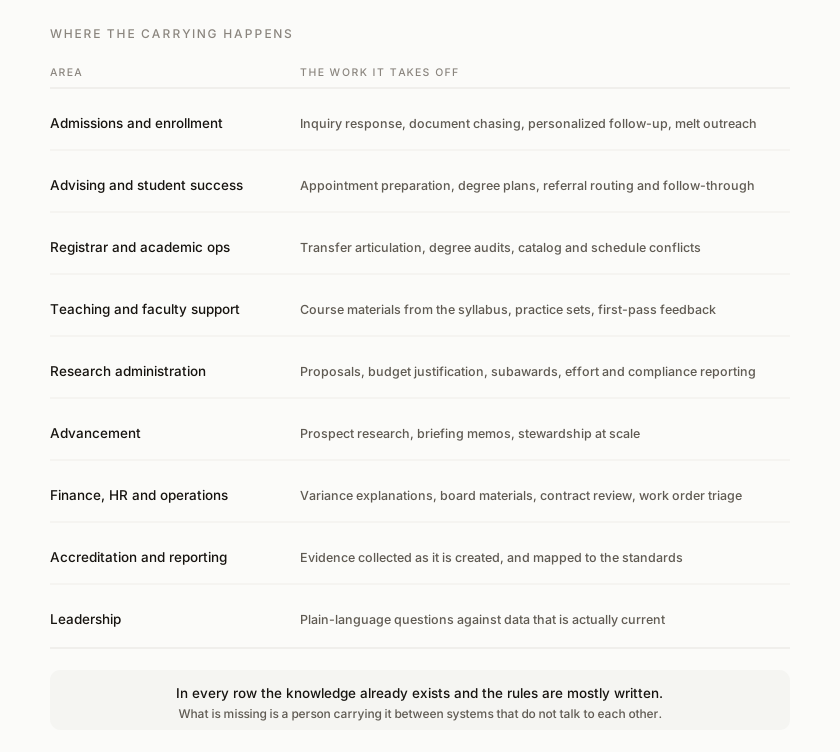
Admissions and enrollment
The work is a funnel made almost entirely of follow-up. Inquiries arrive and need an answer while the interest is live. Applications sit incomplete for want of one document. Transcripts, test scores and residency paperwork have to be chased, verified and entered, often into more than one system. Aid packages have to be explained to families who are comparing four letters written in four different vocabularies. Then the summer, when admitted students quietly disappear.
AI helps here in the ordinary parts. An agent can answer program, deadline, cost and aid questions with current information at the hour teenagers actually ask, draft personalized follow-up rather than the same template to everyone, chase and intake documents, and keep a running picture of where each applicant is stuck. Counselors stop being a routing layer and go back to the conversations that change decisions.
What it needs: the admissions system, the catalog and the aid rules connected and current, and a person on every decision. Nothing here should be deciding who is admitted or what a family can pay.
Advising and student success
Average advising caseloads sit around 300 students, and a great many institutions run 500 to 1,000. At that ratio the job compresses into transactions: approve the schedule, clear the hold, sign the form. Degree planning, the part that actually helps, gets whatever is left.
The other difficulty is that the information needed to help a student is held correctly and separately by six different offices, none of which can see the whole picture, and some of which must not.
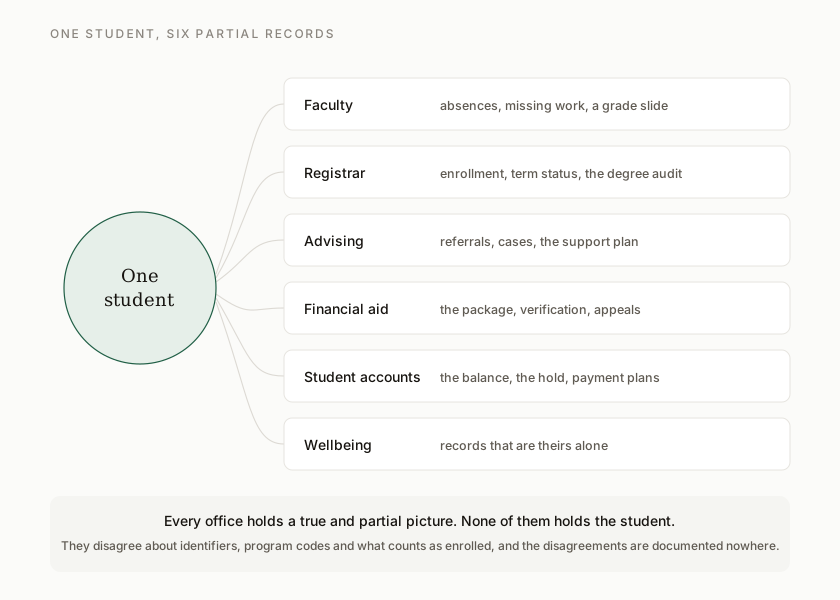
AI helps by preparing the appointment rather than replacing it: assembling what is known about a student across the systems the adviser is entitled to see, drafting the degree plan and the what-if scenarios, routing a referral to the right office and then following up on it, and answering the routine registration and requirement questions that currently fill the calendar. The adviser keeps the judgment and gets the hour back.
What it needs: connectors that inherit the permissions each system already enforces, so that what an adviser can see through an agent is exactly what they could see by logging in.
The registrar and academic operations
This is the most rule-governed work on campus and the most underserved. Transfer credit evaluation, where a transcript is matched course by course against equivalency tables and catalog descriptions, takes weeks at most institutions, and an applicant is making a decision about their life during the wait. Degree audits carry exceptions that live in one person's memory. The catalog drifts from the schedule. Prerequisites conflict. Rooms, faculty and modality have to be reconciled every term.
AI helps by producing the draft. A transcript becomes a proposed articulation with citations to the catalog language it relied on, with the genuinely ambiguous courses flagged for a department chair, and a provisional degree audit the same day. Schedule conflicts surface before publication rather than during registration. The department keeps the judgment; the clerical carrying goes away.
Teaching and faculty support
Faculty are the group with the most to gain and the most reason to be careful, and the two are related.
The gain is in preparation. Course materials built from the syllabus and the assigned readings rather than from a generic corpus, practice activities at several levels of difficulty, worked examples, rubrics, first-pass feedback that an instructor then edits, and the analysis of quiz data that shows which concept the section missed. This is real time back, and it is time that goes into teaching.
The care is about assessment. Faculty are dealing with a live question about what an assignment now measures, and the evidence is that redesign works better than restriction. The institution's job is to support that redesign, not to arbitrate it, and to be clear that grading and academic judgment remain with faculty. That line should be written down and enforced by the system rather than asserted in a policy.
Research and sponsored programs
On a research campus this is the largest body of rule-governed document work anywhere in the institution, and almost none of it touches a student record.
Proposals assembled against sponsor-specific rules. Budget justifications. Subaward setup. Effort reporting. Export control and conflict-of-interest screening. Progress and closeout reports. Compliance evidence that currently gets reconstructed rather than collected. Every one of these is a case where the rules are written, the documents exist, and a person is moving text between forms under a deadline.
What it needs: care with the material. Unpublished work, sponsor-restricted data and the institution's scholarship are the most valuable things it holds, and the terms under which any of it is processed matter more here than anywhere else on campus.
Advancement
Prospect research that currently takes a gift officer an afternoon per name. Briefing memos before every visit. Stewardship that is genuinely personal at a scale no team can staff. Campaign and appeal material drafted from the institution's own language rather than from a consultant's template. Event follow-up that actually happens.
What it needs: donor data is sensitive in a different way than student data, and the access model should reflect that.
Finance, HR and campus operations
Budget-to-actual variance that arrives with an explanation attached rather than as a number to investigate. Board materials generated from live data instead of assembled over two weeks. Position management and job description drafting. Contract and vendor review. Purchasing questions answered from the actual policy. Work order triage, space utilization analysis, and maintenance prioritized by condition rather than by who called.
Accreditation, compliance and institutional reporting
Self-studies, program review, state reporting and the federal transparency and earnings reporting introduced this summer all ask for the same thing: defensible evidence, traceable to its source, about what the institution does and what happened to students afterwards.
Done once every ten years, this is a year in which good people stop doing their jobs. Done continuously, it is exactly the shape of work that suits a system with an audit trail: collect artifacts as they are created, map them to standards, show what is missing, and keep the lineage so a reviewer can see where a number came from. The same machinery answers a state inquiry or a board question in an afternoon.
Leadership
Presidents and cabinets mostly do not lack data. They lack a current picture, and they are asked questions between the reports. What helps is the ability to ask in plain language against institutional data that is actually current, a daily brief that flags what moved, meeting preparation assembled from the real record, and board materials that do not go stale between the draft and the meeting.
The four things every one of these depends on
The areas differ; what makes any of them work does not.
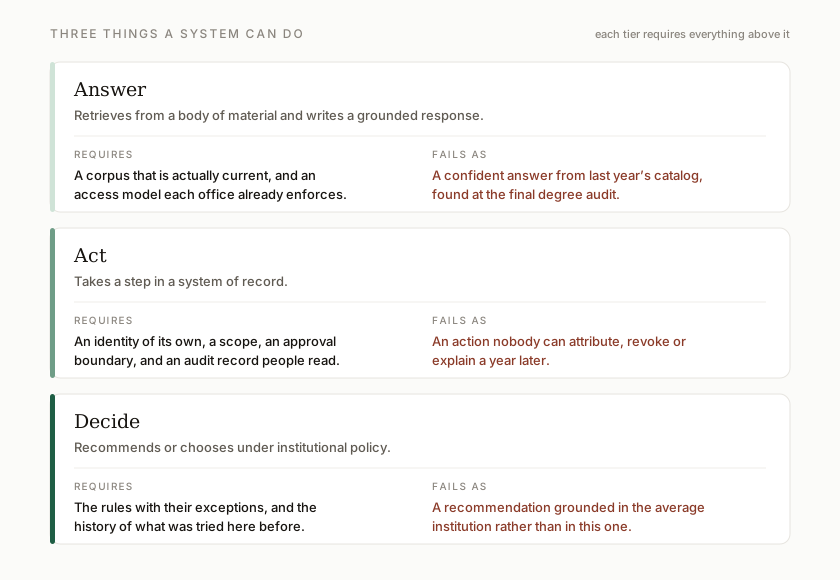
A corpus that is current and has an owner. The catalog, the policies, the handbook, the requirements as they stood in each entering year. A stale corpus produces confident wrong answers at scale, and the failure surfaces late.
An access model that mirrors what offices already enforce. The system should inherit permissions rather than invent them. This is what makes it possible to help with student work at all.
Rules written down, including the exceptions. The exception precedent, which substitutions were approved for which programs and on what reasoning, is the difference between a system that applies generic rules and one that applies yours. It is useful work regardless of what software you buy.
An action boundary, in writing and enforced. What happens automatically, what happens after a person approves it, and what never happens without a human doing it themselves. Consequential actions toward a student, anything irreversible, and anything touching money belong behind an approval gate with a named owner, and everything that happens belongs in an audit record a person can read a year later.
Where the line stays
Some of the boundary is regulatory. Since 2 August 2026 the EU AI Act treats admissions screening and student assessment as high-risk uses, which means documented human oversight rather than a footnote about it. FERPA and the state student privacy statutes determine what may move where.
Some of it is academic, and is the institution's own to draw. Grading and assessment judgments belong to faculty. Admissions and aid determinations belong to the people accountable for them. The durable pattern is the system doing the preparation and a person making the decision: the evidence assembled, the precedent surfaced, the draft written, the judgment human.
Choosing where to start
Two criteria, and the second one matters more than it looks.
Pick work where the knowledge already exists and a person is doing the carrying. Those projects finish, and people can feel the difference in a term rather than believing in it for a year.
Then pick so the second project is cheaper than the first. The objects you define, the permissions you establish and the audit trail you produce should be the ones the next three projects need. Most of the areas above depend on the same underlying question of whether the institution can say who a student is across systems that disagree. Answer it once, deliberately, in the first project, and you have bought down the cost of everything after it. That is the difference between a pilot and a capability, and it is the substance of what we do in an AI transformation with colleges and universities. Which of these areas is worth starting with depends on the institution, and we work through that in no two institutions start in the same place.
Key takeaways
- The best first projects are not the most advanced ones. They are the jobs where the rules are written, the documents exist, and a person is moving information between systems that do not talk.
- Advising is the hardest and highest-value area for the same reason: the information needed to help a student is held correctly and separately by six offices, and coordinating between them is most of the job.
- Research administration is usually the largest body of rule-governed document work on a research campus and the least discussed, and it touches no student records.
- Accreditation and the new federal reporting are the same problem in different clothes: evidence, traceable to its source, produced continuously rather than reconstructed.
- Write the action boundary down before the first deployment, not after the first incident, and make the system enforce it rather than the policy.
The work worth doing first is rarely the work that demonstrates well. It is the work that currently stops at an office boundary.