The credit manager's AI playbook
Where AI earns its place across a credit manager, from origination and monitoring to CLO operations and the wealth channel, and what has to be true first.

In shortCredit managers face two pressures at once. The risk work has deepened, with Fitch reporting a record private credit default rate in August and withdrawal requests running above the caps at many evergreen vehicles. And the distribution work has multiplied, as evergreen funds sold through the wealth channel turn a few hundred institutional relationships into thousands of advisers with the same questions. This playbook walks through each part of a credit manager, from origination and underwriting to monitoring, capital markets, fundraising, fund operations and compliance, and the conditions specific to credit, above all information barriers, that have to hold before any of it works.
Private credit grew up in a decade of low defaults and patient capital. This year has tested both. The Financial Stability Board's May report put the market at 1.5 to 2 trillion dollars and noted that it has never been through a prolonged downturn. Fitch reported a record private credit default rate of 6.3 percent in August, with nearly half of defaults involving deferred or payment-in-kind interest. Several of the largest non-traded credit funds received withdrawal requests well above their 5 percent quarterly caps, and redemptions across the category have run ahead of new inflows.
At the same time, the business has been changing shape. U.S. evergreen funds held about 607 billion dollars across 567 vehicles by March, a record number of new vehicles launched last year, and non-traded business development companies have grown from almost nothing in 2021 to more than 200 billion dollars. Selling through the wealth channel means answering thousands of advisers and platforms, each with their own diligence, rather than a few hundred institutions.
So credit managers face two pressures at once: the risk work has become deeper, and the distribution work has become wider. Both are document-heavy, rule-bound and time-sensitive, which is exactly the kind of work AI is now good at. The firms furthest along say so plainly. Ares has said it evaluated roughly 160 AI use cases and is deploying about 25 across the front, middle and back office, from NDA review and know-your-customer checks to wealth sales and investment memos.
This playbook walks through where AI helps across a credit manager, and what has to be true before it does.
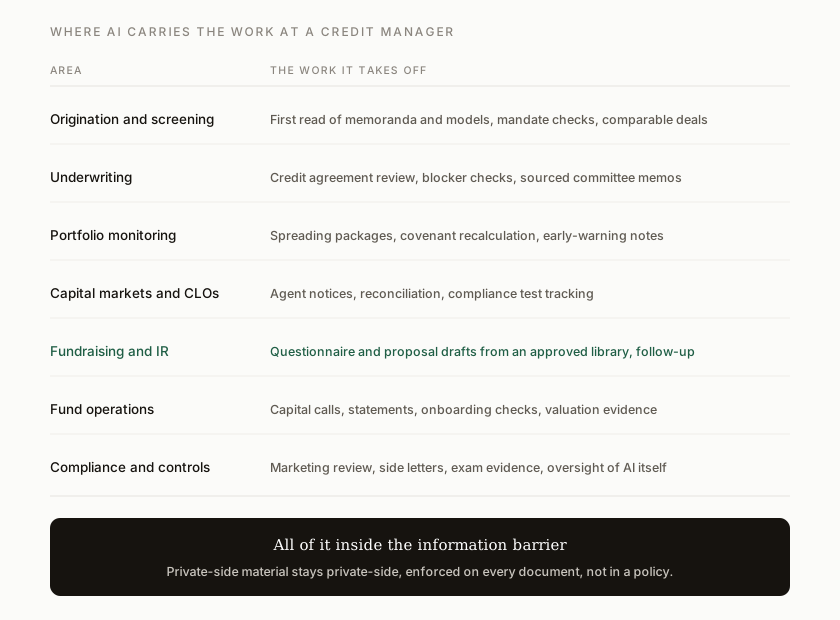
Origination and screening
A direct lending team may see thousands of opportunities a year and close a small fraction of them. Most of the screening work is reading: confidential information memoranda, lender presentations, sponsor models and quality-of-earnings reports, then deciding quickly whether a deal fits the mandate and deserves a team's time.
AI can do the first read: extract the terms, the capital structure, the key financials and the sponsor's adjustments, check them against the fund's mandate and concentration limits, and assemble a short first-pass view with the relevant comparisons from the firm's own history. The investment professional still decides. They decide faster, and on more of the pipeline.
Underwriting
Underwriting is where a credit manager's judgment lives, and where much of the surrounding work is mechanical. Credit agreements run to hundreds of pages. Definitions of EBITDA, permitted add-backs, baskets and covenants vary deal by deal, and the protections that matter most are in the details.
The clearest recent example is documentation risk. Liability management transactions, in which a borrower uses flexibility in its credit agreement to move collateral or prime one group of lenders over another, have become a central feature of distressed credit. Lenders have responded with "blockers" that close specific loopholes; Moody's now recognizes six named blockers, up from three a few years ago, and drafters keep finding new gaps. Checking every agreement for which protections are present, and which are missing, is exactly the kind of exhaustive, precise reading AI does well and people do inconsistently under deadline.
AI also helps populate models from borrower financials, draft investment committee memos with every figure linked to its source, and compare proposed terms against the firm's precedent on similar deals.
Portfolio monitoring
Once a loan closes, the work shifts to watching it. Borrowers send monthly or quarterly reporting packages, compliance certificates and lender updates, in formats that differ for every company. Someone has to spread the financials, recalculate covenants, compare results against the original underwriting case, flag deterioration and route amendment requests.
This is high-volume, repetitive and consequential, and it is where earlier warning is worth the most. AI can read each package as it arrives, update the financial spreads, recompute covenant headroom, compare results with the underwriting case and the prior period, and put a short, sourced note in front of the portfolio manager when something moves. In a software-heavy book, it can also support the re-underwriting many managers are doing now: which borrowers are mission-critical systems with high switching costs, and which are narrow tools more exposed to AI substitution.
Capital markets and CLOs
Syndication, trading and collateralized loan obligation management run on a constant flow of notices and reports: agent notices, trade confirmations, trustee reports, compliance test results and portfolio data that has to reconcile across the manager, the trustee and the administrator. Each discrepancy has to be found and chased.
AI can process agent notices as they arrive, reconcile positions and cash across sources, track compliance tests and concentration limits against their thresholds, and draft the exception follow-ups for operations staff to send. The operations team stops spending its days finding breaks and starts spending them resolving the few that matter.
Fundraising and investor relations
This is the part of a credit manager where AI is most often treated as a cost tool and is actually a revenue one.
The shift to the wealth channel has multiplied the number of conversations a credit manager has to hold. Every adviser platform, consultant and allocator sends due diligence questionnaires, requests for proposals and follow-up questions, many of them variations on the same hundred questions. Product specialists, the people who can answer technical questions about strategy, portfolio and process, become the bottleneck. When they are busy, sales slows.
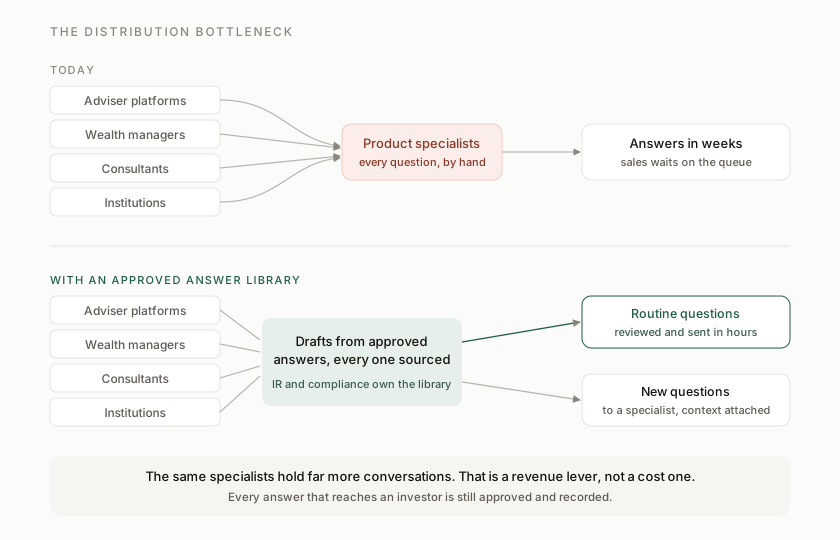
AI changes the ratio. A library of approved answers, kept current by investor relations and compliance, lets the system draft responses to questionnaires and proposals in hours rather than weeks, with every answer sourced and routed for review. Routine questions get answered from approved material; new questions arrive at a specialist with the context already assembled. Meeting notes become CRM updates for approval, follow-ups are drafted the same day, and monthly commentary starts from the data rather than a blank page.
The constraint here is regulatory as much as practical. Marketing materials and performance presentations are governed by the SEC's marketing rule, and every answer that reaches an investor is a statement by the adviser. The system has to draw only from approved material and keep a record of what was said, to whom and on what basis.
Fund operations and finance
Behind the investment and distribution teams sits a large, exacting operation: capital calls, investor statements, subscription documents, know-your-customer and anti-money-laundering checks, expense allocation, and support for valuation. Several of these are named examination priorities. The SEC's 2026 priorities include the valuation of illiquid assets, including those held by private credit funds, and fees and expenses remain a long-standing focus.
AI can pre-check subscription documents and investor onboarding, assemble capital call notices and statements from the fund's records, prepare expense allocations with the supporting detail, and keep the evidence behind each valuation organized and retrievable. When an examiner asks how a mark was determined, the answer should take minutes to assemble, not weeks.
Compliance and controls
Compliance teams review marketing, monitor personal trading, manage restricted lists and, now, oversee the firm's own use of AI. The SEC's 2026 priorities explicitly include whether advisers have policies to supervise their AI tools, and whether their claims about AI are accurate. An adviser that overstates its use of AI to investors is making a misleading statement like any other.
AI can review draft materials against the firm's policies and the marketing rule before they reach compliance, track side-letter obligations and most-favored-nation elections, and assemble audit and examination evidence. The control function also has to govern the AI itself, which is why the conditions in the next section matter.
What has to be true first
Several conditions are common to any AI deployment. One is specific to credit, and it is the one most likely to go wrong.
Information barriers enforced in the data, not just the policy. Many credit managers lend privately while also trading public loans, bonds or CLO tranches. Private-side teams routinely hold material non-public information about borrowers, and the Investment Advisers Act requires written policies to prevent its misuse. A firm-wide AI system that can read every memo, every borrower package and every model will happily surface private-side information to a public-side user unless permissions are enforced at the level of each document and each record. The wall has to be in the system, inherited from the source permissions, not in a training slide.
Documents and loan data connected. The value comes from linking the credit agreement, the reporting package, the loan record and the firm's notes about the same borrower. Without a consistent identity for each borrower and facility across systems, every answer is partial.
Approved sources and a full record for anything external. Anything that reaches an investor, a lender group or a regulator should be drawn from approved material, approved by a named person and recorded. Approval gates and an audit record are what make AI usable in a regulated distribution business.
The firm's history, treated as an asset. A credit manager's most valuable data is its own record: every deal it saw, how it priced it, the deals it passed on and why, and how each loan actually performed. Ares has said its next phase is applying decades of its own investment data, including transactions it declined, to future decisions. That history lives in memos, models and inboxes at most firms. Making it usable, inside the firm's walls, is the durable edge, a point we develop for every industry in the sovereign frontier enterprise.
The freedom to choose models. Extraction from scanned compliance certificates, reasoning over a complex credit agreement and drafting investor commentary are different jobs, and the best model for each changes quickly. Routing each task to the model that does it best, and being free to move, protects both quality and cost. That is the purpose of our Model Hub.
Where to start
The best first projects share three features: high volume, clear rules and a measurable result. In most credit managers, two areas stand out.
The first is distribution: a governed answer library for questionnaires, proposals and adviser questions. It is measurable in turnaround time and specialist hours, it touches revenue directly, and it builds the approved-knowledge foundation everything else uses.
The second is monitoring: reading borrower packages as they arrive, recomputing covenants and flagging movement against the underwriting case. It is measurable in time to detection, and in a year like this one, early detection is worth more than almost anything else a credit team can buy.
Both depend on the same foundations: borrower identity across systems, permissions that respect the wall, and a record of every output. Built once, those foundations serve every workflow that follows. That is the approach behind our AI transformation work with financial services firms.
Key takeaways
- Credit managers face deeper risk work and wider distribution work at the same time. Both are document-heavy and rule-bound, which is where AI performs best.
- In underwriting and monitoring, AI's advantage is exhaustive reading: every credit agreement checked for missing protections, every reporting package recomputed as it arrives.
- In fundraising, AI is a revenue lever. The wealth channel multiplies questions faster than product specialists can answer them; an approved answer library with review changes the ratio.
- Information barriers must be enforced in the data. A firm-wide AI system will cross the wall between private and public sides unless permissions are inherited at the level of each document.
- A credit manager's own history, including the deals it passed on, is its most valuable data. Make it usable inside the firm.
The credit managers that pull ahead will not be the ones with the most AI pilots. They will be the ones that see trouble first and answer every investor fastest.