No two institutions start in the same place
Higher education is covered as one market with one story. Five kinds of institution, what leadership in each is actually working on, and where AI tends to help first.

In shortSector coverage flattens higher education into one market with one problem, usually enrollment, which describes almost no institution accurately. Research universities, public universities and systems, regional and comprehensive universities, independent colleges, and community and technical colleges are each working on something different and difficult. This is a map of what leadership in each is actually holding, and where AI tends to earn its place first. It is not a ranking. What they now share is an evidence burden: the new federal reporting and the accreditation rewrite both ask for outcomes traceable to their source.
Higher education gets written about as one market with one story, and this year the story is usually the enrollment cliff. It is an odd frame for a sector where total enrollment rose 1.0 percent last fall and 1.3 percent this spring, with movement in both directions in different parts of it, for different reasons, all at once.
The practical consequence is that a vendor arriving with one answer for higher education is, by construction, describing an institution other than yours. What follows is the opposite: five kinds of institution, what leadership in each is actually holding, and where AI has tended to earn its place first.
One thing worth saying before the list. This is not a ranking, and the differences here are not differences in quality or in seriousness. Every institution below is doing something difficult. They are simply not doing the same difficult thing, and that is the whole reason a single sector-wide prescription is worth ignoring.
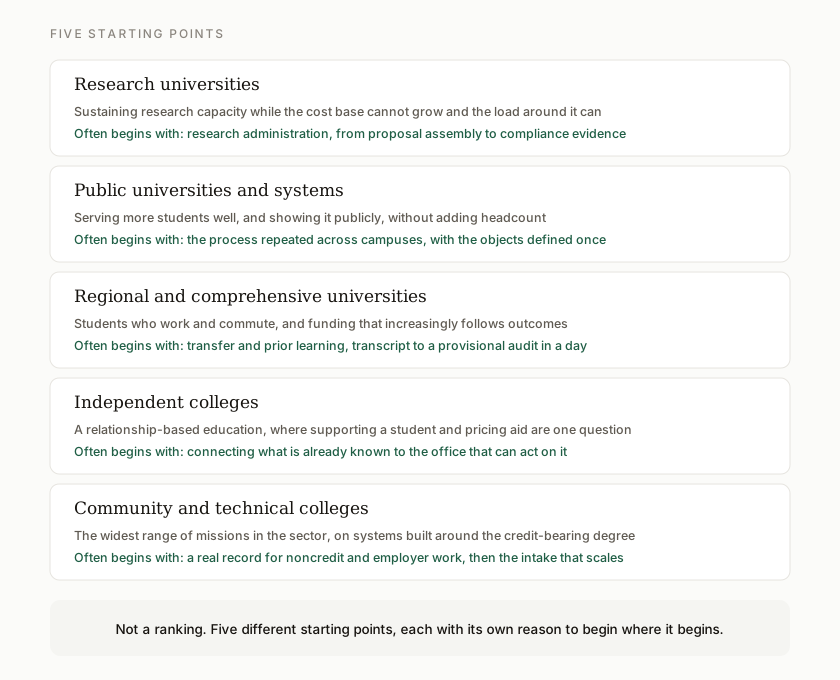
Research universities
The work is sustaining research capacity through a period when both sides of the ledger moved at once. The endowment excise tax rose to 8 percent for the most affected institutions on 1 July 2026; Yale has described an annual cost near 300 million dollars and is reducing PhD admissions by 13 percent over three years. Federal research funding has become harder to plan against. From 15 September 2026 most F-1 and J-1 entrants are admitted for a fixed period rather than for duration of status, which lands directly on doctoral programs that routinely run longer than four years.
The operational shape of that is specific and often missed: the cost base cannot grow, and the administrative load attached to research is growing. Every new reporting requirement, every sponsor rule change, every compliance obligation arrives as work for a research administration office that is not getting larger.
Which is why this is usually where AI earns its place first. Proposal assembly against sponsor-specific rules, budget justification, subaward setup, effort reporting, export control and conflict-of-interest screening, progress reports, and compliance evidence collected as it is created rather than reconstructed under deadline. The rules are written, the documents exist, and no student records are involved. The thing to be deliberate about is the material itself: unpublished work, sponsor-restricted data and the institution's own scholarship are the most valuable things it holds, and the terms under which any of it is processed deserve more scrutiny here than anywhere else in the sector.
Public universities and systems
State support grew about 1 percent in nominal terms in fiscal 2026, the slowest pace since 2021 and below the 2.7 percent inflation rate, which makes it a reduction in real terms. Fitch has flagged appropriations pressure in Illinois, Indiana, Louisiana, Missouri, Ohio and South Carolina. The University System of Maryland's regents reduced the fiscal 2026 budget by 7 percent against a 155 million dollar cut. Alongside that, 71 percent of public doctoral presidents named political interference an accelerating risk in this year's Inside Higher Ed survey.
Leadership here is holding two things at once: serve more students well, and be able to show publicly and defensibly that you did. Headcount is not the lever.
AI tends to earn its place first in the process that runs many times with many variants. Admissions operations, transcript and transfer evaluation, aid verification, procurement, and the system-office analysis that currently consumes a month of analyst time before every board meeting. The return comes from the repetition. The thing worth investing in early is defining the objects once at the system level, a student, a program, a term, a credential, and letting campuses vary the rules on top of shared definitions rather than varying the definitions themselves. Institutions that skip that step end up building the same thing once per campus.
Regional and comprehensive universities
These institutions serve the students for whom the schedule is the hardest part: people working full time, commuting, transferring in with credit from somewhere else, often the first in a family to be doing any of it. Increasingly they are funded on what happens to those students rather than on how many enroll, as outcomes-based formulas spread and expand.
That combination puts a specific premium on friction. An hour of administrative delay here is not an inconvenience; it lands on someone who has a shift after class and a limited number of terms in which this is possible at all.
AI tends to earn its place first on the transfer and prior-learning path, because it is bounded, measurable and directly connected to both enrollment and completion. A transcript becomes a proposed articulation with the catalog language it relied on, the genuinely ambiguous courses go to a department chair, and a student gets a provisional degree audit and a clear answer about what counts inside a day rather than a month. Prior learning assessment, which many of these institutions offer and few make navigable, belongs in the same project.
Independent colleges
The product here is the relationship: small classes, faculty who know students by name, and a level of individual attention that larger institutions cannot staff. The financial structure that supports it is tight. Institutional aid is simultaneously the main instrument of access and the main financial lever, with the tuition discount rate at 57.1 percent for first-time full-time undergraduates in 2025-26 and about nine in ten first-year students receiving institutional grant aid, while net tuition revenue per student declined 2.2 percent.
What that means in practice is that supporting a student and pricing aid are not two questions, they are one question, and most institutions have the two halves in different offices with different systems.
AI tends to earn its place first by connecting what the institution already knows to the office that can act on it. Many of these colleges have already invested in something that collects signals: an engagement survey, a texting platform, an early alert flag. What is usually missing is everything downstream, where a signal has to be noticed, routed to the right office, acted on, and confirmed. That chain is the work, and it is where the value was always supposed to be. Running aid modeling in-house, continuously, so that policy changes can be simulated before a board votes rather than explained after a cycle closes, tends to follow closely behind.
Community and technical colleges
These institutions carry the widest range of missions of any in the sector, and they carry them simultaneously: transfer preparation, workforce and technical training, dual enrollment with local high schools, adult basic education, and employer partnerships that often amount to regional economic development. Undergraduate certificates grew 12.1 percent this spring, short-term workforce credentials grew 28 percent in a year, and community colleges enroll 71 percent of all dual-enrolled students. Workforce Pell went live on 1 July 2026, extending federal aid to accredited programs shorter than fifteen weeks.
The structural difficulty is not of their making. Student information systems were designed around the credit-bearing degree, and a great deal of this work is not that. Noncredit is estimated at around 40 percent of community college enrollment nationally and frequently does not live in the SIS at all. Employer relationships live in individual inboxes. Dual enrollment coordination runs on spreadsheets shared with high schools. These are the fastest-moving parts of the institution and the least well served by the software underneath them.
AI tends to earn its place first by giving that work a real record, and then automating the intake, scheduling and employer coordination that scale with it. Not because record-keeping is interesting, but because Workforce Pell and the new reporting rules will require these programs to be documented to the same standard as degree programs, and because nothing else can be built on top until the objects exist.
What everyone is now asked for
Whatever else separates them, every institution in the sector is subject to the same change in what regulators want to see.
The federal transparency and earnings framework replaced the previous rules on 1 July 2026, bringing a program-level earnings comparison. The accreditation framework is being rewritten alongside it, with final rules expected by 1 November 2026 and an effective date of 1 July 2027. Workforce Pell arrived with documentation requirements of its own.
Each converts a judgment into an evidence production problem: show, at program level, traceable to its source, what the institution does and what happened to students afterwards. That is not a policy exercise. It is the same underlying question that sits beneath every project described above, which is whether the institution can say who a student is across systems that disagree with one another.
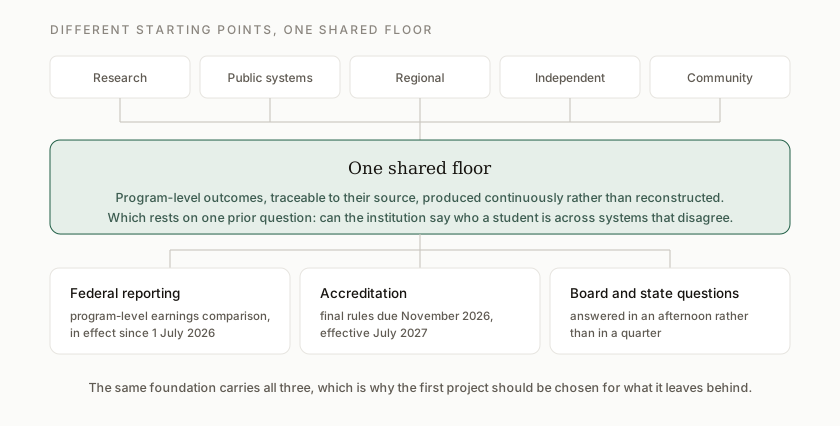
Choosing where to begin
The temptation is to pick the most visible project. The better test is whether the first one makes the second one cheaper.
The objects you define, the permissions model you establish and the audit trail you produce in the first project should be the ones the next three need. A transfer-credit project and an accreditation-evidence project look unrelated and rest on exactly the same foundation. Chosen deliberately, the first project buys down the cost of everything after it. Chosen for visibility, it produces a pilot that is difficult to extend and easy to cancel.
Where that foundation comes from, and what it takes to keep it, is the subject of your advantage is already on campus. The area-by-area version of the work itself is in where AI helps across a university.
Key takeaways
- The enrollment cliff is a real demographic trend and a poor planning frame. Enrollment rose in the last two terms, with movement in both directions in different parts of the sector.
- Research universities are absorbing a cost change whose first operational consequence is administrative rather than academic, which is why research administration is usually the highest-return place to begin.
- For systems, the work worth doing early is defining a student, a program and a term once, so that campuses vary rules rather than definitions.
- At a 57.1 percent discount rate, supporting a student and pricing aid are one financial question held in two offices, and most institutions have bought the signal without buying anything that acts on it.
- The parts of community and technical colleges that are growing fastest are the parts their systems of record were never designed for, and the new reporting rules make that a documentation exposure as well as an operational one.
Sector-wide advice is the one thing higher education has never lacked. The institutions that get value from this technology start from what they are actually holding.