Building an AI roll-up platform
Private equity invented buy-and-build. The AI roll-up is being built mostly outside it. How a private equity firm can run the model, from choosing the vertical to the platform, the people and the exit.

In shortAdd-ons are about three quarters of all U.S. buyouts, yet the most visible AI roll-ups, Long Lake, General Catalyst's portfolio and Thrive Holdings, are being built by venture-backed holding companies. Private equity already has most of the machine: sourcing, financing, integration and governance. What it usually lacks is a shared AI platform and engineers who embed in each acquired company. This playbook covers how to choose a vertical where AI turns capacity into growth, how to underwrite the platform rather than headcount cuts, what the shared platform must contain, whether to build or partner for it, and the one problem holding companies never face: making the AI capability transfer at exit.
Private equity invented the modern roll-up. Add-on acquisitions made up about 73 percent of U.S. buyouts in 2025 and roughly three quarters in the first half of 2026, according to PitchBook data. Buy-and-build is not a strategy at most firms; it is the default.
Yet the most talked-about roll-ups of the year were built somewhere else. Long Lake, a three-year-old AI holding company backed by General Catalyst, completed a 6.3 billion dollar take-private of American Express Global Business Travel on 29 September, after assembling close to 40 services businesses. General Catalyst has committed 1.5 billion dollars to AI-enabled roll-ups. Thrive Holdings' accounting platform passed 50 firms this summer. These buyers compete for the same fragmented, founder-owned services businesses private equity has been consolidating for decades, with a different operating model and, in Long Lake's case, reported results that include doubling free cash flow at its earliest businesses without cutting headcount.
Private equity does not need to become a venture firm to compete. It already has most of what the model requires. This playbook is about the parts it usually lacks, and how to build them.
What actually changes in the math
A classic buy-and-build makes money in familiar ways: buying smaller companies at lower multiples and selling the combined platform at a higher one, consolidating back offices, professionalizing pricing and cross-selling across the combined customer base.
An AI roll-up adds a different lever. It changes how much each employee can do. That capacity can be taken in one of two ways, and the choice decides what kind of roll-up you are building.
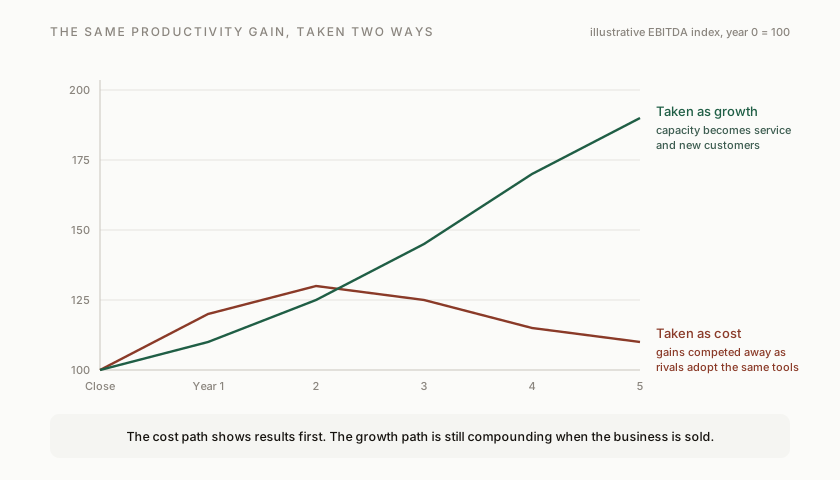
Taken as cost, capacity becomes headcount reduction. It shows up fast, it is easy to put in a model, and in a competitive market it tends to be competed away as rivals adopt the same tools and cut prices, a pattern we examined in beyond cost: AI as a revenue engine.
Taken as growth, capacity becomes faster service, more customers per professional and share taken from slower competitors. It takes longer to show and is harder to model, but it compounds, and it rests on trusted relationships that a competitor cannot copy by buying the same software. This is the path Long Lake describes, and the one behind its claim of doubling free cash flow while keeping its people.
The second lever is integration cost. In a classic roll-up, every add-on has to be absorbed: systems migrated, processes harmonized, people retrained. When the platform already exists, each new company is mostly a matter of fitting it to that company's workflows. Long Lake says its early acquisitions took more than a year to show results and that new ones now see impact within days. If that holds, the cost of each add-on falls as the platform grows, which is the opposite of how most roll-ups age.
Choosing the vertical
Not every fragmented industry suits the model. The ones that do share a handful of traits.
A high share of rule-bound knowledge work. Reading, drafting, reconciling, scheduling, answering and documenting. General Catalyst mapped 70 service categories and found ten where current AI can automate 30 to 70 percent of the work. The share matters; below a certain level, the platform never pays for itself.
Trusted, recurring relationships. Customers who stay for years, renew without much shopping and buy more when service improves. Long Lake screens for very high logo retention and net revenue retention above 100 percent.
Mission-critical work where failure is expensive. Customers in these markets pay for reliability and responsiveness, which are exactly what AI-assisted capacity improves.
Markets where better service wins share. If the market competes mainly on price, productivity gains flow to customers. If it competes on responsiveness and quality, they flow to the best operator.
Fragmented ownership facing succession. Many founder-owned services firms are approaching generational transition. Owners who care about their people and clients respond to a growth story more than a cost story.
The red flags are the mirror image: work an AI-native competitor could deliver directly to the customer without the service business at all, commodity pricing, and customers who would see an AI-assisted service as a downgrade rather than an upgrade.
Underwriting the platform, not the cuts
The underwriting has to change with the model.
Model capacity as ranges, and decide where it goes. Estimate the share of hours the platform can return in each role, then decide deliberately how much becomes growth and how much becomes cost. Underwriting the deal on headcount reduction commits the company to the path that erodes.
Budget the people. Embedded engineers for 18 to 24 months per company is the single largest cost of the model and the part most often underestimated. Without it, adoption stalls and the capacity never appears.
Treat the platform as a shared cost. Its cost should be spread across every add-on, and the cost to deploy into each new company should be tracked as a metric of the strategy itself. If it is not falling, the platform is not working.
Diligence data readiness and trust. Before close, test whether the target's systems and records are clean enough for the platform to act on, and whether its customers will welcome faster, AI-assisted service.
Baseline before close. Capture the operating metrics each lever is meant to move before anything ships. Every later claim of impact, including the one a buyer's quality-of-earnings team will test, depends on it. We go through that discipline in the private equity AI playbook.
What the platform must contain
The platform is the heart of the model, and it has a clear structure.
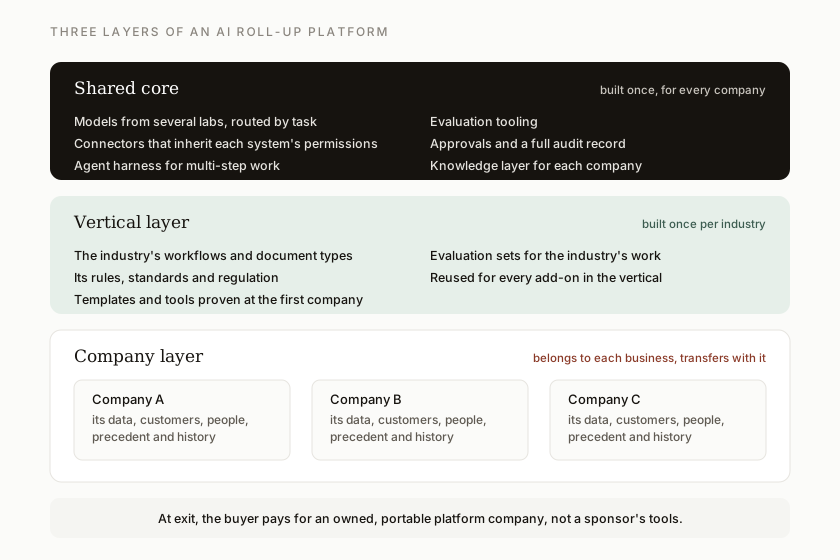
A shared core used by every company. Access to models from several labs with routing between them, connectors to common systems that inherit each system's permissions, an agent harness that carries multi-step work, evaluation tooling, governance with approvals and a full audit record, and a knowledge layer that holds each company's context. This is the part Long Lake estimates at 70 to 80 percent of its infrastructure, and the part that should be built exactly once.
A vertical layer for each industry. The workflows, rules, document types, templates and evaluation sets specific to HOA management, tax preparation, engineering services or whatever the industry is. Built once per vertical and reused for every add-on in it.
A company layer for each business. Its own data, customers, people, precedent and history. This layer is the company's value, and it must stay the company's, which matters most when the company is sold.
Build or partner
A private equity firm can build this platform itself. It is worth being clear about what that means: an AI platform team with skills that are scarce in every industry, often a year or more before the first company sees results, and the ongoing work of keeping a platform current across a model market that reorders itself every few months. Talent is the largest single constraint on scaling AI in private equity portfolios, cited by 35 percent of fund and operating leaders in FTI's 2026 survey.
The alternative is to partner for the platform and the engineers while keeping everything that is distinctive in-house: the investment thesis, the operating partners, the management teams and the company layer. That is a reasonable choice under one condition. The platform company must own what is built on it and be able to run it after the partner leaves. We set out the questions to ask any partner, and the contract terms that protect that ownership, in choosing an AI partner for your portfolio.
The exit problem holding companies don't have
Long Lake has said it has never sold a company and does not plan to. Permanent capital lets it spend two years embedding engineers and decades compounding the result.
A fund does not have that option. Holds average about seven years, and Long Lake describes transforming an operating business as a two-to-five-year process. That leaves little slack. The transformation has to start at acquisition, not in year three, and the capability it creates has to transfer to the next owner. In practice that means four things at exit:
- An owned layer. The objects, rules, precedent, evaluations and integrations belong to the platform company, not to a vendor or to the sponsor.
- Model portability. The platform runs on whichever models are best and cheapest, not on a single provider the buyer may not want.
- Documented results. Impact measured against pre-close baselines, net of the running cost of the platform and the engineers, in a form that survives quality-of-earnings review.
- A team that runs it. People inside the company who can operate and extend the platform without the engineers who built it.
A platform built this way is an asset the buyer pays for. One built as a collection of sponsor-owned tools and departing engineers is a liability the buyer discounts.
Where Fig fits
This is the kind of work Fig is built for. We provide the shared core: company context, connectors that inherit source permissions, agents with approval gates and an audit record, and routing across models from several labs, with post-training on a company's own data when it pays. We provide forward-deployed engineers who embed in each acquired company, build the vertical and company layers with its people, and hand over running software and a trained team, which is how our transformation engagements are designed to end.
What we do not replace is the private equity firm's own edge: the thesis, the sourcing, the operating partners and the management teams. And we do not promise anyone else's numbers. The results Long Lake and its backers report are the bar the model is chasing. A platform company should measure its own from a baseline set before close, and own every part of what it builds.
Key takeaways
- Private equity already runs the buy-and-build machine. What AI roll-ups add is a shared platform and embedded engineers, and those can be built or partnered for.
- The choice that defines the roll-up is where the capacity goes. Taken as cost, gains erode as competitors catch up. Taken as growth, they compound.
- Choose verticals with a high share of rule-bound knowledge work, trusted recurring relationships, mission-critical service and competition on quality rather than price.
- Underwrite the platform and the people, not headcount cuts, and track the cost to deploy into each new add-on as the measure of whether the platform is working.
- Unlike a permanent holding company, a fund must sell. Build an owned, model-portable layer with documented results and a team that runs it, so the capability transfers at exit.
The AI roll-up is not a venture invention. It is buy-and-build with a platform at the center, and private equity is well placed to run it.