The Long Lake playbook
A three-year-old AI holding company just closed a 6.3 billion dollar take-private of Amex GBT. How the model works, what it claims, what is still unproven, and what private equity should take from it.

In shortOn 29 September, Long Lake completed its 6.3 billion dollar take-private of American Express Global Business Travel, the largest test yet of the AI roll-up. Long Lake buys profitable, trusted services businesses, embeds engineers alongside frontline staff for years, runs every company on one shared AI platform, and takes the freed capacity as growth rather than headcount cuts. It reports that its first acquisitions doubled EBITDA in under two years and, according to its lead investor, doubled free cash flow in its HOA businesses without reducing headcount. Those are company-reported figures, and the model carries real risks. But its six moves are clear enough to learn from, and one of them, never selling, is the one private equity cannot copy.
On 29 September, a company founded in 2023 completed the acquisition of a company founded in 1915. Long Lake, which describes itself as the world's first AI holding company, closed its all-cash take-private of American Express Global Business Travel at a value of about 6.3 billion dollars. The deal was funded with equity from Long Lake's existing investors and Koch Equity Development, alongside 2.5 billion dollars of committed debt from JPMorgan, Bank of America, Citi and MUFG. Holders of about 69 percent of the shares, including American Express, Expedia, the Qatar Investment Authority and BlackRock, had agreed to support it.
Amex GBT reported 2.7 billion dollars of revenue and 182 million dollars of operating profit in 2025. It manages travel for about 17,500 businesses in 140 countries. It is not a startup's idea of an acquisition target; it is a buyout fund's.
That is why the deal matters to private equity. The AI roll-up is no longer a venture experiment in small accounting practices and property managers. It is a buyer competing for the same assets, financed by the same banks, with a different operating model. This piece sets out how that model works, what Long Lake says it has achieved, what remains unproven, and what a private equity firm should take from it.
What Long Lake is
Long Lake was founded in 2023 by Alexander Taubman and backed from the start by General Catalyst, alongside investors including Alpha Wave, Elad Gil, D1 and Thrive. In interviews this year, Taubman has described a group of close to 40 companies across five industries: homeowners association management, HR services, specialty tax, infrastructure services such as architecture and engineering, and now corporate travel. With Amex GBT, the group employs roughly 30,000 people, and Taubman expects revenue above 4 billion dollars next year.
Its reported results are striking. Long Lake says its first cohort of acquired businesses doubled EBITDA in under two years. General Catalyst's chief executive wrote in May that Long Lake had doubled free cash flow in its HOA management businesses in two years without reducing headcount. Taubman has said those HOA businesses went from roughly zero to 5 percent annual volume growth before acquisition to more than 20 percent afterward, and that the average employee saves more than eight hours a week using its platform.
These are management and investor claims, not audited figures, and they come from the early, smaller acquisitions. They are worth taking seriously because the operating model behind them is unusually explicit. It comes down to six moves.
Move one: choose industries before companies
Long Lake keeps a ranked list of 15 to 20 industries it considers attractive and screens, by Taubman's account, four to five thousand deals a year against it. The industry comes first, because the platform work only pays if it can be reused across many companies in the same field.
The criteria are consistent: mission-critical services where failure is expensive, very high customer retention, net revenue retention above 100 percent, experienced management, and work that will remain valuable even as AI improves. Taubman draws a sharp line between high-quality services that AI makes better and lower-quality services that AI can simply replace. Amex GBT fits the first category: logo retention in the high nineties and relationships with its largest customers that average about 15 years.
Move two: buy quality, not distress
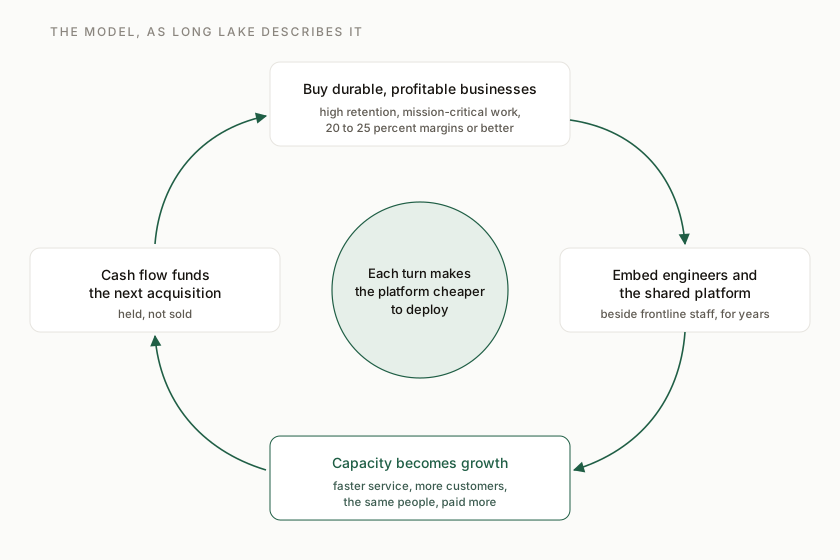
This is the move that most separates the model from a turnaround. Long Lake buys businesses that are already profitable, which Taubman has put at 20 to 25 percent EBITDA margins or better, with management teams worth keeping. The thesis is not that AI rescues failing companies. It is that AI makes good companies considerably better, and that the improvement compounds when the business is already healthy enough to reinvest it.
Move three: one platform, reused
Long Lake runs every company on a single AI platform it calls Nexus. Taubman describes it as model-agnostic middleware that sits between the AI models on one side and a business's data, skills and workflows on the other. By his estimate, 70 to 80 percent of the infrastructure is shared across industries. The remaining 20 to 30 percent is the work of fitting it into a specific company's workflows.
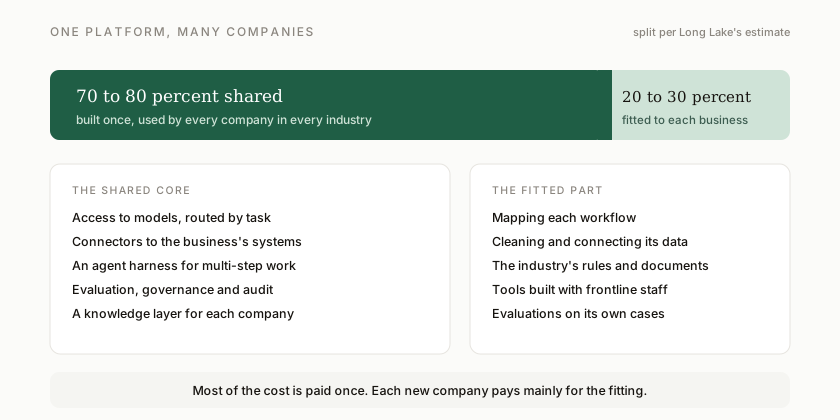
The platform is why the model gets cheaper as it grows. Taubman has said early acquisitions took more than a year to show results. Now, he says, initial impact arrives within days of a new partnership, because most of what each company needs already exists.
Move four: engineers in the field
The most expensive and least imitable part of the model is people. Taubman has said roughly 70 percent of Long Lake's engineering team sits alongside frontline staff in the operating companies, and that engineers may effectively live in an acquired company's office for two years. The loop between a workflow problem and a tool that fixes it is measured in days because the person who builds the tool is sitting next to the person who has the problem.
Adoption is treated as a product problem, not a mandate. In Taubman's words, if Long Lake has to force someone to use the platform, the platform is not good enough. Employees are treated as design partners. In the HOA businesses, responses that used to take 45 minutes to an hour now take five to ten, drafted in each manager's own voice.
Move five: capacity becomes growth
This is the move that makes the numbers. Long Lake does not take AI productivity as headcount reduction. It takes it as capacity, and points that capacity at better service and more customers. Taubman has said the group sees job growth in its oldest companies, pays people more because they are more productive, and retains them well.
The distinction matters more than it looks. Cost savings in competitive markets tend to be competed away as rivals adopt the same tools and cut prices, a dynamic we examined in beyond cost: AI as a revenue engine. Growth built on better service and the same trusted relationships is far harder to copy. Doubling free cash flow without cutting headcount is, if it holds, the signature of the growth path rather than the cost path.
Move six: own it for decades
Long Lake has said it has never sold a company and does not plan to. Taubman describes the transformation of an operating business as a two-to-five-year process, and asks why a company would spend years building the strongest business in an industry only to sell it. The ambition he has described is to keep compounding the value of these businesses for decades.
Permanent capital changes the economics of everything above. It justifies two years of embedded engineers, platform investment amortized over decades, and patience while adoption builds. It is also the one move a traditional private equity fund cannot copy.
The wider category
Long Lake is the most visible example, not the only one. General Catalyst committed 1.5 billion dollars to what it calls AI-enabled roll-ups. It mapped 70 service categories and identified ten where today's AI can automate 30 to 70 percent of the work, with the aim of at least doubling the EBITDA margins of the companies it acquires. Thrive Holdings' accounting platform, now called Current, passed 50 firms this summer, with more than 2,000 employees and over 500 million dollars of revenue. It works with engineers embedded by OpenAI and reported that its tax product prepared 7,000 returns last season while cutting preparation time by about a third.
What is still unproven
A fair reading of the model has to include its open questions.
The results are self-reported. None of the headline figures have been independently audited, and they come from early, smaller acquisitions chosen because they suited the model.
Scale is a different problem. An HOA management firm and a global travel company with 2.7 billion dollars of revenue, decades of legacy systems and operations in 140 countries are not the same transformation. Amex GBT is the first real test of whether the playbook travels.
AI output can create work as well as remove it. Research from Stanford's Social Media Lab and BetterUp Labs found that 40 percent of surveyed employees had received low-quality AI-generated work they had to fix, at a cost of nearly two hours per instance. A model built on productivity has to measure net productivity, not tool usage.
The people are scarce and expensive. Engineers who can sit with a frontline team for two years and ship tools that people choose to use are among the hardest people in the economy to hire.
Leverage still matters. The Amex GBT deal carries 2.5 billion dollars of debt. AI does not change what leverage does to a business when operating results disappoint.
What private equity should take from it
Five of the six moves translate directly to a private equity buy-and-build: choose industries before companies, buy quality, build one platform and reuse it, put engineers in the field, and take capacity as growth. Private equity already runs most of that machine. It knows how to source, finance and integrate add-ons; add-on acquisitions made up roughly three quarters of all U.S. buyouts in the first half of 2026.
The sixth move is the problem. A fund has to sell. That means the AI capability built during the hold must transfer to the next owner: a platform layer the portfolio company owns, runs on any model and can document to a buyer's diligence team, rather than a set of engineers and tools that leave when the sponsor does. We work through what that requires, and how a private equity firm can build the platform without becoming a software company, in building an AI roll-up platform.
Key takeaways
- Long Lake's 6.3 billion dollar take-private of Amex GBT, closed on 29 September, makes the AI roll-up a direct competitor to private equity for mature services assets.
- The model has six moves: choose industries first, buy profitable and trusted businesses, run them on one shared platform, embed engineers in the field, take capacity as growth, and hold for decades.
- The reported results, doubled EBITDA and doubled free cash flow without headcount cuts, are company and investor claims from early acquisitions. They are a benchmark, not a proof.
- The growth path is the durable one. Cost savings get competed away; better service and more customers built on trusted relationships do not.
- Private equity can copy five of the six moves. The sixth, never selling, means a fund must build an AI capability that transfers at exit.
The most important thing Long Lake has shown is not that AI can cut costs in a services business. It is that AI can make a mature, trusted services business grow again.