The Bending Spoons playbook
Bending Spoons runs more than 50 acquired software businesses on one shared platform with a core team of about 600. What the platform contains, why AI changed its economics, and how any roll-up or private equity firm can build its own.

In shortBending Spoons, now a public company valued at more than 20 billion dollars, has acquired more than 50 software businesses and runs them on a shared platform: a data and metrics layer, a lifetime value model, one payments and subscription system, an experimentation toolkit, a recruiting system and AI agents for engineering, reliability and support. Every acquired business is moved onto it within about a year. AI-authored code went from under 10 percent to over 90 percent of its pull requests in twelve months, which removed the company's main constraint on growth: people to run transformations. This playbook explains what the platform does, what happens in the first year after a deal, what AI changed, and how a roll-up or private equity firm can build the same capabilities in a sensible order, with one difference a fund cannot skip: everything has to separate cleanly at exit.
In July, an Italian company most people had never heard of listed on Nasdaq and finished its first day valued at about 25 billion dollars. Bending Spoons owns Evernote, WeTransfer, Vimeo, AOL, Eventbrite, Meetup, komoot, StreamYard, Remini and, since September, Airtable. It has agreed to buy Miro. Its revenue went from 387 million dollars in 2023 to 1.31 billion in 2025, and it has guided to roughly 2.8 billion for 2026 before counting Airtable or Miro, with adjusted operating margins above 50 percent last quarter.
The company says its advantage is not its deal team or its financing. It is a platform: a short list of shared systems that every acquired business is moved onto, run by a core staff that numbered 621 people at the end of March.
The model is spreading. On 13 October, Bumble agreed to be acquired for 1.3 billion dollars by Ithaca Holdings, a new holding company whose stated mission is to use frontier technology to renew and grow established companies. Software buyers, private equity firms and AI holding companies are all asking the same question: what exactly is in the platform, and can we have one?
The answer to the second part is yes. Most of what Bending Spoons built over nine years with a few hundred engineers is now within reach for any serious roll-up, because AI has changed what it costs to build, connect and migrate software. This playbook walks through what the platform contains, what happens in the first year after a deal, what AI changed, and how to build your own in the right order.
How Bending Spoons buys
The acquisition side is disciplined and unglamorous. In 2025 the company looked at more than 2,500 opportunities, studied about 200 in depth and closed six. It underwrites to return hurdles of 65 percent on a levered basis and 25 percent unlevered, and it sizes acquisition debt conservatively: no more than 85 percent of enterprise value, and no more than the acquired business's own projected free cash flow could repay within five years.
Three features of the buying model matter for anyone copying it.
It does not underwrite growth. Projected organic growth affects the price, but decisions rest on expected returns, made, in the company's words, "assuming we'll never sell the acquired business." That lets it buy mature products with flat or declining revenue that growth investors pass on.
It prices with data from every previous deal. With more than 50 acquisitions behind it, the company has benchmarks for what a product like the target should be able to achieve on subscription conversion and revenue retention. A first-time buyer guesses; Bending Spoons compares.
Its constraint has been people, not capital. The company has passed on acquisitions because it did not have enough of its own staff to run another transformation. That constraint is the one AI is now loosening, and it is the most important fact in this playbook.
The platform, system by system
Bending Spoons describes its platform as people, proprietary technology and proprietary data. The technology is built by a central team and offered to every business, and most of its businesses adopt nearly all of it. The systems it has described publicly are a short list.
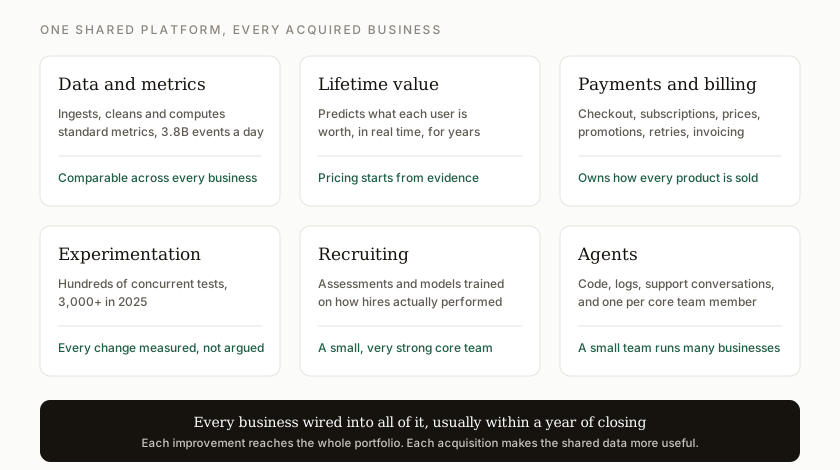
A data and metrics layer. Three systems handle ingestion, transformation and the computation of standardized metrics, processing about 3.8 billion data points a day. AI now harmonizes schemas, tags events and checks data for privacy, and there is a conversational interface for analysis. The point is that "conversion," "retention" and "lifetime value" are computed the same way in every business, so they can be compared.
A lifetime value model. An AI system predicts what each user will be worth, in real time and over several years. It can transfer what it learned in older products to a newly acquired one, so pricing and marketing decisions in a new business start from evidence rather than a blank sheet.
One payments and subscription system. Checkout, subscriptions, price changes, promotional codes, billing retries, invoicing and pricing experiments run through a single system that also integrates App Store and Google Play data. After an acquisition, it takes over subscription management from whatever the business used before. Card processing stays with the usual providers; what Bending Spoons owns is the logic of how products are priced and sold.
An experimentation toolkit. It supports hundreds of concurrent experiments with audience targeting, and the company ran more than 3,000 of them in 2025. Combined with the data layer and the billing system, it means a new business can start testing prices, paywalls and onboarding within weeks of closing, and every result is measured the same way.
A recruiting system. Built since 2017, it uses first-party assessments and models trained on how hires actually performed. It lets each recruiter handle tens of thousands of applicants a year, which matters when the whole model depends on a small, very strong core team.
AI agents for engineering, reliability and support. Agents analyze logs and codebases to find the root cause of incidents. Automated analysis of support conversations decides which reliability problems to fix first. Tools first built to add AI features to one product are now shared across all of them. And every member of the core team now has an agent in the company's chat tool with exactly that person's permissions: if someone can open a codebase, so can their agent.
None of this runs on exotic infrastructure. The businesses run on the major public clouds, card payments run through the standard processors, and AI models come from several providers plus self-hosted ones, in an architecture the company says is designed to make switching easy. The advantage is not any single system. It is that every business is wired into all of them, so each improvement reaches the whole portfolio at once, and every new acquisition makes the shared data more useful.
The first year after a deal
Bending Spoons runs each transformation the same way, and its filings describe the sequence in unusual detail.
Before closing, it assembles a task force of dozens of its own people across engineering, data science, AI research, design, product and growth, most of whom have done this before at other businesses in the portfolio. They study the product, the data and the diligence materials while the deal is still pending.
In the first weeks to months, the team meets most of the acquired staff individually, studies the codebase and infrastructure, interviews customers and reviews pricing and marketing. The output is a transformation plan: a new organization, a technology backlog, a product roadmap and a list of pricing and marketing experiments.
Within the first year, the plan is executed. The shared systems are connected, the most serious technical problems are fixed, the most important product improvements ship and the first round of pricing and marketing changes goes live. The company says it has typically finished each transformation within twelve months.
The published examples show where the economics come from.
At Evernote, the team broke a fragile monolithic system into services and moved the apps from constantly polling the server to receiving updates as they happen. IT infrastructure cost as a share of revenue fell 47 percent between 2022 and 2025. Automated analysis of support conversations guided more than 6,000 reliability fixes, until a dedicated reliability team was no longer needed.
At StreamYard, the team cut unnecessary vendors, deleted petabytes of unused recordings and automated cloud capacity to follow demand, lowering IT infrastructure cost as a share of revenue by 65 percent against the last full year before the deal. It introduced agents that analyze logs and code to find the causes of incidents; the incident rate fell about 75 percent. Release preparation went from weeks to hours.
The model has a visible cost, and it should be named plainly. Transformations have included deep workforce reductions; at Evernote, the team fell from 341 people to 60. Price increases and tighter free plans at several products drew sharp criticism from long-time users. And acquisitions, not existing products, drive the growth: organic revenue growth was 3 percent last quarter. A firm studying this model should be clear about which parts it wants to copy.
The parts most worth copying are the ones that do not depend on cuts: lower infrastructure cost, fewer incidents, faster releases, pricing set by evidence and a product that keeps improving years after the deal. Bending Spoons shipped the most significant Evernote update in years three years after buying it.
What AI changed
The share of Bending Spoons pull requests authored or co-authored by AI went from under 10 percent in the first quarter of 2025 to over 90 percent a year later, with about 70 percent written by AI alone. Revenue per core employee went from 1.12 million dollars in 2023 to 2.57 million in 2025.
The obvious reading is that AI makes engineers cheaper. The more important reading is that it removed the company's bottleneck. The hardest part of every transformation is working inside a large, old, unfamiliar codebase: understanding it, fixing it and connecting it to the shared systems. That work used to require dozens of experienced people for a year, which is why the company sometimes had to pass on deals. When agents can read the code, propose the changes and write most of them, the same team can run more transformations at once. In the first quarter of 2026, three newly acquired businesses with more than 1,800 staff between them were being absorbed alongside the existing portfolio.
The same shift changes the buy-or-build decision for everyone else. The platform took Bending Spoons nine years and a world-class engineering team to build. The individual pieces, a metrics layer, a billing engine, an experimentation service, agents that read code and logs, are now far cheaper to build and, more importantly, far cheaper to connect to each acquired company's systems. Integration was always the expensive part, and it is the part AI has changed most.
Building one for your roll-up
A roll-up or private equity firm does not need all of it on day one. It needs the pieces in an order where each one pays for the next.
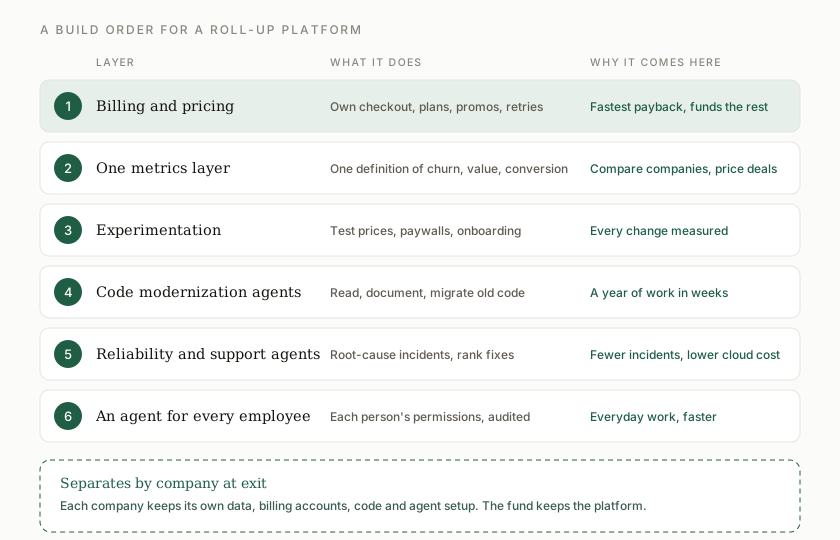
1. Billing and pricing first. Owning checkout, subscriptions, price changes, promotions and failed-payment retries across the portfolio is the fastest lever on revenue and the foundation for everything that follows. Most acquired software businesses run billing through a mix of third-party tools configured years ago, with pricing nobody has tested since. A shared billing and pricing layer, with an agent that maps each company's plans, customers and history onto it, typically pays back within months, and it puts the business in a position to test prices on evidence instead of opinion.
2. One metrics layer. Connect each company's product events, billing and finance data to one set of definitions for conversion, retention, churn and lifetime value. Agents now do most of the mapping work that used to take a data team weeks per acquisition: reading a company's tables and events, proposing how they map to the standard metrics and flagging what does not fit. Without this, the portfolio cannot compare its businesses, and the next deal cannot be priced against the last one.
3. Experimentation. Once billing and metrics are shared, a shared experimentation service lets every business test pricing, paywalls, onboarding and messaging with consistent measurement. AI can now handle much of the analysis, finding significant results and flagging anomalies, so a small team can run many more experiments than before.
4. Codebase modernization agents. This is the capability that changed Bending Spoons' economics, and it is the one most roll-ups underestimate. Agents that can read an unfamiliar codebase, document it, find the riskiest parts and carry out migrations under engineering review turn a year of specialist work into weeks. They also make diligence sharper, because the technical condition of a target can be assessed from its code before the deal closes.
5. Reliability and support agents. Agents that analyze logs and code during incidents, and that read support conversations to rank what to fix, reduce incidents and infrastructure cost without touching the product roadmap. These are often the quickest wins to show a board after the billing layer.
6. An agent for every employee. Finally, give each person in each portfolio company an agent that works with exactly their permissions across the company's tools. This is where everyday work speeds up: drafting, analysis, triage and the hundreds of small tasks that sit between systems. It only works safely once permissions, data access and audit records are set up properly, which is why it comes last rather than first.
Throughout, choose models by task and keep the ability to switch. Bending Spoons' chief executive has said that self-hosted open-weight models handle about 99 percent of its agent requests, with frontier models from the major labs reserved for the hardest tasks and for supervision, and a routing layer deciding which is which. A roll-up should be able to do the same, so that cost, data sensitivity and quality decide which model handles which work, and no single provider becomes a dependency.
The one thing a fund must do differently
Bending Spoons can integrate everything because it never intends to sell. A private equity fund has a three-to-seven-year hold and an exit. That changes the design requirements in one important way: every layer must separate cleanly by company.
In practice that means each portfolio company keeps its own data, its own billing accounts and customer records, its own code and its own agent configuration, all running on shared capabilities rather than a shared, entangled system. At exit, the buyer receives a company that works on its own, with its billing, metrics and agents intact, and the fund keeps the platform for the next deal. Done well, that separation is a selling point: the buyer inherits a modern product, clean data and a working AI capability, rather than a business that has to be untangled from its former owner.
This is the main design difference between a permanent holding company's platform and a fund's, and it should be decided at the start. Retrofitting separation after three years of integration is far harder than designing for it.
Where Fig fits
Fig builds this kind of platform with the firms that own the companies. Our forward-deployed engineers work inside each acquired business to connect its systems, set up the shared layers and deploy agents for the work that matters most, starting with billing, metrics and code. We build on the models that are best for each task, so a portfolio is never tied to a single provider, and we design every deployment to separate by company from day one, so the capability transfers with the business at exit.
For the broader model of buy-and-build with AI, see our playbooks on building an AI roll-up platform and the Long Lake playbook.
Key takeaways
- The platform is a short list. Data and metrics, lifetime value, billing and pricing, experimentation, recruiting, and agents for engineering, reliability and support. The advantage is that every business is wired into all of it.
- The economics come from more than cuts. Infrastructure cost, incident rates, release speed and pricing set by evidence improved sharply at the businesses Bending Spoons has described, and those gains do not require deep cuts to copy.
- AI removed the bottleneck. Agents that can work inside large, unfamiliar codebases let a small team run many more transformations at once. That is what turns a platform into a scalable acquisition engine.
- Build in order. Billing and pricing first, then metrics, experimentation, code modernization, reliability and support, and an agent for every employee.
- Design for exit. A fund's platform must separate cleanly by company. Decide that on day one.
If you are building a roll-up and want to see what this platform would look like for your portfolio, talk to us.